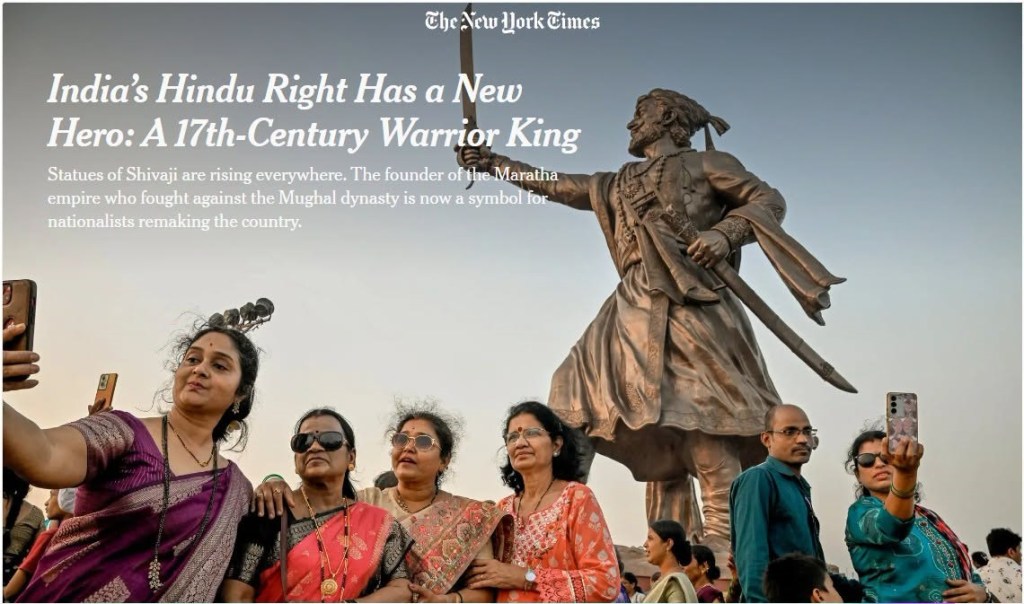
I had been asked to comment upon this New York Times piece (which, oddly enough, had also turned up in my local newspaper here in New Zealand). Predictably, I had a somewhat … critical line.
I don’t get how Shivaji is supposed to be a “new” hero ?
For a start, there’s the blatantly obvious point that the perception of Shivaji as ‘hero’ has been basically (and actively) ‘A Thing’ for somewhere more than three and a half centuries by this point.
Replete with something, I would say, rather closer to the more archaic essence to ‘Hero’ than one tends to mean (or even be aware of) today. (We shall see if I manage to muster the energy to explicate what I mean via that, in due course)
In any case, however the writers of this NYT piece mean ‘(new) hero’ (and one infers the “showed up out of nowhere” framing of the first line is quite deliberately intended to connote more broadly than ‘just’ the statue) … I would have thought it rather uncontroversial to acknowledge that the ascription to Shivaji of the status of a hero was something already (quite understandably) taking place while he was alive.
This is something that’s – funnily enough – quite directly / literally present within the panengyric poetry composed at his court – ‘hero’ being the direct meaning for Braj “bīra” (i.e. what in Sanskrit would have been ‘Vīr’), as occurs in various verses of Kavi Bhūṣaṇ, for instance.
And, for that matter, from the same poet: “tegahi ke meṭe jauna rākasa marada jānyau sarajā sibājī rāma hī ko avataru hai |” [VB, v. 148] – “He knows how to seize and crush Rakshasas. Shivaji is the avatar of Rama himself” [translation as given by Borek; who underscores the application of ‘Rakshasas’, there, viz. more … contemporary human antagonists of the time]; the Śivrājbhūṣan having been prepared in advance of Shivaji’s coronation. As Bignami, Mucciarelli, & Dębicka-Borek put it – “we find the language, and more precisely the literature (authored by Bhūṣaṇ), used as a medium of a political pattern in which a new hero has to be created” [from their introduction to ‘Cosmopolitanism and Regionalism in Indian Cultural Dynamics’].
We might also draw upon the ‘Śri Śivabhārata’ of Kavīndra Paramānanda, likewise prepared at Shivaji’s court – and, indeed, by his behest. Therein, one finds an evocative assertion of Shivaji’s (heroic) historical mission – as every bit the pious lord, of divine essence, incarnated for the specific purpose of overcoming they who are against the Gods, protecting the Gods, Brahmanas, Cows, and all the rest of it [I 15, 24-38].
Rather a contrast from Prof. Truschke’s claim that “Shivaji would be highly confused by modern allegations that he was fighting for Hindus” – and I find the phrasing of this, viz. allegations of Shivaji fighting for Hindus to be quite telling of her own biases upon this regard!
(And also rather curious that she’d cite “texts from Shivaji’s time” to “show that he sought upper-caste status” … and yet somehow not have noticed said corpus of texts wherein one finds proclamation for his family’s archaic descent from the Kshatriya milieu (Bendrey’s excellent ‘Coronation of Shivaji The Great’ indicating such traditions of pedigree are found referenced within the efforts of the earlier-drawn-upon Kavi Bhūṣaṇ; Manasataramgini also notes attestations within the Śri Śivabhārata & Parṇāla-Parvata-Grahaṇākhyāna) – also tend to be quite congruent with these so-called “allegations” of Shivaji as “a defender of Hinduism”.)
I also find Truschke’s bit about “undermining the notion that [Shivaji] embraced a unified Hindu identity” to be … a strange view. We shall leave aside the first part of that sentence of hers, viz. “Texts from Shivaji’s time show that he sought upper-caste status rather than accepting the lower caste of his birth”, for the moment … because I literally went off and went through all the texts from his lifetime that mention his caste &c., and therefore have an entire subsequent writeup in relation to what’s wrong there.
So back to the “unified Hindu identity” part, specifically the inference she makes around what’s associated with Shivaji’s coronation (i.e. confirmation of Kshatriya status) “undermining the notion that he embraced a unified Hindu identity” …. this is rather “tendentious” might be the polite way of putting it. She basically seems to have this conception that it’s only by being a “lower caste” person that one affirms a “unified Hindu identity”. Absolutely not the case. The very point of a King is that the King is there to be ruling everybody and exercising authority over / on behalf of same. This gets rather significantly delved into in Bendrey’s “Coronation of Shivaji The Great”, if you want an academic work that’s looking at some specifics (involving the interrelationship with Brahmin – as we’d call them, ‘V1s’) for the ‘practical necessity’, so to speak; but I would have simply pointed to the description (from the same work), viz. the coronation itself, to show just how incorrect Truschke’s assertion is in ‘symbolic’ terms: “When he was seated on the specially prepared seat for third bath, amidst the chanting of Vedic Mantras, the Brahmins, Ministers and officers poured ghee from the eastside golden pot, Senapatis and Kshatriyas from the south poured milk from the silver pot, merchants and Vaishas poured curds from the west from the copper pot and other servants and Shudras poured water from the earthen pot on the north, all at the same time chanting the “slogan” […] Thus by this special bath they accepted Shivaji Maharaja as the King of ail including Brahmins.”
Seems a pretty diametrically opposed approach to his coronation “undermining the notion that he embraced a unified Hindu identity”, no?
Also, as applies the “sought upper-caste status” bit – again, this is a misapprehension / pretty “tendentious” take which is being advanced. I’ll expand upon this in a subsequent writeup, but the long and the short of it is that it would appear that Shivaji’s clan had, basically, ‘lapsed’ in terms of various of the proper ritualine undertakings for true Kshatriya (we would say ‘V2’). Basically, the relevant “upper caste” status that Truschke refers to … isn’t a matter of lineage, being born into a family which has a bloodline traceable back to acclaimed ancestors of such status. You can very well have that, and not be accorded the status of a Kshatriya (or, for that matter, same deal with Brahmins &c.). This is made quite clear in, for example, the Manusmriti sections (X III 43) detailing how so-called ‘Vratya-Kshatriya’ groups wound up with ‘Vṛṣala’, i.e. ‘Peasant’ status, in exactly this manner (i.e. “by the omission of the sacred rites, and also by their neglect of Brāhmaṇas”, as the Gaganatha Jha translation phrases it).
And if we take a look at the one source from during Shivaji’s lifetime which makes mention of his supposedly lacking the status of a “Kettery” (i.e. “Kshatriya”) – that being the letter of Le Feber, who, as Gajanan Bhaskar Mehendale observes, appears not to actually have been at the coronation – what we then hear of is the sort of purificationary rites being undertaken by Shivaji of precisely the sort which one would anticipate to rectify the preceding (intergenerational) lapse of conduct by his clan … and thus restore to proper Kshatriya status the man who would thence be crowned King. (See also the comments in Har Bilas Sarda’s ‘Śivāji – A Sisodiā Rajput’)
This is all, you understand, entirely Hindu orthodox metaphysical operation – even if, to be sure, it was a rather remarkable and decidedly rare event to actually be happening by the mid-2nd millennium AD. And I highlight the ‘acting as intended’ nature of all of this, because it flies rather directly opposed to the characterization of him, and the ‘concern’ of this area, advanced by Truschke in a now-deleted tweet of hers as, and I quote “wanna-be upper-caste kings, like Shivaji”. There is no “wanna-be” about it. There is “actually-being”, and quite a different characterization for his ‘bloodline’ (or however one wishes to refer to it) than she seeks to suggest, in the “Texts from Shivaji’s time”, as we shall delve into later (as in, in subsequent writing to this piece – perhaps).
Returning to the laudatory assessments of his contemporaries – Abbé Carré’s travelogue of his 1672-4 journeying within India includes a somewhat lengthy section endeavouring to convey Shivaji for a European audience. Were we especially eager to establish Shivaji’s credentials as someone who, in life, could very directly ‘live up’ to the connotations of ‘Hero’ as the popular consciousness deploys the label in our time … then Carré’s descriptions as to his character would certainly make for quite a good starting-point.
Although it is Carré’s choice to favourably invoke both Gustavus Adolphus and Julius Caesar as significant points of resonancy for Shivaji within the European history of warfare and politics that I find particularly, for our present purpose, insightful (Henry Gary, writing a few years later in 1677-8, has Alexander the Great as a point of comparison – indeed, the remarkable way in which Alexander had succeeded in taking the Sogdian Rock, more specifically). Why so? Other than the pleasure I have at seeing a comparison I, myself, had arrived at in my younger years, viz. Gustavus Adolphus (albeit I had also other bases for it in mind) – it is because if we consider these figures and their foundational role for their nations (or empires) … we arrive quite naturally at the understanding that their saliency is something which is not ‘new’ when it is returned back to – it is, instead, something which becomes rather ‘immortal’ within the recognizance of those who are their inheritors.
(For interest, translation of Carré’s comparison comments, as presented in Surendra Nath Sen’s ‘Foreign Biographies of Shivaji’ : “[…] one of the greatest men the East has ever seen. In his courage, the rapidity of his conquests and his great qualities he does not ill resemble that great king of Sweden, Gustavus Adolphus. […] To this quickness of movement he added, like Julius [Caesar], a clemency and bounty that won him the hearts of those his arms had worsted.”)
Likewise (given the attentions of both India’s Navy and Army toward Shivaji being remarked upon within the New York Times piece), just as one would surely feel there is merit as a modern military man in studying the campaigns of Caesar and drawing upon the ethos, understandings, and legacy of Gustavus Adolphus [and, indeed, it is not hard to find modern militaries and adroit commanders who have been doing exactly these] … so, too, should it seem entirely natural for the modern Indian military to persist in its engagement viz. Shivaji. Absolutely correct, as well, for the Indian Navy to have strong regard for the man whose doctrine was “Jalaim Jasya, Valaim Tasya”, i.e. command of the waters enabled prodigious strength, and who is one of the few who can say they beat the British Royal Navy (at Khanderi, in 1679).
As applies Shivaji’s enduring salience among the people post-mortem – the prominence of Shivaji amidst the ‘Powada’ ballads of Maratha culture spring instantly to mind (even the New York Times piece acknowledges these – “His martial spirit and Hindu pride […] have also been celebrated in past centuries by balladeers”); with both the fact of their persisting within said culture on down to the modern era, as well as their manner of resonance in Shivaji’s own time, being of relevance to our subject (or, rather, this New York Times piece’s apparent ignorance thereof).
To quote from Dr Amarendra Kumar’s “Perception of History in Popular Practices: A very short note on the Powadas of Shivaji Period”:
“In the era of internecine battles, hence, when the mighty opponents deployed all means to demolish the very foundations of the nascent Swarajya, the Shahirs, or the authors of Powadas, assumed as their duty to inspire their audience- the masses, to fight back with all their strength. The life of Shivaji, therefore, constituted the subject matter of the Powadas composed during the late seventeenth century. These compositions, usually accentuating the unimaginable heroic deeds in terms of daring military adventures of Shivaji and his loyal associates, were publically sung so as to stimulate the spirit of brotherhood and patriotism. The Shahirs belonged to the same generation which lived in that age to witness such heroic acts. It became a bounden duty for them to draw up faithful account of the true events which were actually watersheds of contemporary history.”
And, further from the same source:
“During the initial years of his military campaigns, one of his most outstanding achievements was the defeat and the destruction of a contingent of the invading Bijapuri force at Pratapgarh in 1659. The leader of the Bijapuri force, Afzal Khan, was killed in a dare-devil attack by the Chhatrapati. This episode had charged up the political atmosphere in the Maratha land, as this was no mean an achievement of their leader. To celebrate and immortalize the daring exploit of the Maratha King, Shahir Adnyandas was commissioned to compose a Powada on the orders of the queen mother Jijabai. The result – the first ever Powada pertaining to Shivaji period, titled ‘Afzal Khan cha Wadh’, i.e., ‘The Powada of the Killing of Afzal Khan’ was composed. The Shahir, being a contemporary of Shivaji, wrote by his personal knowledge and first-hand information of the event. From the religious angle, the defeat and death of the ‘Muslim tyrant’ was universally hailed as the death of a demon which could only be accomplished because of the blessings of the Hindu Goddess Tulja Bhavani.”
Or, phrased another way – a ‘popular legend’ of the hero-king Shivaji, was not only ‘right there from the start’ … but actively, so to speak, ‘politicized’ : as in, deployed popularly, organically, and as a mobilizing ethos. Something which we shall be returning to pick up upon once we’ve jumped ahead to the late 1800s.
One would also, of course, at the ‘courtly’ level make reference to the ongoing production of ‘Bakhar’ (‘biographical’) literature about Shivaji – commencing from the late 1600s, and continuing on with subsequent efforts down the decades.
What do we find therein ? Well, to quote from Govind Sakharam Sardesai’s ‘New History of the Marathas’ (Vol. 1 – Shivaji & His Line), concerning Shivaji’s characterization amidst “early bakhars” &c. :
“[…] all these particularly treat the subject of the rise of Shivaji, but explain it in a different manner. They describe the Earth as personified, unable to bear the atrocities of the MIechhas towards Gods, Brahmans and cows, and seeking relief from the god Brahmā, Who in His turn appeals to Shankar [Shiva], Vishnu or the Goddess Bhavāni, and ultimately these Gods heeded the solemn prayer of the Earth and agreed to undertake a fresh incarnation for redressing the prevailing wrongs, and thus is Shivaji described to have been born. This is the orthodox explanation of the rise of Shivaji recorded before the days of the present epoch of historical research.”
I shall spare the reader’s patience from delving into the fairly overt ‘mythic resonance’ of the above viz., for instance, the circumstances that resulted in the ‘First Sword’ being brought forth and thence passed down as the essential element of (human) kingship, as one finds detailed within the Mahabharata, or other such episodes from the voluminous Hindu legendarium. But suffice to say, it’s there and it’s an intentional resonation. And which, even with the early Bakhar efforts chronicling Shivaji’s story dating from only the time of his son’s rule onwards, finds ready correspondence in the aforementioned suites of courtly encomia that had been composed under and approved by Shivaji himself.
Meanwhile, one rather … unfortunate demonstration for the fact of Shivaji’s ‘Śravas’ being ‘Akṣitam’ (rather than recently cobbled together) would be the curious situation surrounding the Sword of Shivaji having reportedly been ‘gifted’ to the British Crown Prince, Edward (VII) during his tour of India in 1875-6 – it would not have been something ‘fit for a king’ in imperial tribute, had its original wielder not been even then still of such stature (some two centuries after his death). Moreover, it should probably be noted for an outside audience that, given the … mythic dimension of the Bhavāni Tulwar, it’d be rather like giving away Excalibur – albeit with the German(ic) foreign ruler in this story, at least, unlike that of King Arthur, not being the colonizing force against whom the blade was empowered. (And I say “curious situation”, because there is a strong likelihood that the real Sword was never allowed to be alienated in such a manner – but rather, had surreptitiously remained housed at the seat of the Maratha Court at Satara, with a fine annotated depiction of it being produced by one Bajaba Balaji Nene upon the 20th of April 1877.)
Of course, this would not be the only ‘encounter’ of Shivaji and his legacy with the post-Mughal loomings of Empire.
For reasons no doubt obvious, the king whose cause had been labelled “Hindavi Svarajya” found quite the ‘modern political’ saliency within the context of the Swaraj [‘Self-Rule’] activism of the late 1800s / early 1900s – with Bal Gangadhar Tilak (better known today for ‘The Arctic Home of the Vedas’, perhaps) rather famously incepting (from 1896) an annual festival expressly oriented toward Shivaji as national hero (indeed, “hero”, was quite literally the word Tilak used).
In essence, Tilak was replicating his very successful earlier effort that produced the modern (and today very popular) Hindu observance of Ganesh Chaturthi – i.e. the ‘potentiating’ of an already-extant local/regional veneration as vector for popular mobilization and sodality-building, accomplished through the cultivation of a communal & celebratory facet of observance (i.e. a public festival – which, yes, Tilak expressly referenced those of Ancient Greece about), literally ‘put on by the community’ (a great way to build community, as well as get everybody having some practice for putting on other kinds of ‘large numbers of people engaged in performative spectacle’ style actions, if you get my drift), that thereby also provides a ‘subtext’ for people to come together into, as well (Think ‘Ganesh the Liberator’ … ); and which basically proliferates itself organically from locality to locality and then region to region as it ‘catches on’, and brings its ‘substrate’ of shared values and unifying experience along with it as it goes.
As applies the Ganapati undertaking of Tilak – his ‘seed’ for this had been basically a local, household observance … albeit one which, prior to the British takeover from the Peshwa governate about a century beforehand, had also featured a public festival put on by said Peshwas, who regarded Ganesha as their patron deity (‘Kuladevata’ – ‘Clan-Deity’) – which certainly makes for an interesting shade of a (para-)’resurrective’ resonance. And correspondingly significant Sovereignty-struggle salient ‘subtext’ : In the absence of the institution upon which the public observance had once been contingent, ‘the people’ could nevertheless manifest a successor.
Similarly – in the absence of the heroic warrior-king who had embodied the Sovereignty sought for in a previous era, Tilak sought to inspire Hindus of all backgrounds (indeed – more than just Hindus; Shivaji’s regime being very much one where Muslims and others could make their contribution and rise to a high post to serve the cause, was very much also upon Tilak’s mind) to step forward into his shoes and thus play their part in (re-)delivering the ‘Hindavi Svarajya’ [‘Indian Self-Rule’] successor of the modern age.
Earlier, I had made mention for Shivaji as being “Replete with something, I would say, rather closer to the more archaic essence to ‘Hero’ than one tends to mean (or even be aware of) today.”
There are two frequently advanced most-archaic underpinning etymologies to ‘Hero’, tracing back via its Ancient Greek and into the mists of Proto-Indo-European.
One would link it to PIE *Ser-, i.e. ‘to protect’ – and thus, the ‘Hero’ as a figure who guards and watches over (even, since we are dealing within the realms of the archaic Greek ‘Hero-Cults’, post-mortem for the man who would bear such an august title). That would certainly feel somewhat apt for Shivaji – and, indeed, his Jayanti today is very much a religious occasion (contra the impression one might get from this New York Times article, it is not something so restricted to either Maharashtra, nor the political sphere: Shivaji Jayanti has been featured upon the religious calendars put out by my local Mandir here in New Zealand, for instance, as far back as I am aware of same).
Yet I have had another prospect within my mind to the term. One which links the quality of ‘Hero’ to a certain Great Goddess – Hera, as the Ancient Greeks would have called Her.
There are two dimensions as to the significance for this here. The first being that what makes a man a Hero worthy of myth in our view … significantly tends to entail the active blessing, indeed ‘choosing’ of him for the task, by Her. You can see it in the relationship of Rama to the Goddess most readily (and we are fond of the Devi Purana Mahabhagavata Ramayana recounting especially), Whom Shivaji was extolled as an ‘Avatar’ of in his court poetry by the Kavi Bhūṣaṇ, for instance; or there is the Atharvanic empowerment rite (AV-S VI 38) that calls upon the Goddess Who is Mother of Indra to bestow alike qualities to such a man to make him ‘heroic’. And you can also observe within the Vedic Coronation Rites (Sbr V 5 2 8 etc.), the becoming-King worthy being adopted by Her as Son (“Śūraputrām” – “Hero-Son”, indeed!). Carl Jung’s remark that “He who stems from two mothers is the hero: the first birth makes him a mortal man, the second an immortal half-God” (Collected Works 5, translation as in Segal – ‘On Mythology’) was, oddly enough, basically correct.
In the case of Shivaji, the conceptualizing of him as being very much under the aegis of the Goddess, was something already salient during his rise (for example, from the Śivabhārata – Gode references the sections (XIV-XXIII) declaring the Goddess entering into Shivaji’s sword to enable the smiting of Afzal Khan by Shivaji, as an essential act for the upholding of Dharma’s immanence within our world – one thinks of the nature of the First Sword wielded by Shiva, recounted in the MBh); the close linkage reminding one also of the supposition for the other PIE *Ser- , i.e. ‘to attach’ , => *sērah₂- => ‘Hera’, that has found some currency (García-Ramón cites such as advanced by Peters, Willi) … although we would suggest the figurative sense ought be akin to the close support illustrated via Athena’s engagement with Diomedes in Books IV-V of the Iliad – the hero as one with Goddess ‘attached’ thereto, and thus able to be so remarkably ‘heroic’.
The second Hera-relevant ‘Hero’ prospective foundation would be from PIE *Hieh₁-r (‘year’, which is also therefrom), via that similar speciation which has given ‘ὥρα’ (‘hora’ – viz. the appropriate time for something), and indeed, our own modern English ‘hour’ : and therefore, so to speak, the Hero as the ‘Man of the Hour’ – or, to put it around the other way … ‘Cometh the Hour – Cometh the Man’. The ‘hour’ in question being the situational context which finds itself the requisite stage to the parodos for our Hero.
The circumstances of the 1600s and the reign of Aurangzeb must surely require no fulsome explication as to their concordance to such a characterization – and so, too, the later era of Shivaji’s salience for the Swaraj Struggle, when the Mughals had been replaced by the British.
As India, sovereign and rising, continues to step forth toward anticipated ‘Great Power’ status here amidst the 21st century – who better to call upon than the man who, himself, had presided over his realm’s transcension from discongealed subjugative vassalization through to emergent Power (and Historical Subject) embarking upon its Stormaktstiden !
Not a ‘New Hero’ at all – but rather, one who might quite fairly invoke the immortal words of LL Cool J (from a track, rather aptly, named for the martial order from a Mother):
“Don’t Call It A Comeback – I Been Here For Years”


Audrey Truschke is a horrible person. I wish she could be sacrificed to the Great Devi Kali – after all, the Devi demands the flesh and blood of demons as sacrificial offerings, and Truschke fits the description of “demon” (in modern formatting, of course) quite well.
LikeLike
On the one hand – having delved through various things she’s come out with in the process of putting together the above piece … being rather robustly ‘unimpressed’ with such is most certainly not an inappropriate reaction.
On the other hand – one would not like to lend her ammunition by playing in to the characterization she seeks to wield as an attempted delegitimation of criticism.
[-C.A.R.]
LikeLike
Thanks for the reply, and yes, good point, I agree. As an aside, if you ever come to Maharashtra – esp. Pune – do try and make a trip to the temple of Raireshvara. This temple is a very special one in Maratha history, as it is upon the Shivalingam in the same, where Chh. Shivaji Maharaj (along with a few trusted friends of his) performed an abhisheka with his own blood, and took a sacred vrata of waging a grim long war, for establishing Hindavi Swarajya, and all this at the tender age of just 14! Forgive me if this sounds like fanboying, but I really find it amazing, and the mere thought of it gives me goosebumps.
Jai Bhavani, Jai Shivaji!
LikeLike
Do not say such things. Attack her arguments and only her arguments. Do not call for violence against her person, even jokingly. However bigoted her scholarship may be, she is a human being with a family, and so she does not deserve any of this.
LikeLike
My only reason for agreeing that calling for violence against her is that, as Mr. Rolinson pointed out, such calls only give her more ammunition to use against us in her war against Hindus – in other words, he simply said that, to use the language of Cost-Benefit Analysis, calling for violence against her is, a net negative.
However, I see nothing problematic apart from that. If you want to stick to this humanitarian BS and indulge in this morals-and-ethics game even against sworn enemies of Dharma, that’s your problem, not mine – and unfortunately one that is seen far too often even among Hindus who are aware of what we’re up against, which would probably be part of the reason why Hindudom is in the unenviable state it is in today.
It is this exact same attitude that led to repeated and costly failures by the Rajputs, even though they were courageous to a degree very few of their contemporaries were (Shakha-Jauhar rites and all), and were almost always better warriors with superior martial skills, physically stronger and with a better physique in general, and often wealthier, than their Islamic enemies. Contrast this with the Marathas, who were warriors alright, but clearly inferior to the Rajputs in the above, but achieved what the Rajputs never could, i.e. reestablishment of Hindu rule throughout most of South Asia – this was only because the Marathas fought with their brains, unlike the Rajputs. It is not for nothing that even East India Company military historians characterised Rajputs as “honourable foes” and the Marathas as “formidable ones”.
Learn to read your opponent and fight accordingly. The days of the Mahabharata – where the concept of “honourable warfare” was, at least in principle, the default norm – are over (and I might add, both sides broke those rules umpteen times in the 18-day war, so there goes even the Mahabharata justification). Learn to hate your enemies. Learn to support the concept of total war against them. Learn to take pleasure in the sufferings of those who hate Dharma and work against it. At the very least, if you don’t want to fight, fine – but stop this stupid moralizing against your own fellow brothers in Dharma, simply because the latter believe in “an eye for an eye, a tooth for a tooth, and a bullet for a bullet”.
Jai Bhavani, Jai Shivaji!
LikeLike
The Chatraprakash (1710) by the Bundeli monarchy accuses Aurangzeb of seeking to destroy the Hindu dharma (the words it used outright) and praised Shivaji as the only guy with the guts to oppose this. Notably, the paper I learned this from thanks Audrey ji for reviewing it – so she must have forgotten lol
LikeLike