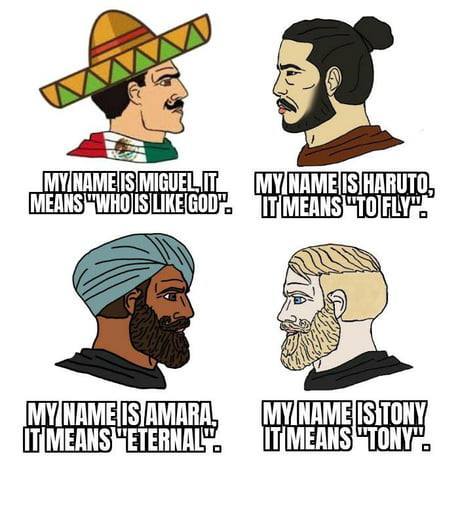
It probably almost goes without saying that the names one typically finds being bestowed within the Anglosphere also tend to have meanings … albeit with their actual salience often tending toward the ‘peripheral’ at best.
I’d suspect there to be three major drivers to this (no doubt ‘inter alia’).
First – quite a swathe of the names we [of the Anglosphere] conventionally tend to give our kids … are actually sourced from what are effectively ‘foreign’ contexts relative to our actual language of use (i.e. (Modern) English).
Many are Biblical (i.e. Hebrew / Aramaic … and potentially also featuring some degree of Hellicization / Romanization). One also fairly regularly encounters names sourced from Greek (also potentially Romanized), or from (old) Germanic languages (and yes, even as the direct ancestor for our modern English, Old English / Anglo-Saxon functionally counts as ‘foreign’ – not least given ‘The Past Is A Foreign Country’, as the aphorism notes), amidst an array of others.
In their original (culturo-)linguistic habitats, many of these names would have been significantly more overtly “meaningful” (as in, straight-up, full-of-meaning) than they are now amidst ours.
Not simply because that’s their culture-of-origin, with an immediate awareness of what a name might mean as a result (something which, as applies various of them Biblical names, you can still today get amidst more engaged Christians – who can tell you that “Michael”, for example, is an Archangel and of the relevant characterization, and may also relate that it literally means something like “Who is like God”, with the ‘-El’ bit, meaning ‘God’ also shared with certain other Biblical-origin names like ‘Samuel’, etc.).
But (also) due to the fact that various of these names were, reasonably straightforwardly, constructed out of words (or from stems thereof) from the languages in question (as we still see with Sanskritic Hindu names today) – and thus would actually be fairly immediately parseable in terms of their meaning for those whose languages they were, almost just as readily as we’d read modern English names like ‘Hunter’, or ‘Dawn’, or ‘Liberty’, or ‘Pearl’, etc. etc. and fairly instantly know their essential underpinning meanings. (That is – the direct and reasonably literal meanings. There may also be more ‘involved’ purports – such as the one to the naming of Elon Musk’s daughter by Grimes, “Exa Dark Sideræl Musk”; which in addition to the ascribed meaning of (and I’m literally quoting from the interview here) “Exa is a reference to the supercomputing term exaFLOPS (the ability to perform 1 quintillion floating-point operations per second). [Dark is] the unknown. People fear it but truly it’s the absence of photons. Dark matter is the beautiful mystery of our universe. […] [Sideræl is] “a more elven” spelling of sidereal, “the true time of the universe, star time, deep space time, not our relative earth time […]” … as an English speaker, basically suggests a subtextual reading of “These Parents Really Want You To Know They’re Into Sci-Fi”, to put it er … politely)
Thus something like ‘Alexander’ – which, in its original Ancient Greek iteration of ‘Alexandros’ (Ἀλέξανδρος), would immediately be registered via ‘alex-‘ (ἀλέξ-) plus ‘andr-‘ (ἀνδρ-) and ‘-os’ (-ος) … i.e. ‘protect-‘ ‘men’ ‘one-who’ – that is, ‘Protector of Men’.
Except for us in modern English, we don’t (most of us) speak (Ancient) Greek – and so therefore, instead of hearing a name made up of words which mean something to us independently, we just hear ‘Alexander’, and probably think of the Alexander (i.e. The Great) if somebody asks us for its meaning.
Which is the second reason for why there’s often some difficulty when it comes to Anglosphere-encountered names and their proper ascription as to their underpinning meanings – because not infrequently, it seems the immediate mental association of others who’ve borne the name, whether famous or personal acquaintance, has rather displaced it. “Winston”, for instance, when encountered as a first name bestowed at any point over the past eighty or so years, tends to have “Churchill” as the ‘meaning’ that springs to mind – with no contemplation for the Old English, potentially ‘Wynn’ and ‘Tun’, i.e. ‘Pleasant’ and ‘Town’ (not least because – again – we do not speak Old English; even if ‘-ton’ as ‘-town’ is something we’re reasonably familiar with still today).
The third reason, meanwhile, I suspect to be a certain level of semi-pervasive unenthusiasm around parts of the Anglosphere for names which are, so to speak, ‘just words’ (and therefore instantly registerable to possess meanings) in their immediate composition. Essentially because they don’t necessarily come across as ‘Name-y’ enough. And so therefore there’s perhaps been a bit of a haziness as to the directness of concept involved otherwise.
There are obvious counter-instances to this, of course – increasingly, we see names such as ‘River’, ‘Storm’, inter alia; and one readily might meet a ‘Faith’, or a ‘Felicity’ (not that the regular noun’s such a common one in English these days), etc. and not bat an eye (at least partially due to familiarity).
Yet were one to encounter a ‘Junior’ (as in, not ‘Jr.’, in the sense of the distinguishment suffixed on upon a name shared between father and son … just ‘Junior’ as the name), or a ‘Denim’ (both of which I have done), this might be somewhat less anticipated (I’d go so far as to suggest “Rebel”, as borne by Australian actress Rebel Wilson, to feel rather ‘incongruous’).
And more especially when it comes to some of those very definitely Actively Intended To Be Meaningful names out there such as “Believing”, “Committed”, “Vigilant”, “Devoted”, &c. (all of which are actual names borne by actual children born in the 21st century to a particular community here in NZ) … or, for that matter, “Hate-Evil” (a Puritan ‘hortatory’ name occasionally registered), “Praise-God” (prominently affixed to Praise-God Barebone, a British MP of Cromwell’s time, for whom the ‘Barebone’s Parliament’ convening was known), “Fear-God” (the aforementioned Barebone’s elder brother), or, indeed, “If-Christ-had-not-died-for-thee-thou-hadst-been-damned” (another of the Barebone clan – his rather unwieldy hailing abbreviated, apparently, to its last word; and thus, in his professional life being, per at least one source, spoken of as “Dr. Damned Barebone”) … as one can see, despite coming from the same stylistic (and, for that matter, cultural) milieu that produced “Faith”, “Felicity”, “Hope”, etc. (so-called ‘Virtue Names’, for reasons which ought prove rather readily apparent) – we don’t seem nearly so enthusiastic toward the broader range of prospects for English names wrought from our immediately-intelligible vernacular.
Possibly because some of these might sound more ‘inanimate’ than ‘animate’ (to draw upon the archaic ‘genders’ of Proto-Indo-European); potentially (also) because these might sound more like ‘job-requirements’ or ‘job-requirements’ rather than individuals who might hold them.
Certainly, this latter prospect for titular resemblance should seem to inform the New Zealand Department of Internal Affairs’ decision-making in recurrently rejecting multiple applications annually to name children here “King”, “Prince” or “Princess” (all generally about 6-8 per year, with occasional variety of spelling; “Queen”, whilst also auto-blocked, is slightly less frequent; interestingly, the Maori ‘Kingi’ is also now restricted), “Judge” or “Justice” (not to mention “Jahstice”, “Jusdyce”, “Justus”, “Juztice”, nor “Jhudg” – none of which are immediately confusable with the judicial title, at least when written), “Sovereign”, “Messiah” (or, for that matter, “Sovereign-Messiah”), “Emperor”/”Empress”, “Caesar” (blocked at least twice), “Chief”, “Duke”, “Majesty”, “Bishop” (and, for that matter, “Rabbi” at least once, as well as “Pope” and “Padre” at least twice), “Saint”, “Royal” (or “Royale”, “Royalty” … or, efforts such as “Roil”, “Royelle”, “Rhoyal’, “Royalt”, “Royality”, “Royal’Tee”, etc.), or what we might call ‘second function’ salient designations such as “General”, “Commodore”, “Captain”, “Major”, “Knight”, “Sheriff”, “Sargent”, or “Constable” (albiet with most of these other than “Major” being rather rarer) … to decidedly inexhaustively conjure instances from our specific Anglosphere (legal) context.
I mention some of these because it occurred to me that whilst “King”, “Royal”, &c. might be officially disallowed – one has no problem registering a “Rex” / “Regina” (Latin), nor a “Raj” (Indo-Aryan); nor, for that matter, a ‘Basil’ (from Ancient Greek ‘βασιλεύς’), amidst what I’m sure are a range of further examples.
Or, in other words – quite literally ‘in other words’ – it’s only once the ‘meanings’ are actually ‘safely’ obscured so as not to be immediately parseable in English that they’re able to be affixed as names. Which, while in this suite of instance it’s a matter of one particular state’s specific public policy directly oriented toward names which could sound like titles … I nevertheless wonder as to whether such a precept might have some resonance as to why we’re seemingly often reasonably OK with our names’ meanings not being so overtly nor immediately obviously realized. Here in the Anglosphere, I mean.
Which ought not be misconstrued as any advocacy upon my part against the greater awareness for names – including here, amidst the Anglosphere – possessing meanings. Quite the contrary.
I have long been an appreciator for the potency of ‘Nominative Determinism’ – what we might (roughly) countenance as the concept that ‘Names Have Power’.
Guard Them Well.

