By this point we are all (hopefully!) well-acquainted with Zeus’ overseeing of Xenia (‘Sacred Hospitality’). It is a pervasive Indo-European understanding – with the Sky Father in disguise testing our upholding as to same.
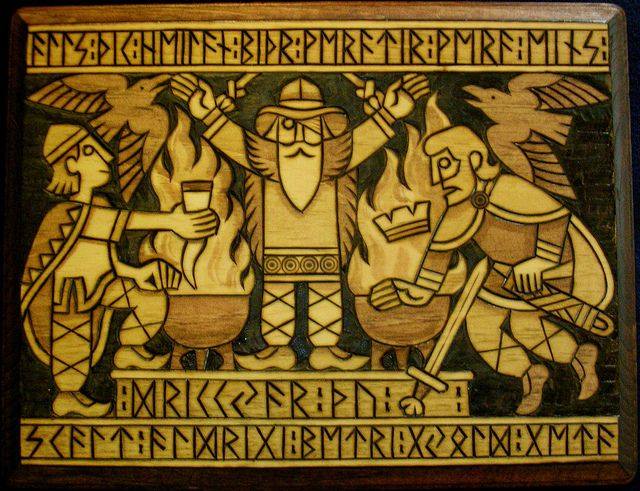
[Illustrated here via this lovely pokerwork of Odin in the Grimnismal, I believe by Jesseca Trainham]
“Atithidevo Bhava” ‘The Guest is God’ is a saying prominent in India even today (in fact, it is an Upanishadic quote – from Tait. Up. I XI 4); and one also thinks of the suite within AV-S XV 10-13, wherein even a King is to treat properly the Vrātya who comes to his door as Guest:
“1 So then, to the houses of whatever king a thus-knowing Vrātya may come as guest,—
2 He should esteem him better than himself; so does he not offend (ā-vraçc) against dominion; so does he not offend against royalty.
⌊That is, ‘he [the king] should esteem him [the Vrātya] better,’ etc.⌋”
[AV-S XV 10 1-2, Whitney translation & footnote]
It helps, of course, that the context of those verses – the Eka-Vrātya that is the subject of the Atharvanic suite of hymns … is Rudra
What should be further observed (and there is a glimmering of this within the Grimnismal), is that this notion for Sacred Hospitality, the ‘attending upon the Guest’, and with the ‘Guest as God’ – is also a fundament of Indo-European ritual operation.
After all – the God(s) come to us, our rites and places ‘down here’, as our Guest(s)
This is quite literal when it comes to the Hindu understanding – we find it labelled (aptly enough) via ‘Ātithya’ (notice the term in ‘Atithidevo Bhava’); and, as I say, the ‘underpinning’ understanding comes across heavily within the Grimnismal.
Therein, the context is a wager between Odin and His Wife, Frigg, over the character (as, evidently, resultant from the ‘proper upbringing’) of a particular adopted son of Odin, king Geirröth.
Frigg assets of him that “He is so miserly that he tortures his guests if he thinks that too many of them come to him.” [Bellows translation; “Hann er matníðingr sá, at hann kvelr gesti sína, ef honum þykkja of margir koma.”]
Odin insists Her to be wrong, and sets out to prove it by turning up Himself as a Guest at Geirröth’s court. An emissary of Frigg tells Geirröth to “that a sorceror who had entered that country did not undo him” [Ingham translation] – a completely correct warning ! Albeit which Geirröth then renders entirely self-fulfilling, by failing to provide the Hospitality to ‘Grimnir’ (‘The Masked One’) – having Him tortured, instead !
It falls to young Agnarr, instead, to be the only man in Geirröth’s court to do the proper thing – and make an offering of sustenance to the visitor Who is ‘between Fires’. And for this he is saluted !
As Odin Himself says it:
“eins drykkjar / þú skalt aldrigi / betri gjöld geta.”
“For one drink, you will never get a better reward” !
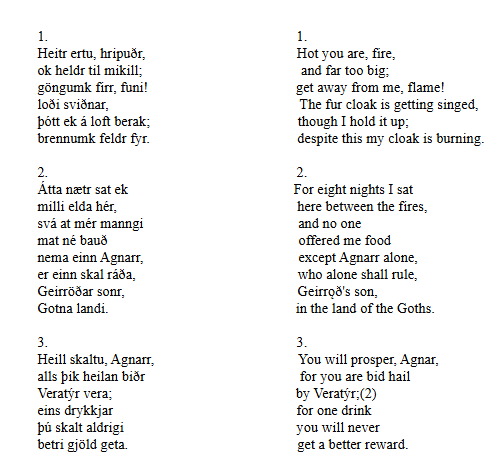
[again, Ingham translation]
Meanwhile, for further exemplar as to the principle’s violation – one need look no further than that vile effort of king Lycaon, wherein the mortal received Zeus as Guest, and plotted to kill Him as He slept under the king’s roof !
The king did this seeking to ‘prove’ the God was not divine.
And, alongside this, served to his Guest a meal most improper – the flesh of (per Ovid) a Hostage (i.e. a Guest) [“obsidis”] !
Truly a reprehensible action upon every level !
And one which features the human king in question failing similarly upon multiple levels – as a Host, of course; as a King (as it’s a hostage killed!); and underpinning them all – as a human being !
The ‘Sacred Hospitality’ is, indeed, Sacred – and where it is not honoured, Impiety is surely the correlate.
Thus it is that we hear from Polyphemus [here in Butler translation]
See how he declares himself exactly that ! And thusly unbound by the Custom of Xenia :
Odysseus: “We therefore humbly pray you to show us some hospitality, and otherwise make us such presents as visitors may reasonably expect. May your excellency give reverence [aidôs] to the gods, for we are your suppliants, and Zeus takes all respectable travelers under His protection, for He is the avenger of all suppliants and foreigners in distress.’
“To this he gave me but a pitiless answer, ‘Stranger,’ said he, ‘you are a fool, or else you know nothing of this country. Talk to me, indeed, about fearing the Gods or shunning Their Anger? We Cyclopes do not care about Zeus or any of your blessed Gods, for we are ever so much stronger than They. I shall not spare either yourself or your companions out of any regard for Zeus, unless I am in the humor for doing so.”
[Odyssey IX 269-278, Butler translation]
And thus – I believe – it is, likewise, that Odysseus, the Man In Disguise (and having escaped the foul thing’s clutches via blinding him), ripostes the remarks of the Cyclops :
“‘Cyclops, that man, it seems, was no weakling, whose comrades thou wast minded to devour by brutal strength in thy hollow cave. Full surely were thy evil deeds to fall on thine own head, thou cruel wretch, who didst not shrink from eating thy guests in thine own house. Therefore has Zeus taken vengeance on thee, and the other gods.’”
[Odyssey IX 475-479, Murray translation]
 arya-akasha