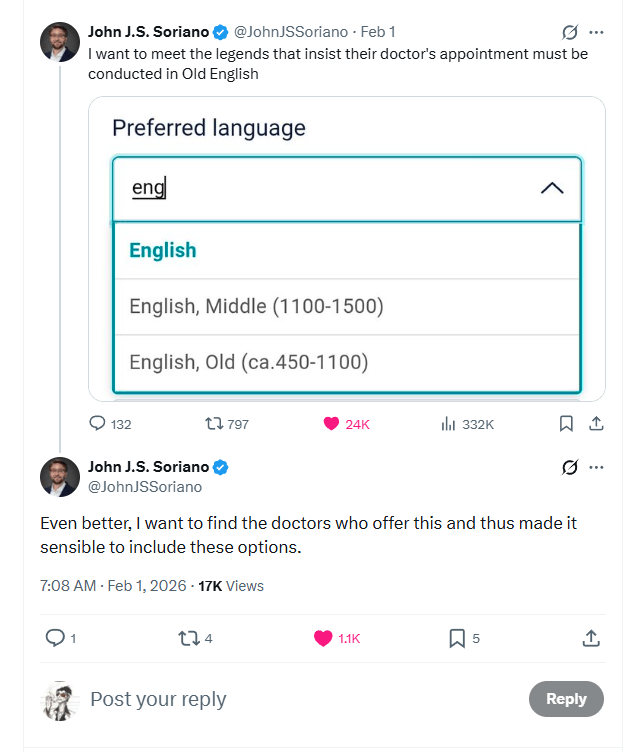
I saw this, and my immediate thought was, of course, that renowned prescription featuring the greatest of physicians – the Anglo-Saxon ‘Nigon Wyrta Galdor’ (‘Nine Herbs Incantation’), and Woden (Odin), respectively (a portion as to which follows).
“ðas VIIII magon / wið nygon attrum. 30
Wyrm com snican, / toslat he man; 31
ða genam Woden / VIIII wuldortanas, 32
sloh ða þa næddran, / þæt heo on VIIII tofleah. 33
þær geændade / æppel and attor, 34
þæt heo næfre ne wolde / on hus bugan. 35”
[text for the above as given in Kia-Choong, with dividers added]
Or, phrased in a language which we might all be more familiar with (less-old English … and with some annotations; both translation and assorted interleavened trivia, my own):
“30 These VIIII [Nine] have Power [‘Magon’ – c.f. Sanskrit Magha (मघ), English ‘Might’] /
‘Gainst [wið – ‘with’, but more ‘toward’] Nine Black/Malevolences [‘Attrum’ – often translated as ‘Poisons’, Arthur includes ‘infections’; ‘Attrum’ appears to be an introduced Latin term – a form of ‘Ater’ (āter if we are being fancy with macrons), which has such a meaning (beyond “black”, “dark”, “gloomy”, etc., Lewis & Charlton also noting Latin usages for “malevolent, malicious, virulent”, and “poisonous”) , and interestingly enough, derives from the same PIE (*h₂eh₁t(-)r- ‘fireplace’, per de Vaan) which I tend to believe underpins ‘Atharva-‘ ].
31 A Wyrm [Serpent / Dragon] came Sneaking [‘Snican’ is more directly ‘Crawling’, but ‘Sneaking’ may be a cognate], /
In Two Slit he a Man [‘Toslat’ : ‘to-‘ is an OE prefix for ‘dividing’ into ‘two’ – often with quite some force involved; ‘slat’, perhaps more ‘tear [asunder]’ than ‘slit’ in terms of its actual intended meaning and understood phrasing at the time];
32 Then Woden took / VIIII [Nine] WuldorTanas [a term we shall return to in a moment … ],
33 Slew [‘Sloh’] then the Adder [‘Næddran’], / that it into Nine flew [‘tofleah’ – ‘to-‘ prefix again for breaking apart; ‘-fleah’ – ‘flew’].
34 There brought-to-an-end [‘Geændade’ : ‘ge-‘ – completed (i.e. perfective); ‘-ænde’ – ended] / Apple ‘gainst [‘and’ – ‘anti’] Venom [‘Attor’ – c.f. Old Norse ‘Eitr’],
35 That it never [‘næfre’] would [‘ne wolde’ literally ‘not/nor would’ – note, due to relevant OE grammar, not a double-negative as literal word-by-word translation might otherwise erroneously imply] / into the House turn [‘bugan’ – ‘bend’].’
The key component within this remedy should seem to be this nine-piece configuration of what’s therein expressed as ‘Wuldortanas’ – a term whose interpretation we shall contemplate a little later.
For the moment, it shall suffice to offer that the ‘Wuldortanas’ (literally – ‘Glory-Twigs’), would feel a fairly potent potential correlate for the Vedic Sanskrit ‘Oṣadhi’ ( ओषधि ).
This latter term designates a ‘herb’, a ‘medicine’, and etymologically is likely ‘Light-Bearing’ or ‘Light-Container’ (Monier-Williams: “Light-Containing”) – what’s rendered there as ‘light’ assumedly being ‘Oṣa’ (ओष ), “burning, shining”, per Monier-Williams (in terms of root – de Vaan has ‘Oṣati’, ‘to burn, scorch’ coming from PIE *h₁eus-e/o- ‘to burn’).
Of course, it’s a rather … active remedy. As befits that which is hailed as having Rudra(‘s potency) therein [TS V 5 9 i, AV-S VII 87, also inf. SBr VI 1 3 12]. And which Rudra can be said to have ‘prescribed’.
To quote myself upon the subject via way of explication:
“Rudra is, per quite the expansive array of Vedic attestations, a Bringer and Bestower of healing elements, particularly of the herbal variety. You can see this in such theonymics as ‘Jalāṣabheṣaja’ [as at RV I 43 4 … inter many alia], which means pretty much exactly that. In various instances, the ‘herb’ in question is referred to using the rather excellent term ‘Oṣadhi’ (ओषधि – anglicized rather variously as Oshadhi or Osadhi, etc.) […] it is perhaps worth noting that it is not necessarily ‘just’ a plant, nor utilized purely in the sense that we may think of as ‘medicinal’ today.
What I mean by that is that one does not ordinarily encounter the (metaphysical) equivalent to high explosive thought of as a medicine – unless, perhaps, as applies the nitroglycerin prescribed for a variety of blood-pressure related symptoms.
If you think I’m joking about this … consider a few verses wherein we observe this phenomenon ‘in motion’. (And, again, I’m going to have to restrain myself from … going through word-by-word and line-by-line a whole suite of Atharvanic Hymnals …
AV-S VI 32 2 has Rudra called upon to pulverize (śṛṇātu) the necks and ribcages of both Pishachas and Yatudhanas (śṛṇātu yātudhānāḥ – a most admirable sentiment indeed, quite literally an imperative !) – with this being presented correlate with the aptly named Vīrudh (वीरुध्) plant, of omnipresent grave and glorious potency (viśvatovīryā), which is declared to ‘unite [the demonic / demon-worshipping foe] with Death’ (Yamena samajīgamat).
AV-S V 14 has the Osadhi enlisted to, per the Bloomfield translation, “Seek thou, O plant, to injure him that seeks to injure (us), strike down him that prepares spells (against us)! / Strike down the wizards, strike down him that prepares spells (against us); slay thou, moreover, O plant, him that seeks to injure us!” ; Griffith renders those verses (the second half of AV-S V 14 1, and the whole of line 2, in case you were wondering): “Harm thou, O Plant, the mischievous, and drive the sorcerer away. / Beat thou the Yātudhānas back, drive thou away the sorcerer; / And chase afar, O Plant, the man who fain would do us injury.”; And, for completeness, Whitney: “seek thou to injure, O herb, him that seeks to injure; smite down the witchcraft-maker. / Smite down the sorcerers, smite down the witchcraft-maker; then, whoever seeks to injure us, him do thou smite, O herb.””
That we are speaking of demon- (and demon-worshipper) smiting within the course of what had been introduced as medical operations for the remedying of disease should come as little surprise – a good doctor does not merely address the symptoms, but moves to directly target that which is at the root to the condition. This, in various cases, proving no mundane malady, but rather the morbid manifestation inflicted via an insidious metaphysical malevolence. And therefore mandating a most judicious form of treatment, administered via the Divinity’s salience thusly invoked. That treatment, per various citations, tending to be a course of what we might call Electro-Shock Therapy. Whether labelled as ‘Vajra’ (as at, say, AV-S IV 28 6-7, wherein it is Rudra as Bhava-and-Sharva, Lords over both those-who-go-upon-two-feet and those-who-go-upon-four, called upon through such means to (as Whitney’s translation phrases it) “free us from this distress”), or (as we find at AV-S X 1 23) as the Lightning, the Missile of the Gods (again, drawing from Whitney, viz. “Vidyutaṃ Devahetim”).
Where am I going with this?
Well, apart from noting that there’s established Nordic precedency for an Odin-bestowed ’empowered’ plant, which can be deployed with such impressive results (the ‘Styrbjarnar þáttr Svíakappa’ features Odin providing a “reyrsprota” (‘reed-sprout/stick), which when thrown with appropriate invocation of He, then proceeds to generate an effect strongly correlate to the (Meteoric) Vajra deployed by Brihaspati in a rather famous occurrence : that is to say, a mountain (“feallit”) falling out of the sky with blinding (implicit) flash, to annihilate an opposing force) … it’s to suggest that that ‘Wuldortanas’ we’d encountered deployed within the Anglo-Saxon incantation above for a Odin-templated spot of botanically-impelled dragon-slaying (ref., not only Brihaspati contra Vala there, but Bhava-and-Śarva (Rudra) as Dragon-Slayers, per an earlier verse of one of our afore-cited Atharvanic hymns – “vṛtrahanā” at AV-S IV 28 3), might in fact be rather more overtly resonant for this approach as a hailing.
‘Tanas’ renders reasonably straightforwardly as ‘Twigs’ – albeit most likely of a specialized type.
To elaborate: Orton informs us that in addition to a “basic meaning [of] a natural, unmarked fragment of a living tree”, one also encounters a “second, more specialized, meaning of tān [as] ‘a twig used in casting lots’;” and flowing from this observation for ‘tan-‘ as entailing, so to speak, ‘metaphysically potentiated’ twigs (likely via Runic inscriptions emplaced thereupon) – a more generalized induction upon his part (arrived at with particular consideration for our ‘Nine Herbs Charm’ exemplar and its context) “that ‘tanas’ means ‘inscribed twigs’.”
(Cooke also observes the potential resonance in another direction – the sword wielded by Beowulf, Hrunting, which [at 1459b] bears the evocative descriptor “atertanum fah” [‘ātẹrtānum fāh’, if we are being fancy with the macrons] – parsed by W. F. Bolton, whom he quotes, as “adorned with twiglike patternings of deadly effect”; perhaps even wreathed via such dread energies in the manner of a certain setting’s lightning-twined power-blades)
We would, at the very least, vigorously assent to the notion that ‘metaphysically active’ / ‘power-bearing’ twigs were entailed here; even as we acknowledge that Orton’s supposition for the precise mechanism for such potency as entailing (Runic) inscription remains (plausible) conjecture. (And, indeed, we might also, perhaps, make mention for the Gothic ‘wulthre’, as Lehman’s ‘Gothic Etymological Dictionary’ has it, bearing a seeming meaning of ‘annotation’ – this being a cognate for the ‘Wuldor’ which forms the other part to ‘Wuldortanas’, and indicating something to bear the value of something else … potentially one word which links to a rather more extensive explication : it is not hard to see how this might resonate to a small twig bearing a Rune or Runes – or some other such symbolic signifier – and thereby standing for Great Forces indeed ! )
‘Wuldor-‘, meanwhile, whilst often rendered as ‘Glory’, we would instead suggest to bear here a rather more ‘flashy’ conceptual manifestation – rather literally, in fact. The entry within Lehman’s ‘Gothic Etymological Dictionary’ for “wulþus” – which he gives as “splendor” – while acknowledging the customary parsing for Old English ‘Wuldor’ as ‘Fame’, also references Old Icelandic “Ullr” as “the gleaming one” (per Palmér), and traces a PIE root of *wel- ‘see’ *wl̥-tu- ‘appearance’ (Kroonen’s version having “A tu-stem to the PIE root *uel- ‘to see’. Also cf. OE wuldor n. ‘glory’ < *wuldra- < *ul-tró / *ul-dʰro-.”). We would therefore, ourselves, anticipate that just such a ‘visually perceptible’ dimension had been entailed – a rather bright one, also, based upon the Nordic skein of comparanda, as well.
To return to our relevant Incantation :
“ða genam Woden / VIIII wuldortanas, 32
sloh ða þa næddran, / þæt heo on VIIII tofleah. 33″
“32 Then Woden took / VIIII [Nine] WuldorTanas,
33 Slew then the Adder, / that it into Nine flew.”
We would suggest it possible that the Nine Wuldor-Twigs which Odin took and thence deployed … would rather overtly resemble that which AV-S X 1 23 expresses through “Vidyutaṃ Devahetim” – Lightning, the Divine Missile (and not least given Odin’s station upward in the ‘Mid-Atmosphere’ / Antarikṣa , as we have observed in our Cosmology series). The phrasing of ‘tanas’ or ‘twigs’ serving well to express the general shaping of the crackling bolt; the ‘Wuldor’, conveying that very visible energy which flashes through the sky in such branch-jagged ‘tanas’ shape and course.
Which then explicates the anticipated mechanism of action for the nine rather more terrestrial twigs no doubt intended to be utilized by a human operator acting in (re-enactionary) emulation for the above : these nine well-renowned (to draw from the other sense to ‘wuldor’) twigs (and whether they be ‘inscribed twigs’, to reference Orton’s conjecture; or whether their being ‘resonant-‘ or ’empowered-‘ was otherwise entailed) being engaged with (mesocosmically) in order to manifest the correlate metaphysical force.
And as for why the number nine – we would surmise its underpinning to be the same as that of the ‘Nine Paces’ (“fet níu”) traversed by Thor following the combat with Jormungandr in the Völuspá [56], or the latter’s Vedic correlate of the ‘Nine-and-Ninety’ (“Nava Ca […] Navatiṃ”) ‘Rivers’ (“Sravantīḥ”) likewise traversed by Indra post Vṛtra-slaying (see my earlier ‘Thor Lives! – The True Outcome Of Thor Contra Jormungandr , Illuminated Via Indra’s Exile’ for more in-depth explication upon this episode). That is to say – an evident archaic Indo-European symbolic concept for a division of nine as encompassing, basically, ‘to the ends of the [habitable/enclosed] universe’; and with further exemplars readily in evidence amidst the Classical IE realms, also (c.f. Hesiod’s Theogony citing nine divisions of the Oceanus encircling Earth & Sea (790 – “ἐννέα μὲν περὶ γῆν τε καὶ εὐρέα νῶτα θαλάσσης”), with the Styx as tenth; the linked one-plus-nine-year penalty for transgressing the Oath of the Gods (791-806); and his presentation of the expanses between Heaven & Earth and Earth & Tartarus in terms of the distance over nine days and nights which an anvil would fall (720-725), where this ‘Nine and Nine’ is no doubt a similar enhancement to ‘Nine’ that ‘Nine-and-Ninety’ would be).
In each instance, we find the ‘nine’ encompassment to be extant alongside that cosmology’s ‘Three Worlds’ style arrangement – it’s a different mechanism for speaking about ‘the whole [habitable] universe’, not a displacement; albeit one which, in the Nordic sphere, has become a rather curious more ‘literal’ connotation, replete with ‘Nine Worlds’ (“níu […] heima”, per the Völuspá, for instance; and notwithstanding the fact that there are rather more than nine such ‘heimar’ given across the canon – and the usage of Nine Worlds Beneath Niflhel at Vafþrúðnismál XLIII (“níu kom ek heima fyr Niflhel neðan”) in a fashion that seems resonant for Hesiod’s ‘Nine’ distance between Earth and Tartarus as mentioned above), alongside what is clearly the direct continuance for the Three Worlds arrangement (for example – the “himin ok jörð ok loftin” of the Gylfaginning).
This ‘both’ rather than ‘either’ approach presumably informs the situation for our Anglo-Saxon incantation under discussion, which rather famously features Seven Worlds (39 – “VII worulde”; the herbs being ‘set and sent [with]in’ (“sette and sænde on”) such), rather than the more immediately-familiar Germanic styling of the ‘Nine Worlds’ as encountered amongst the Norse. For these Seven, I would infer that originally it entailed something akin to the various Vedic ‘set of seven conduits of the Divine’ (e.g. Tongues of Agni, Metres of Vedic Verse, Sacred Rivers, etc.) – and hence its closely stated connexion as applies something of the Divine which is then sent out into the universe (“The wise Lord, holy in the heavens, created those herbs, when he hung. He set and sent [them] into the seven worlds […]”, to quote Kia-Choong’s translation for the relevant verses 37-39; “þa wyrte gesceop witig drihten, / halig on heofonum, þa he hongode; / sette and sænde on VII worulde”, in the original language – and with the ‘overlap’ evident between Woden ‘hanging’, as with Odin in receiving the Runes, an ordeal I have elsewhere contemplated in light of the throat-afflicting ordeal of Mahadev undertaken to secure the Amrit … albeit with Arthur interpreting the aforesaid line 37 as referencing Christ).
With the specific number that is Nine Herbs being itself a continuance for this ‘Nine’ as ‘full-spectrum’ encompassment of (habitable) universe – and, more to the point, a fairly direct resonation as to why one finds the Weapon of the Sky Father (e.g. the TriKanda and TriShula wielded by Rudra, or the Thunderbolt of Zeus / Jupiter / Vejovis &c.) to be a Triple weapon … that is, to have operative potency across the Three Worlds (and a useful thing, too, given that it is called upon to be deployed against demonic opposition that spans likewise across the Three Worlds, also!).
The circumstance for that adversarial wyrm, upon the application of the Nine WuldorTanas in its slaying, proceeding to ‘fly into nine’ – we would contemplate as communicating not necessarily the most literal of potential meanings (i.e. it was hacked apart metaphysically into nine pieces), but instead something more oriented toward the ‘nine’ rather than the ‘serpent’. That is to say, the ‘nine’ division of the universe – figuratively, something along the lines of scattering something ‘to the four corners of the globe’, to the four winds, etc. ; or, so to say, basically hitting it with such energetic force (it is, after all, a Lightningbolt – at least, so our inference guides us to say) that it is almost ‘atomized’ … blasted into oblivion (perhaps one might also ask of those ‘Nine Worlds’ beneath Niflhel…?), and with the remnants, the debris, scattered across the whole of the cosmos – in a manner that one might say has rendered the enemy demon-dragon not so much ‘history’ as ‘Geography’.
A most mighty medication, indeed ! In the sense that Rudra is the great Healer, the great Bringer of Medicines (consider AV-S II 27 6, featuring Rudra as “JalāṣaBheṣaja”; called upon to Smite & Dessicate (“jahy arasān kṛṇv”) an adversary and their efforts (“prāśaṃ pratiprāśo”), via a ‘Herb’ – “Oṣadhe”) – and the great upholder of Order (‘Vratapāṃ’ – as at RV X 61 7, amidst other stylings & occurrences) …
Well, it is indeed – ‘Just What The Doctor Ordered [With]’.
And for that – we hail the God Who makes available such remedies to mortalkind.
Whether this is done in ecclesiastical Sanskrit – or, as in the case of these apparent doctor’s appointments, Old English as well.
Although speaking of doctor’s appointments … we might, in light of verse 34 of our Old English incantation – “þær geændade / æppel and attor” – perhaps suggest some refinement to the prominent modern rhyme :
How does “An Apple From ‘Day’ Keeps The Demon[‘s Poison] At Bay” sound.
Hara Hara Mahādeva
 arya-akasha
Pingback: Metaphysically Potent Medication, Anglo-Saxon & Atharvanic | arya-akasha | Vermont Folk Troth