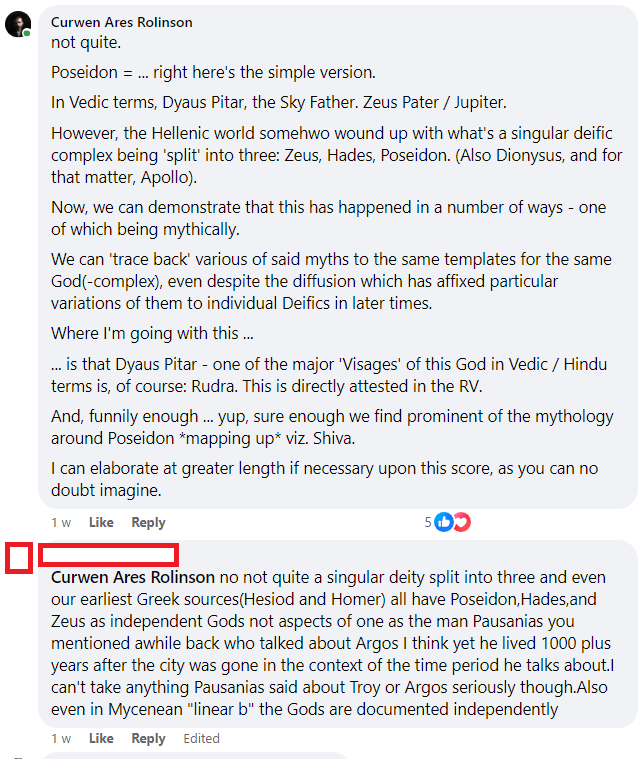
I should clarify that I’m not posting this with an intent of having a go at the gentleman who’d raised the counterclaim (hence, in part, why I’ve anonymized his comment in the cap below) – but rather, because various of the elements in my reply might be of a broader interest (the situation as to the ‘Refraction’ of the Indo-European Sky Father deific being a most important one, after all, in terms of understanding the relevant theology).
And also because it seemed a bit of a waste, having written all of this, to see it languish only in a comment sub-thread beyond noticing.
Anyway, reply begins:
—
I am not quite sure if you have misunderstood my position, but for the avoidance of doubt allow me to restate it more clearly for you.
When I say “singular deific complex”, i.e. “Dyaus Pitar, the Sky Father. Zeus Pater / Jupiter.” … I am referring to the original Proto-Indo-European religious situation and era.
When I say ” individual Deifics in later times” … I am referring to Zeus, Hades, Poseidon (etc.) [the “individual Deifics”], and with, yes, Homer, Hesiod, and all that came after them most definitely being within the ambit of “later times”.
Because relative to the Proto-Indo-European phase of things … yes, yes they very much are.
Now, unless you are going to tell me that you believe that the religious positions of the 1st millennium BC amidst the Hellenic sphere were Exactly Identical to those back upon the Urheimat somewhere around two millennia prior to this (which would be rather remarkable given that the language, culture, and customs shifted (by which I mean ‘developed’/’evolved’) in various ways quite demonstrably) … then you would assumedly agree that development and change has occurred over that timescale as applies the religious / mythic / theological perspective(s) as well.
What this means is that we have a question of what has developed from what. And in a not at all dissimilar fashion to the manner in which I assume you would not object to the identification of both Jupiter and Zeus Pater having come from the same archaic PIE deific complex … well, so too do we observe that within as well as between the broad individual IE cultural spheres there are rarely only a single exemplar / expression for various major foundationry.
Now, sticking with the Roman sphere for a moment via way of illustrative potentia … you would be aware of Vejovis / Vediovis / Veiovis : which, as the name would imply, was understood to be a Jupiter ‘expression’ . Ovid’s Fasti (III 437, 447-8) quite directly having Him as such (and as applies the latter situation, he rather handily points out direct coterminity with the Zeus / Jupiter mythology; oh, and, viz. the Temple(s) … you can observe this causing a bit of intrigue amidst academia due to the situation for a certain temple, mentioned at Livy XXXV 41 8, which serves to rather usefully confirm exactly this underpinning). Gellius in his Noctes Atticae (V 12 12) notes that Vediovis was also identified as/with Apollo. Which is not incorrect – see my (not fully enumerated) list of Classical ‘Sky Father’ deific expressions above for why.
Vejovis is ‘independently’ attested for the most part, particularly in the most archaic (not that that’s saying a huge amount relatively speaking) evidence – by which I mean, one is not usually looking at direct “Vejovis = Jupiter” inscriptions and things. Because why would you. Whaat would be the need to actually inscribe such a thing, rather than on a more ‘freestanding’ basis. The underlying coterminity would have been known & acknowledged (indeed, was known and acknowledged), even notwithstanding the obvious element in the theonymic(s) themselves.
Effectively, what is observed is a ‘Wrathful / Destructive’ Facing to the Sky Father – Gellius makes this point implicitly … explicitly viz. the ‘harmful’ dimension in his intepretation for the nomenclature. Compare Rudra relative to Shiva, Zeus Maimaktes relative to Zeus Meilichios, etc.
And yet – it can easily look like a situation of an ‘independent’ God ; and according to your earlier logic about ‘separate attestations’, you would assumedly disagree with me (and various sources both ancient and modern) which trace the deific back to that same root (deific complex) as Jupiter.
Let’s use a more directly pertinent exemplar.
Dis Pater.
Now, as is well known, the Romans readily understood Dis (Pater) to be Hades – you can see it quite directly in Ovid’s use (Fasti IV (e.g. line 449) & Metamorphoses V (e.g. line 395)) for the Roman theonymic in application to the familiar figure of Hades within the recognizable Persephone myth.
Why do I mention this?
Well, if we accept that the Roman mythology did indeed have a Hades equivalent figure (and there seems no meaningful reason to doubt this; the ‘Dis’ with relation to ‘Pluto’ is an interesting further potential ‘buttressing’) – then the following passage of Varro’s De Lingua Latina (V 66) makes for useful reading:
“Hoc idem magis ostendit antiquius Iovis nomen: nam olim Diovis et Diespiter dictus, id est dies pater; […] Idem hic Dis pater dicitur infimus, qui est coniunctus terrae, ubi omnia ut oriuntur ita aboriuntur; quorum quod finis ortuum, Orcus dictus.”
Which, for those of us whose Latin is a little less than totally functional after a … few years since we were properly taught it at secondary school –
“This same thing the more ancient name of Jupiter shows even better : for of old He was called Diovis and Diespiter, that is, dies pater ‘ Father Day […] He is likewise called Dispater in His lowest capacity, when He is joined to the Earth, where all things vanish away even as they originate ; and because He is the end of these ortus ‘ creations,’ He is called Orcus”
[Kent translation]
Or, phrased another way … they (the Romans) could quite readily accept the notion for their Hades-equivalent as being another ‘Facing’ to their Zeus-equivalent. And not just that … they’d (largely ‘in essence’ correct) trace out a chain of etymological derivation for the theonymic (and, indeed, the Deific) to go with, too. [Only part they’re missing … other than some slight refinement of the linguistics – which, as aforementioned, are ‘conceptually’ if not quite ‘linguistically’ accurate … and, of course, the idea of PIE etc. , would be the ‘Solar Afterworld’ concept that we find most readily attested in archaic IE spheres … but more upon this, perhaps, some other time.].
Now, sticking with Hades – but actually going back to the Hellenic sphere directly …
Here’s Heraclitus:
“If it were not Dionysus for whom they arrange the procession and chant the hymn to the shameful parts , they would act in the most shameless way; but the same are Hades and Dionysus, for whom they rave and celebrate Lenaia.”
[Heraclitus, fragment 15 – as presented in Adomenas]
And, for backup, the Kerenyi translation for that aforementioned verse:
“If they did not order the procession in honor of the god and address the phallus song to him, this would be the most shameless behavior. But Hades is the same as Dionysos, for whom they rave and act like bacchantes”.
[Kerenyi, as you’re likely aware, has quite the effort at sketching out why this is a correct (co-)identification]
Why am I mentioning Dionysus here ? Well, for starters, if you scroll up, you’ll find Dionysus in amidst my (incomplete) enumeration of Hellenic ‘Sky Father’ Deific Expressions. Along with Hades.
But also because, as you shall be aware, one encounters Dionysus [“Di-Wo-Nu-So”] in Linear B materials … and yes, alongside “Di-We” [i.e. ‘Di-Wo’, that is to say ‘Zeus’] – like, KH Gq 5 has both theonymics encountered, and apparently with twice the honey-amphora offering going in the direction of Dionysus as compared to Zeus / the Temple of Zeus.
Now, does this axiomatically indicate that we’ve got two separate Gods here?
Let me put it this way: when I go to my Mandir [Hindu temple, for the audience’s benefit] … I would be rather curious indeed were I to somehow believe that the Shiva in the ShivLing, the Shiva of the Murti standing up behind such, the Bhairava standing nearby, etc. were all different Gods – or, for that matter, that the Parvati near the Shivling Shrine was a different Goddess to the Durga with Her Own Shrine on the other side of the Temple.
I would, however, be rather remiss if I insisted that – even though the same Goddess – the Durga was the same ‘Aspect’ as Kali. Just as I would be rather idiotic if I attempted to insist that Kali was not the same Goddess as Parvati simply because we often encounter both theonymics, even in separate ’embodiments’ in mythic encounters , and with the former referred to shorthandedly as a ‘Kanyaka’ (‘Daughter’ – more properly, I have said, ‘Emanation’) of the latter.
Why do I mention that? Well, if we take a look at the various major proposals for just what the -nysos / -Nu-So of ‘Dionysus’ / ‘Di-Wo-Nu-So’ is supposed to mean … well, some suggest ‘Young’ Zeus (see earlier remark viz. Vejovis), others suggest a ‘Tree-Zeus’ (and ref. the prominent Shaivite epithets/theonymics as the Lord in Tree(s) found in the Sri Rudram etc. … via way of the observation as to the ShivLing’s archaic rootedness within the Tree/Sacral Post understanding and, of course, Odin with relation to Irminsul – Dionysus / Liber having a decidedly ‘ShivLing’ style propitiation focal per the aforesaid Heraclitus quote, plus Augustine’s own (amusingly affronted) remarks upon the subject; as applies the Nymphs of similar nomenclature – well, see what happens with ‘Ash-Nymphs’ in both Hellenic & Germanic sphere] , and others still have gone for ‘Son of‘ Zeus – as applies the linguistics a situation which Beekes attempts to claim “finds no support”, “is improbable”, yee. [I’d suggest that if one went down this particular path – that ’emanation’ understanding previously observed viz. ‘Kanyaka’ is rather pertinent]
Although speaking of ‘Son of’ with relation to Dionysus … one would rather handily utilize this to once again illuminate my core point in another way, also: namely, by asking the rather natural question of Maternity.
You shall be aware that various sources state the mother to be Semele (Thyone) [this includes your apparently much-derided Pausanias with reference to Argos – II 31 2 & 37 5], whilst others declare it Persephone [as attested in several Orphic hymnals and fragments, and also cited by Cicero in his De Natura Deorum, along with the Thyone lineage as well; Nonnus likewise mentioning both] and still others again have Demeter in the role (c.f., inter alia, Hellenic materials running back to at least the 4th century BC, and with a reasonably broad array of further occurrence for the concept post-then and into the Roman sphere – Marcovich provides more detailing).
Surely it is not beyond the bounds of ready likelihood that various of these tellings … quite apart from being separate … are, in fact, ‘refractions’ as applies both their core concept and their major ‘Dramatis Personae’.
As an example for exactly this ‘in motion’ – we would draw upon the myth which is found in Pauranika occurrence for Surya, Saranyu & Chhaya [it’s briefly attested in the RV also]. I shan’t over-lengthen this post with all of the details, but suffice to say that it features a ‘Bright Sky’ deific expression and His Wife but also a ‘different form’ thereof or a ‘substitute’ of ‘Dark / Shadowy’ characterization, as well as pursuit in animal-shape (particularly, as Horses), and some quite important identifiable progeny (these including the Asvins / Divo Napatah, as well as Tapati, Manu & Yama, and others contingent upon the version – Revanta, and Shani, for instance).
It is well-assented that Poseidon in pursuit of Demeter Erinys/Melaina, in Horse forms, is a co-expression of the myth in question.
I also believe that Zeus in relation to the conception of Helen of Troy (Tapati) and the Dioscuri, Castor & Pollux (i.e. the Asvins – the Divo Napatah) is, likewise: Nemesis being similarly ‘Dark’ and ‘Avenging’ in the manner of Demeter Erinys / Melaina , and with an animal (particularly avian – a Goose & Swan) form pursuit involved … whilst as applies Leda (to whom Zeus appears as a Swan), the underlying etymology for this name (ref. Leto – but also the fact that this works out not only as ‘Wife’ but also resonates viz. ‘Death’ in the relevant Lycian) works out rather well for what goes on as applies the aforementioned ‘substitution’ with the “Sa-Varna” ‘alternate’ [if rather ‘generic’ in a certain sense] ‘Wife’. The detailing viz. a mortal queen receiving an egg in the Nemesis versions also works out with the Vaidika ritual via which a king would seek divinely infused offspring … but more upon this some other time (have already writtne upon it a few times previously).
Now, interestingly, in addition to the Asvins being spoken of as Sons of Rudra (and, of course, ‘Divo Napatah’ – well, the first word there is cognate in its understanding with the ‘Dios’ of ‘Dioscuri’ … ‘Zeus’ Boys’, and the Sanskrit as ‘Sons of Dyaus’), we also find Revanta being engaged with as a Son of Shiva [ref. Skanda Purana account] , and Shani likewise stated to be such (ref. Brahmanda Purana II 10]
Even had we not the direct attestations in Vedic primary materials for Rudra being Dyaus, and Rudra also occurring (inter alia) as Aditya, Surya … we would make the logical inference, surely. (And we can tell that there’s a coterminous myth going on involving Rudra … due to the way in which Kali directly and very pointedly aligns in the narrative presentation and also the theology with Demeter as encountered in that aforesaid Poseidon-featuring episode, whilst also doing so viz. Persephone, likewise; oh, and we have another myth viz. Zeus defending Semele and sanctioning Actaeon which likewise directly ‘maps’ viz. Rudra defending His Wife in an array of most pertinent details as we have covered at some considerable length elsewhere)
Another example for this sort of ‘same myth – refracted’ , would be with reference to the bestowal / distribution of the Weapon(s) to the Sky Father.
Now, in Vedic terms … we have this myth (and the ritual ‘operationalizations’ for same) quite prominently – the Thunderbolt weapon , which is a Three-Arrow [TriKanda – the underpinning to the later-prominent Trishula] is congealed for Rudra utilizing the Fire-Altar, with this weapon then utilized to attack Rudra’s Father (Prajapati) on behalf of the Gods, and to ensure / secure the Rulership of the Three Worlds [viz. the Upasads expression of the conceptry and the Tripurantaka epithet ; interestingly, both of these deeds in different Vedic texts are how Rudra attains the Pashupati epithetic theonymic; one also observes Agni to have the Fortress-Destroyer Archer hailing (and a most impressive ‘Bull’ visage for He, likewise) at RV VI 16 39 in relation to this exact deed, Rudra being Agni], by overcoming & driving out the A’Suras therefrom ; an essential part to the understanding being the Rite of the Covenant / Alliance / Fraternity , the Tanunaptra , conducted as the foundational stage for Their Divine War Effort, with that Fire Altar
In Hellenic (& Roman) terms – we hear in Pseudo-Hyginus’ De Astronomia (II 39) and (Pseudo-)Eratosthenes’ Catasterismi (XXXIX) of the (Ouranian Cyclopes-produced/manned) First Altar, where i) the Gods Swore Their common purpose & allegiance at the outset of Their campaign against the Titans [i.e. the Tanunaptra understanding] … with this being also, per the fragments which go with the latter text’s iteration, being whence the (Ouranian Cyclopes-produced) Thunderbolt of Zeus is produced and given unto He.
Hesiod’s Theogony has the Rite of Covenant around the line 400 mark – with the role of the Styx therein being pretty correlate to Varuna’s House (Water) in the Aitareya Brahmana iteration for the Rite.
Apollodorus’ Bibliotheca [I 2 1] makes reference to what looks like this Alliance-Rite concept, although it is there phrased in liberating potential allies that’d been cast out of the habitable universe ; however it then directly has that which we had earlier mentioned, viz. the Ouranian Cyclopes arming Zeus with the interestingly triple weapon (“βροντὴν καὶ ἀστραπὴν καὶ κεραυνόν,”). Hesiod’s Theogony [around about hte 500 mark] has pretty much the same thing – the liberation of driven-into-exile allies, followed by the bestowing of a triple weapon (“βροντὴν ἠδ᾽ αἰθαλόεντα κεραυνὸν καὶ στεροπήν”), which likewise ensure Dominion. [The Alliance element, replete with an Offering of Nectar + Ambrosia, even is also there from ~617; and again followed swiftly by the Triple-Weapon : ” κεραυνοὶ ἴκταρ ἅμα βροντῇ τε καὶ ἀστεροπῇ ποτέοντο” … and a triple-division of cosmology replete with a bronze fortification wall : you know, exactly what occurs in the relevant Brahmana suite of conceptry, and intriguingly, per the Ait. Br. iteration [I 23], with the Gods having built ‘counter-fortification’, so to speak, with a view toward doing much as Poseidon does therein.]
Now, with reference to the above-mentioned passage(s) of Apollodorus, what we find is that at the same time (and from the same forge / fire-altar) as Zeus is in receipt of the Triple Weapon … Pluto is given His ‘Helm of Invisibility’ (ref. ‘Kaal’ – and, of course, Hades’ Own Name), and Poseidon, His Trident. Interesting, that. A Triple-Weapon.
What I would say is that given the Vedic situation simply has the one Triple-Weapon [of Three Elements] bestowed – to the Sky Father deific (Rudra) … the fact that there’s three elements bestowed in this Hellenic accounting (two of which are, it would seem, expressly ‘Triple’, themselves) should seem to suggest, as I have stated – that a ‘refraction’ has taken place here. (Elsewhere, Zeus, Hades, and Poseidon, having Thunderbolt (akin to Spear), Bident, and Trident, respectively, should be … well, basically on the money for it; the situation of Hades’ Helm of Invisibility – in some ways, it is a bit of a departure that that is that which is specified here. And yet, if we examine the actual Upasads mytho-ritual detailing … we observe at Ait. Br. I 23, two ‘Day-‘ associated undertakings, and One element correlated with “the junction of day and night” – which, per my previous work, we would of course suggest correlates rather well with the PIE *ḱel situation for a certain ‘Veil of the Unseen’ ; whilst, of course, the ‘Day-‘ linked Sky Father (literally there in the name viz. ‘Dyaus’) we see ‘either side’ of this for reasons which ought prove rather readily apparent … so, Zeus & Poseidon, eh?)
Apollodorus has the situation of the ‘allotment’ of the Three Worlds to Zeus, Hades, and Poseidon, as having been accomplished via the ‘casting of lots’ (a detail also to be observed at Iliad XV 187 [Callimachus, for his part, disagrees quite vehemently with the entire thing, folding it all into a unified ‘Sovereignty’ of Zeus through His Potency, at 61-67 of his hymnal ‘To Zeus’] – albeit with some slight divergence about the Earth (and Olympus) and thusly a disruption to the ‘neat’ Tripartite structure to the Cosmos … although one not without precedent given, say, Ait. Br. I 25 having four for “the larger worlds” [or, for that matter, the “αἰθέρος ἠδ’ Ἀίδου, πόντου γαίης τε τύραννε,” i.e. ‘Aether, Hades, Sea, Earth’ under Zeus’ ‘Tyranny’ (in a non-negative sense, I hasten to add) in that Hellenic hymnal Clement of Alexandria attempted to get shenanigany with in his ‘Stromata’ (V 14)]). In one way this resembles the repeated pattern observed within the Vedas for the correlate situation – wherein we find The Gods At Large ‘pooling’ various powers/potencies, and indeed undertaking the “Tanunaptra” [i.e. the ‘extension’ [‘tanu’] of ‘kinship’ [‘napata-‘] ]; with the objective of this being to overcome the “disunity” (as the Ait. Br. translation has it) which had rendered Them relatively easy pickings for the A’Sura-Rakshasas … the result of this Unity being “Thence the Asuras could not conquer Their Empire” (from the Haug translation.).
To make it more explicit … in both cases, we wind up with the placing into the same ‘bucket’ [paraphrasing the Vedic there ..] : it is just that there is a divergence because for some reason, whereas things are held in unity and under the aegis [er .. in the English sense to the term] of the Sky Father deific singular in the Vedic end of things : for ‘some reason’, the Hellenic recountings have wound up with the ‘potencies’ of regency being ‘taken back out again’ and parcelled off to three deifics. I would say to three Sky Father deific expressions … because fundamentally it’s the same myth. But I appreciate that it might look rather different by the time the tradition has come down to us.
Or does it …
An interesting point about the Pausanias passage which you have taken issue with [II 25 3-4] concerns the following:
“The reason for its three eyes one might infer to be this. That Zeus is king in heaven is a saying common to all men. As for him who is said to rule under the earth, there is a verse of Homer which calls him, too, Zeus:—
“Zeus of the Underworld, and the august Persephonea.
The god in the sea, also, is called Zeus by Aeschylus, the son of Euphorion. So whoever made the image made it with three eyes, as signifying that this same god rules in all the three “allotments” of the Universe, as they are called.”
[Jones & Ormerod translation]
The former – the remark of Homer, viz. “Ζεὺς καταχθόνιος” – is at Iliad IX 457; the latter, the wording of Aeschylus, I have not yet tracked down to my own satisfaction.
There is quite the constellation for these ‘Zeus of the Underworld’ occurrences (although the Homeric epithet, καταχθόνιος, is rather intriguing precisely because the ‘Kata-” is … rather ‘extra’; the opposite of “over and above” our expectations, of course, because it’s literally going in the opposite direction, but you see what I mean. It assumedly may have something to do with the specific context for the invocation here – featuring the Erinyes …] ; the scholar Walter Leaf having the following to say upon the subject:
“Ζεὺς καταχθόνιος is a unique title in H., but we have “Ζεὺς χθόνιος” in Hesiod Opp. 465, where he is coupled with Demeter, and Soph. O. C. 1606; and there was a cult of him in Corinth (Paus.ii. 2. 8) and Mykonos. Compare the phrases “Ζεὺς ἄλλος” and “τὸν πολυξενώτατον Ζῆνα τῶν κεκμηκότων”, quoted from Aischylos. “Ζεὺς χθόνιος” is a favourite name in the Orphic poems and Nonnos. The name seems to imply a different set of myths from that general in H. — a theogony in which one Zeus is the god of heaven, earth, and underworld alike, and is worshipped in all these different aspects (cf. Paus. loc. cit.), instead of being differentiated into three gods.”
I would say that he is basically ‘on the money’ with that one.
For interest’s sake, the Hesiod reads in the Evelyn-White translation as the following:
“Pray to Zeus of the Earth and to pure Demeter to make Demeter’s holy grain sound and heavy, when first you begin ploughing, when you hold in your hand the end of the plough-tail and bring down your stick on the backs of the oxen as they draw on the pole-bar by the yoke-straps. Let a slave follow a little behind with a mattock and make trouble for the birds by hiding the seed; for good management is the best for mortal men as bad management is the worst. In this way your corn-ears will bow to the ground with fullness if the Olympian himself gives a good result at the last, […]”
As we can see, the same ‘Zeus Chthonios’ hailing which is often taken to refer to Hades, here is in reference to an ‘Olympian’; and, more to the point, we find in confederation with Demeter. The reason why this is of particular interest to us concerns that much-earlier aforementioned mythic pairing of Poseidon and Demeter … via way of the Kashmiri iteration of what is evidently the same myth, which, of course, features Shiva (and, interestingly enough, agriculture; and detailings pertaining also to Hades – I have elaborated upon it at some length elsewhere). Sir Richard C. Jebb’s take upon the phenomenon is that “The Zeus Chthonios was a benevolent Pluto, associated with Demeter in the prayers of the husbandman […]”.
Which is interesting because what he was commenting upon at that point concerned the afore-cited Sophocles (‘Oedipus at Colonus’) – wherein one hears of the “thunder” (“κτύπησε”) which was “sent forth” by “Zeus of the Underworld” (” Ζεὺς χθόνιος”); and we can be fairly sure that this is an Underworld (or, at least, a ‘Deathly’) Zeus meant via the context – precisely because of what is going on at those points within the play’s narrative (it’s Oedipus basically being summoned into the afterlife) … albeit with a no doubt entirely deliberate ambiguity intended, considering that “It was no fiery thunderbolt of the God that removed him, nor any rising of whirlwind from the sea; it was either an escort from the Gods, or else the dark world of the dead kindly split open to receive him.” [Jebb translation]
Timothy Gantz in his ‘Early Greek Myth: A Guide to Literary and Artistic Sources’ runs through several examples of this evident phenomenon and basically concludes that “it appears that at times Zeus and Hades represented simply different facets of a single extended divine power.” And I am sure that were I so inclined I could dig up a bunch of other academics making the similar observation – although it is not usually my way to rely upon modern scholarly takes so heavily, in preference to my own (often better-informed as applies the comparative IE sphere than single-culture specialists) renderings.
Now, I would also add that with regard to the full scale ‘Triple’ schema – we are, again, in possession of an interesting array of apparent attestations as to its (Zeus-centric) occurrence.
Pausanias [II 2 8] makes reference to just such a ‘triple’ array – “The images of Zeus also are in the open; one had not a surname, another they call Chthonius (of the Lower World) and the third Most High.” I was briefly reminded of the situation presented in the Gylfaginning – and would have been tempted to ask whether you would insist upon Hárr, Jafnhárr, and that ‘on top’ / ‘uppermost’ (“sá ofast”), Þriði, being similarly separate deifics rather than Odin in three forms (and, interestingly, with a similarly tripartite cosmological division shortly invoked – “himin ok jörð ok loftin” … Heaven and Earth and the [Mid-]Air). As one would probably anticipate … this is a rather ‘recognizable’ (to some extent) situation with regard to the foundational Vedic tripartite cosmology : immortalized most prominently to the modern mind within that particular Gayatri Mantra formulation wherein we of course observe Earth (‘Bhu’), the Mid-Atmosphere (‘Bhuvar’ – for Antariksha, that space one can ‘look through’), and the High Heaven (‘Svar[ga Loka’). Something which does not contradict with the other prominent Tripartite Vedic Cosmology – that of ‘Sindhu’, ‘Prithvi’, and ‘Dyauh’ … the Waters/River/Ocean, the Earth, and the Heaven (‘Div-‘), as one encounters in a swathe of RV verses within RV I 105 through to 115 (as in, all of those hymnals), or in a slightly different style of formulation, at RV X 63 2 … wherein we have Aditi (Heaven), the Waters (Adbhyas – from ‘Ap’), and Prithvi (Earth), as the Triple Mother(s) of the Gods. Or, for that matter, the cryptic “Gods Eleven” (“Devāso […] Ekādaśa” – ordinarily taken to mean Rudra(s)) encountered in Heaven (Divy), (upon the) Earth (Pṛthivyām), and either amidst the ‘Waters’, or amidst the ‘Clouds’ of the Mid-Atmosphere (contingent upon which way one wishes to construe ‘Apsukṣito’ – basically it comes down to whether it’s ‘Water(s)’, viz. ‘Apas’ in locative plural, or whether it’s ‘Ap+Su’, as in ‘Water-Producer’ (c.f. Madhva’s Chandogya Upanishad II 4 2 commentary) as at RV I 139 11.
You shall, of course, be familiar with the various Hellenic labellings – Earth (‘Gaia’), in Heaven (‘Ouranos’), and the Sea (‘Thalassa’) [Theogony, 426 : γαίῃ τε καὶ οὐρανῷ ἠδὲ θαλάσσῃ ], Apollodorus’ Bibliotheka [I 2 2] having Ouranos, Thalassa, and Haides … οὐρανῷ […] θαλάσσῃ […] Ἅιδου, for Zeus, Poseidon, and Pluto / Plouton ( Πλούτων ), respectively. Although considerably less remarked upon are those other Tripartite Divisions – that at Iliad XIV 271-4, featuring the Styx, Earth, and the ἅλα μαρμαρέην (“Shining Sea” / “Shimmering Sea”, the latter per Murray); or as at Iliad XV 36, Odyssey V 184-5, and the (Third) Homeric Hymnal to Apollo (84-86), wherein we have Gaia and Ouranos and Styx.
I would suggest that the cosmology of the archaic Indo-European milieu is of trenchant value in explicating what has happened in its ‘descendant’ formulations. In this particular case – we have observed the obvious relevance for Zeus (Dyaus) to, well, the Shining (High) Heaven. We had also, earlier, noted the situation viz. the Roman ‘Dis Pater’ (and, of course, for that matter, ‘Dies Pater’) with relation to ‘Dyaus Pitar’ (well, more properly, the PIE formulation underpinning ‘Dyaus Pitar’, but I am being lazy at 03:07 in the morning so we’ll stick with the Sanskrit as a placeholder that nevertheless more-than-adequately gets the point across): a situation which is fairly direct linguistically, and which we can also attest via the cosmological development / derivation … built around the archaically Vedically attested scenario for the ‘Afterworld’ realm being a celestial one, in the sky and significantly of ‘Solar’ characterization. We would also point toward the likely underpinning etymology to Neptune, viz. PIE *nebʰ- … either due to the situation of the Sky also being, in a certain sense, ‘Sea’ (again, something of rather archaic demonstration), or perhaps (also) due to the utility for this PIE term with reference to ‘Clouds’ [ref. Germanic ‘Nebel’, the ‘Nebula’ we are probably better familiar with, etc.) and in the manner of having the ‘damp’ element in that mid-atmosphere intermediate zone a la the aforesaid ‘Apsukṣito’ [de Vaan has *nebʰ- => *nebʰ-tu-, meaning ‘moisturing’, and then notes possibility viz. adding suffix *-h₃n- “for indicating ‘rulers’: hence ‘Lord of moisturing'”].
As applies ‘Poseidon’ – there are, of course, a number of speculated etymologies. A frequent (and I would suspect, correct) presumption concerns the first part being of PIE *poti-s , meaning “husband” (or ‘lord of’). Now we are certainly well familiar with an extended array of “-pati” style theonymics in Hindu terms (and for the relevant deific complex, even, too). And so the question would become … what might the *second* portion to the name mean, then ? One possibility (by Ehrlich) is for the element to be of PIE *dem-, as in ‘house’ … which would be an interesting figurative resonancy for ‘Vastospati’ in the later interpretation for *that* dimension. And, now that I think about it, a most intriguing ‘male counterpart’ viz. Despoina. Which would make quite some logical sense for a few reasons that … we shall return to explore at another time. (The supposition viz. ‘Demeter’ in relation to the same PIE root viz. ‘House’, has not come in for much modern support which I have seen, but I mention it any way for completeness).
But ‘Husband’ / ‘Lord’ of ‘What’, or rather of ‘Whom’ … ? Well … one prospect, I would observe (see Komita, 1990 etc.), is the eminently logical ‘Waters’ – as in, the (variously reconstructed – Pokorny has ‘*dā-‘ and ‘*dhen-¹’ ) which refers to such (and which, not coincidentally, shows up in an array of hydronymy right from the Urheimat on outwards in various directions). Now, this is rather pertinent because of course, we do not only have that certain figure ‘Danu’ attested in Hindu terms … but we also encounter the Irish (at the very least potential) occurrence viz. the ‘Tuatha Dé Danann’ (with the ‘Danann’ there being ‘of Danu’ [subject to some alternative possibilities], the ‘ Dé’ as ‘Devas’, ‘Dei’, ‘Tivar’, etc. and ‘Tuatha’ as ‘Tribe of’ … effectively much like how ‘Adityas’ works relative to ‘Aditi’ in Vedic terms (especially, it should perhaps be observed, for our purposes with relation viz. RV X 77 – wherein the Maruts are described via ‘Adityas’); Aditi with reference to Dyaus, you understand).
But we can go further. Much further.
Consider the prominent occurrence for Perseus’ parentage: Zeus, and a woman by the name of ‘Danaë’. We can demonstrate – and, in fact, I have done so, repeatedly – that the mythology around Perseus’ ‘origin story’ is of fundamentally archaic Indo-European provenance: it resonates quite strongly with the birth-mythos of Indra , and shows up also in the tellings of Krishna (the Mother of Whom, Devaki, being Aditi incarnated – as one ought anticipate …). Indra in the relevant accountings has Tvastr as ‘Father’ (ref. RV III 48 2, RV II 17 6), and we find comments with relation to Danu for Vrtra, also [viz. SBr I 6 3 … and cognizant for Tvastr’s place in relation to both ‘descended’ figures]. Which would – I would say – fit rather interestingly as applies i) Hera having sent the Hydra (as you’ll be familiar with from Hesiod), ii) the Pauranika era mythos having Parvati basically responsible for Vrtra’s occurrence (in terms of a certain curse). One would, of course, also make mention for the ‘Danaans’ and the ‘Danes’ within this context. As with Trita Aptya … well, a ‘Watery’ origination, indeed.
We would observe the situation for the Scythians – in one of those origin mythoi presented by Herodotus [IV 5] – and what would seem to have been the Dnieper river (‘Borysthenes’ => ‘Borysthenis’; the situation for a ‘Daughter of the River’ apparently being resultant from the Greek intermediary misinterpretation for the original Iranic noun (a feminine) as, due to the vagaries of Hellenic grammar, a masculine; and/or interpreting in-line with the frequent Hellenic custom for a male river divinity … and thus necessitating the shift and otherwise-unnecessary addition of a child of the river to the relevant point in the myth). Why I mention this is that the parentage of the Scythian ‘First Man’ – ‘Targitaus’, per that Herodotean account – features this River (again, in what is likely to have been the original account), and Zeus. This River … the Dnieper … which we would therefore quite reasonably presume to have been a Scythian ‘Danu’ figure loka-lized thereto. I shall say that again: ‘Zeus’, by which we mean the Scythian equivalent and therefore a quite archaic expression of the Indo-European ‘Sky Father’ deific complex … in a ‘Pati’ (Sanskrit – ‘Potis’ etc. for the Greek) configuration or relationship with ‘Danu’. You know – like that ‘Poseidon’ etymology proffered forth earlier.
Perhaps this may also assist us in making sense of the otherwise slightly curious (unless you reason the whole thing through in the manner I have done elsewhere) remark of Apollodorus (Bibliotheka I 3 1) viz. Zeus in an apparent conjugal relationship with The Styx rather than Demeter. And I say, of course, again: the mere fact of Zeus & Demeter … when we have prominent Poseidon & Demeter often, should help to demonstrate fundamental coterminities going on beneath the ‘surface level’ of the pop-mythology that has come down to us.
—
… I’m not entirely sure where you got the idea that Pausanias “lived 1000 plus years after the city was gone”, if you are referring to Argos. Argos was very much still a city for him to actually visit in the course of his efforts. The “time-period he talks about” is for him the ‘present day’ – he reports what the ‘Argives’ of the time believed (or said they believed) to him. And, interestingly, he often did so rather critically (see, for instance, his remarks about the ‘grave of Hyrnetho’ at II 23 3 (which I shall reproduce below), or his points in relation to the demonym of ‘Mycenae’ at II 16 4, etc.).
So, if you “can’t take anything Pausanias said about […] Argos seriously” – then you are telling me that you can’t take him being skeptical and outright dismissive of some of the seemingly rather far-fetched and self-aggrandizing claims of the Argives of the day seriously.
And, given that it’s exactly one of those local legends that is the subject here … you see the difficulty.
Via way of exemplars:
“Now even the guides of the Argives themselves are aware that their account is not entirely correct. Nevertheless they hold to their opinion, for it is not easy to make the multitude change their views. The Argives have other things worth seeing;”
[II 23 6]
” If they allow that it is merely a cenotaph erected to the memory of the lady, their account is likely enough but if they believe that the corpse lies here I cannot credit it, and leave anyone to do so who has not learnt the history of Epidaurus.”
[II 23 3]


Pingback: Why We Offer To The Gods [Part Three: I Bring The Fire] | arya-akasha
Pingback: Metaphysically Potent Medication, Anglo-Saxon & Atharvanic | arya-akasha