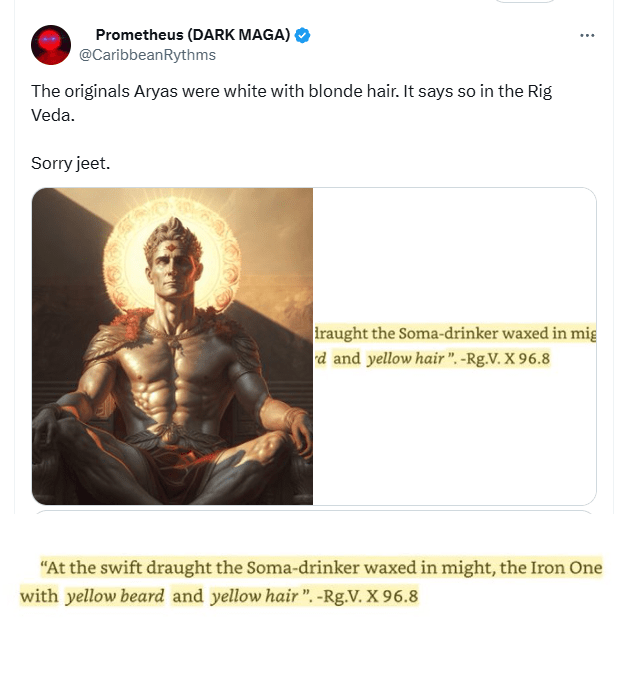
I’ve seen this RigVedic verse – RV X 96 8 – come up several times in the past few weeks; quoted (in English only) by persons seemingly looking to assert that Indra was purportedly in possession of both hair and beard of blond, in the manner of some rather particular stereotype of Northern European (or, as here [the tweet screencapped above], “white” – and one wonders where that term is supposed to be found either in the translation or the original).
Suffice to say – this is not what the verse is actually conveying. And if one were to take the rather radical step of actually reading the Sanskrit text, a rather different picture would emerge.
We’ll start with one crucial word – “āyasas”. Which Griffith, there, as you can see, has chosen to render as “Iron”.
Curiously, the same people who seem absolutely insistent upon “harikeśa” (the preceding word in the verse) being taken as (literal) blond (human) hair, and therefore as some form of physiognomic / phenotypical descriptor for the Vedic Aryas … don’t appear to be nearly so vehement as to “āyasas” being interpreted likewise. Wonder why.
Now whilst Griffith has translated it as “[of] Iron”, that isn’t what “āyasa” should be understood to mean during the time of the RigVeda.
Instead, it would be (of) ‘Bronze’ or ‘Copper’ (in-line with Latin ‘Aes’ – ‘bronze’, ‘copper’; Proto-Germanic – *Aiz(a) – ‘brass’, ‘bronze’, etc.) – this is, after all, a Bronze Age text; and whilst Iron *does* turn up attested in later Vedic texts, it tends to be specifically demarcated as “Black / Dark Metal” (‘Kṛṣṇāyasa’, ‘Kārṣṇāyasa’, ‘Śyāmayas’). The root to “āyasa”, ‘ayas’, only comes to refer to ‘iron’ by default (or, for that matter, “steel”, upon still-later attested occasion) as the corresponding material culture of the Aryas itself shifts to make such the most commonly encountered / thought of metal – rather than the ‘bronze’ or ‘copper’ which had been predominant in the earlier era.
But why does that matter?
Well, consider what Bronze or Copper are. They’re ‘metallic’, yes (which renders them ‘shiny’, ‘lustrous’) – but they’re also orange, or somewhat close thereto. Which is why one finds such utilized as a pretty good figurative term for Fire. (Indeed, Kroonen makes the interesting supposition for the metallic PIE *h₂éi-os that underpins Sanskrit ‘Ayas’, Latin ‘Aes’, Proto-Germanic *Aiz(a), as itself potentially coming from PIE *h₂ei- – ‘to burn’; one also observes within Homer the phrasings such as ‘αἴθοπι χαλκῷ’ [Il. V 562 & 681], rendered by Murray as “flaming bronze” in relation to panoply of war, etc.)
And hence we are unsurprised to find ‘Ayas-‘ to be utilized elsewhere to poetically evoke ‘Fire’ – the association proving prominent enough for several Sanskrit dictionaries to simply list ‘Fire’ there as a meaning for ‘Ayas-‘ quite directly.
So, this “āyasas” ought be read not as “[of] Iron” in the manner of Griffith’s rendering (Indra as “Iron One”); nor the “Made of Metal” proffered via Jamison & Brereton’s modern translation.
It should be interpreted as Indra, here, proving “[made of] Fire”.
That is – Indra having been invoked into and thence appearing as the Living Fire at the justified heart of the Vedic sacrificial rite.
Hence – with a sidereal presence (i.e. ‘down here’, amongst us) which is, indeed, “[made of] Flame”.
Where am I going with this?
Consider a candle-flame.
What one would perceive there is for the lower section around the wick to be of a darker shade of light, running ‘brown’ through to ‘orange’. Bronze-ish and/or Copper, in other words.
Above?
We move to the decidedly more ‘golden’ hues.
Which, should one ‘scale up’ the fire in question from a relatively small candle-flame through to the potentially quite sizeable blazes of the Vedic Yajna … not only brings these colours into more readily visible occurrence (there being more to see for the ‘bronze’ sector due to the broader base of the flame, and across more area in light of its much grander height); but also features, in contrast to the single (and relatively stable) ‘blade-point’ of the candle-flame, a much more ‘wavy’ (frequently – ‘billowing’) presentation for the fire’s decidedly yellowing upper ‘edges’.
Rather like, you might say, ‘hair’.
That is, per the verse – “Harikeśa” , or ‘Golden Haired’ / ‘Golden Maned’ (‘Kesha’ being Long Hair most particularly – c.f., for instance, the root’s use in ‘Vikeśī’ when referring to the ‘plume’ or ‘tail’ of a comet).
But what of this term rendered as “Yellow Bearded” (“Hariśmaśārur”) ?
That is somewhat more complex, due to the relative rarity for “śmaśāru”. I’d personally wondered if it bore some relation to Śmaśāna – i.e. ‘cremation ground’ , and funnily enough, Prof. Mayrhofer (in his Kurzgefasstes Etymologisches Wörterbuch des Altindischen) acknowledges such a prospect [viz. ‘Śmaśa’]. There is a potentially interesting tangent-hole to go down in terms of what might actually be the underpinning sense of meaning to the term … but just this once, we shall refrain and simply acknowledge that yes, it’s now interpreted for this verse to mean ‘beard’, although it also carries within it a seeming implication of the channel down which an offering or libation is supposed to go.
Meanwhile, if we flip over to the next line [RV X 96 9], we hear of “śipre […] hariṇī ” – i.e. gold/yellow lips (it’s dual case) to receive the offering [into the Fire].
This is effectively what underpins the ‘Beard’ inferred conceptry.
Hence why said “lips” are also described at the start of that same verse as “sruveva” (“sruva” + “iva”) – ‘as the sruva-spoons’ , the Sruva spoon or ladle being utilized to pour ghee for the libation into the Living Fire.
Which is, after all, where the God has emanation into for exactly this purpose (i.e. to receive the offerings made unto He).
Phrased more directly – the verse this guy is quoting is describing Indra in / as the Fire of the Yajna, as libations are made to Him.
Hence why He is described, as we have seen, with this ‘shiny’ bronze/copper ‘body’ and ‘golden’ peripheral / offering-receiving extensions.
People misuse this verse by attempting to insist upon a literal reading for parts of it – but only as it suits them.
Hence we have “literal” Hair … but not literal Bronze/Copper (or Iron for that matter) body.
And yet, even though we find ‘lips’ in the very next verse – for some reason they never seem to cite this bit for “Vedic Arya” physiognomy.
Perhaps because they realize that saying “Indra has Spoon-Lips” , ‘golden’ or otherwise, does not sound so very convincing. Or perhaps because it does not sound very ‘Northern European’.
Now I hasten to add at this point that not everybody who indulges in this kind of contemplation is out-and-out some kind of bad-faith (in multiple senses to the term) actor who is merely out to try and via hook or crook claim that the archaic Vedic canon of texts and the religion to go with is part of their directly-ancestral clade of Indo-European descendance and somehow not to do with the actual, literal descendants of the Vedic Aryas who’ve successfully kept those rather literal fires of tradition burning for some three-and-a-half millennia or more and counting.
Not everybody questions translations as they are presented, simply out of hand; and it is entirely possible to pick up the Griffith rendering and read it ‘as-is’ as presenting Indra as being of ‘golden haired’ etc. description. Which does not, of course, axiomatically lead one to the presumption that He bears some overt resemblance to a certain placenta-obsessed Black Metal musician (whether “Kṛṣṇāyasa”, or perhaps “Grishnackhayasa”, or otherwise), in physiognomy or otherwise. (Although in light of the ritual equivalency attested at RV X 86 for a certain ‘Monkey’-visaged deific-expression, perhaps somebody shall instead suggest a ‘Super-Saiyan’ styling for the ‘Golden Hair’ instead)
One point we have often found ourselves reiterating is that “Scriptural Literalism Leads To Bad Theology”. Indeed, one might quite fairly suggest it to be a significant step upon the road to Euhemerism – i.e. the decidedly aggravating insistence that figures of theological salience are not, in fact, anything of the sort … but rather simply human (or otherwise physical-material and mundane) figures and phenomena which have become ‘mythologized’. Although, that said, it takes … rather more than ‘literalism’ to arrive at some of the more ‘outlandish’ propositions along such a trajectory (and certainly upon a spectrum) as declaring various things to ‘in fact’ have been about the placenta.
Indra is a God, not a human. And whilst one does encounter such ‘mesocosmic’ saliencies within the Vedic textual and ritualine canon wherein a human is to be identified with Indra (for instance, the human king Trasadasyu co-identified with Indra(and Varuna), assumedly due to ‘imbuement of essence’ in the course of coronation – interestingly, the relevant RigVedic hymnal featuring ‘Ardhadeva’, or ‘DemiGod’, to describe the resultant situation. More broadly, one thinks of the SBr’s attestation for Yajurvedic operational undertakings wherein the leading Priest ‘acts as’ and ‘steps into the shoes’ (so to speak) of Indra – with that human priest therefore referred to as such in the ritual manuals, accordingly), these are cases of a human being identified with Indra … not a case of Indra being identified (merely) as a human being.
It is not – necessarily – unreasonable to suggest that Gods may appear not simply ‘in human form’, but in manners which deliberately recall a particular human culture or station within said culture. A very good … extended suite of exemplars for this may be rather easily found via consulting the Sri Rudram (also of the Yajurveda), wherein one does indeed find quite the extended list of various ‘human-styled’ appearances which Rudra(s) may be thought of and/or encountered as / in relation to. Along with trees, as it happens (something in definite occurrence for the Sky Father elsewhere – exemplars for Odin and relevant Classical deific expressions spring instantly to mind) – and certain terms which are also utilized in later Sanskrit occurrences to designate rather ‘non-Arya’ groupings out there upon the ‘fringes’ of the Vedic sphere. These latter sorts being utilized by those who wish to try and argue for a non-Indo-European situation of Rudra, without having considered that the ‘symbolic register’ in question is intended to connote a ‘barbaric’ and ‘wilderness hunter’ sort of saliency rather than ‘is literally a figure incorporated from the non-Arya & non-IE religion of such-and-such-a-group’, as we have explored somewhat elsewhere with reference to the Kirata.
However, the presumption that Gods are – even, and perhaps especially, when ostensibly spoken of with ‘human’ sounding characteristics – to be regarded as simply presenting through Their hallowed features only some sort of an ‘archetypal’ image of a given people’s human phenotype … is, as I say, quite clearly ‘bad theology’ – often undertaken in decidedly ‘bad faith’ by those whose interest is not really ‘theology’ at all, but rather to seemingly compulsively look to plunder therefrom in pursuit of the construction of a ‘racial mythology’ which bears precious little resemblance nor resonance to either the authentic religion or actual Bronze Age (or prior / subsequent) history / ethnology.
(And not least because it tends to involve these sorts seeking to lay claim to whatever they so happen to like from Indo-European spheres which are not those of their own direct forefathers – but instead, what would be the heritages which are as ‘cousins’ or (great-) ‘uncles’ to them. Whilst both chiselling these elements out from their actual operative and mythic contexts in order to make these more comfortably ‘fit’ whatever it is they Want To Believe Anyway; alongside endeavouring to spuriously displace those whose (actual, direct) ancestral sphere(s) are involved as purported ‘squatters’ who’ve somehow entirely ‘illegitimately’ managed to keep things alive and operating across the span of millennia. Quite a different prospect from a European who genuinely wishes to engage with the Hindu facing to an IE deific in the proper and respectful manner !)
This puerile attempted-enforced ‘reduction’ of theology down to barely-even-19th-century-pseudo-anthropology is not a phenomenon confined to Indra, India, and that most illustrious of sought-for terms, “Arya(n)” – I have, myself, observed self-proclaimed adherents of certain latter-day iterations of mid-20th century ideological currents attempting to insist that Poseidon was somehow not an Indo-European deific, on grounds of His being described as ‘Κυανοχαίτης’ (‘Kyanokhaites’ / ‘Kyanokhaitis’ – Dark Blue/Black Haired; ref. Theogony 278, Odyssey IX 536, Iliad XX 144, and in that vocative formulation, κυανοχαῖτα, at the first line of His Orphic Hymnal [16/17 1]) rather than ‘blond’. Which is … not only incorrect (as we can rather readily demonstrate via the relevant comparative IE theological elucidations), but fairly blatantly ‘missing the point’ as to why said hailing features in the first place.
That ‘χαίτη’ (‘Khaite’) word utilized for ‘Hair’ there (which is, as it happens, a cognate for Sanskrit ‘Keśa’ / केश , the term in-use for Indra’s Hair in that ‘wavy’ manner we had alluded to above for the relevant RigVedic verse), is similarly one for (per Liddell & Scott) “loose, flowing hair” or “long, flowing hair” (and, potentially, tree “leaves” or “foliage” – as it is also used for viz. Shiva in the Sri Rudram [VS XVI 17 / TS IV 5 2] … as a Tree : ‘Harikeśebhyaḥ’ being a form of the very same ‘Harikesha’ word utilized for Indra in RV X 96 8, no less ! ‘Hari-‘, there, in more of a ‘green-gold’ dimension unless Autumn is, perhaps, implied), with Beekes additionally specifying “curly hair, loose flowing hair” into the bargain.
Poseidon being Lord of the Sea, it might, perhaps, make some sense for Him to be hailed through a term for something which is ‘dark blue’ (‘Kyano-‘) and ‘wavy’ (‘-khaites’); the Sea being archaically correlate with Sky in Proto-Indo-European conception (hence why we’ve got a Sky Father deific expression in charge thereof per the Hellenic and Roman iteration(s) descended thereof; and c.f. VS XXXVIII 7, wherein the text seems to present such an equation most directly viz. Vata & Samudra, etc.), you can basically parse this also in-line with the Roudran hailing of Vyomakeśa (‘Vyoma(n)’ meaning ‘Sky’ / ‘Aether’ / ‘Water’ / ‘Wind’ / ‘Atmosphere’). One also finds an array of ‘hair’ style hailings utilized for Hades, Dionysus, & Zeus – and of similarly ‘symbolic’ potency. But I digress. This is, after all, supposed to be a work about the Sky Father’s Son’s ‘Hair’ – and in one particular Vedic, rather than broad Hellenic, attestation.
So, to return to that most specific context immediately aforesaid [i.e. RV X 96 8], and Indra’s (literally) ‘evocative’ description encountered therein … as we have seen already, the liturgy in question is describing Indra figuratively. In that it is utilizing both words for metals and words for (often-)human features, in relation to an offering-fire – which is, for the purposes of the rite and the liturgy thusly involved, where Indra is and what He is to be observed as herein.
The extent to which this would therefore express what Indra might be like in other circumstances, contexts, and Form(s) He might choose to appear in … is therefore perhaps surprisingly not as axiomatic as one might otherwise suspect.
And, as applies the sentiment of the person whose tweet kicked off all of this … the extent to which the descriptive elements housed therein might seem to therefore be directly applicable as describing the worshippers of Indra at that time (in literal, human-physiognomic terms) is even more limited again.
Unless, of course, one seriously wishes to proclaim that the Vedic Aryas of old were quite literally men on fire.
Spiritually, yes – and it is certainly something aptly resonant in that regard … and not least as it is a fire which has never gone out.
But literally, in the manner being advocated for here?
File it with the Trees likewise being purportedly ‘Northern-European’ (human) in phenotype, upon exactly the same basis of Harikeśa in elsewhere Vedic attestation.
And then make very sure you don’t happen to see the ‘wood’ for them – the bark, after all, being often of a shade that’s rather ‘Babhru’ (‘Brown’).
 arya-akasha