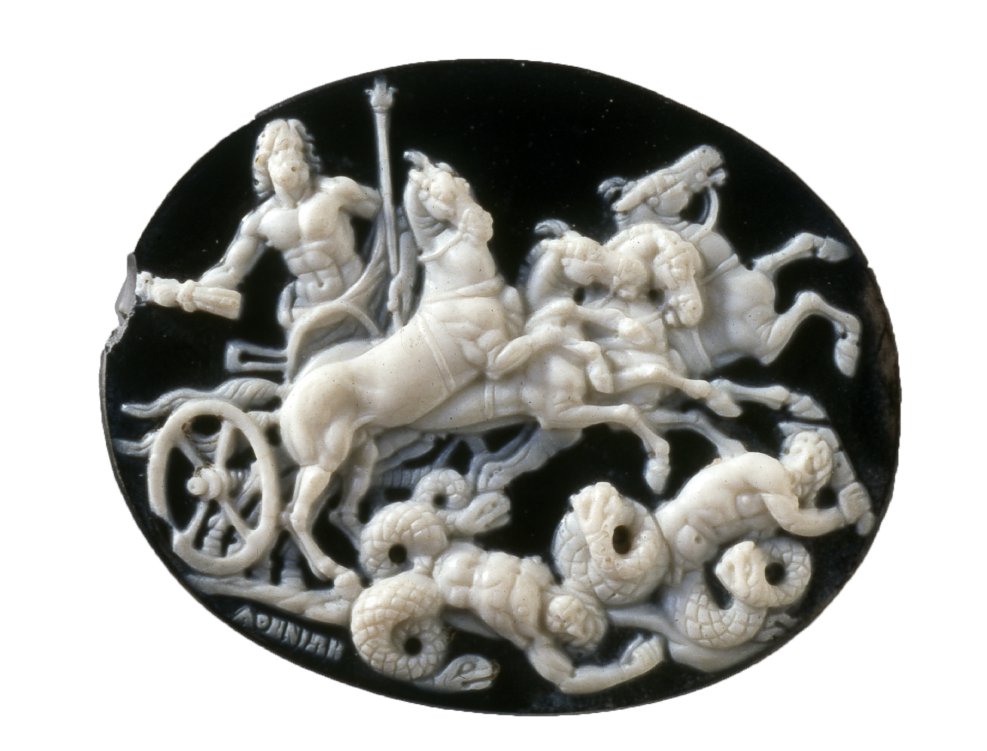
We had earlier received a question as to the iconography of the Gigantes of Classical myth – more specifically, what was up with the Serpents they so prominently feature instead of legs in an array of renderings.
And, because it’s a very, very cool illustration for the concept – here’s a beautiful 2nd-3rd Century (BC) cameo of Athenion (you can see the signature down bottom left) which depicts Zeus in a war-chariot, preparing to electrify the Gigante(s) that He hasn’t already run down.
As we’ve previously pointed out, the mytheme of the Indo-European Sky Father engaging in a suite of demon-dragon-slaying is a pervasive one – and there’s often not just one but several occurrences which can be pointed towards in various of the relevant IE spheres.
Some of these (as with Zeus contra Typhon, or Brihaspati against Vala … or Odin against the wyrm of the Nigon Wyrta Galdor [‘Nine Herbs Charm’]) have the adversary as being fairly directly ‘Serpentine’ / ‘Draconic’.
Others are cases wherein the situation is, perhaps, a little more ‘inferential’ – although not unfairly presumed via the constellation for other materials (Rudra (Śarva & Bhava) as ‘vṛtrahaṇā’ at AV-S IV 28, Agni at RV VI 16 34, etc.; Odin in the Ynglinga Saga undertakes a deed clearly correlate with Brihaspati’s – only the ‘obscuring / covering’ Dragon has been reduced merely to a weight of earth via euhemerism or questionable transmission/comprehension in relation to the name; that situation viz. the Fenris Wolf, due to the pointed ‘overlap’ of ‘wolf’ and ‘serpent/dragon’ terminology, as we had covered elsewhere, ought also count in terms of the underpinning nature to the adversary).
And in other iterations still, one observes that the demon-slaying(s) in question do not seemingly feature an overt draconic / serpentine characteristic to the adversarial figure(s), yet nevertheless bear other essential characteristics that serve to typologically link them to certain of those conflicts aforesaid. (Exemplars for this including Ymir as slain by Odin (et co.), and the Tripurantaka deed of Rudra – this latter exemplar proving rather salient here due to the Winning of the Three Worlds which are accomplished therethrough).
Now, our purpose is not to delve into those combats but briefly mentioned above. We’ve done that – to a certain extent – in various works over the past more than a year (consider last July’s ‘On The Sky Father As Dragon Destroyer‘, for instance), and with others that are still being conjured apace as we speak.
But it did seem important to reference the constellation of other occurrences afore looking to consider the ‘Anguiped’ style of iconographic rendering for the Gigantes that we’re ostensibly here for tonight.
Now, the first thing to be observed about it is that it’s actually a comparatively ‘late’ attestation as applies the (visually attested) iconography of the Classical world – which does not, of course, mean that it’s necessarily only a comparatively late development as a concept (and not least because we’ve got earlier Typhon depictions which appear to presage the style to varying degrees) , although it should also be observed that earlier physical renditions for the Gigantes would often appear to have simply gone with the more ‘conventional’ anthropomorphic approach.
After all – when it comes to demon-dragon figures elsewhere attested, particularly towards the East, the adversaries in question often seem rather more ambiguous in their shape : depending upon text, circumstance, and interpretation … one might quite readily encounter Vrtra, for instance, as ‘Serpent / Dragon’ and/or as a more human-style figure.
Considered in these terms, then, the serpent-legged styling exhibited in these forms for the ‘Gigantes’ could simply be the straightforward expression as to such an ‘ambiguity’.
Except that doesn’t quite track. After all – there’s pointedly not simply a ‘serpent-tail’ instead of legs, but instead two serpentine-appendages … and, more intriguingly, with two snake heads involved rather than two snake tails as one might, perhaps, have anticipated were ‘conventional biology’ something anybody had thought would prove more than a perfunctory afterthought.
So what’s going on here?
Well, ‘Tricephaly’ is a fairly well-attested characteristic for the adversarial figures to at least certain for the Divine.
The mind instantly goes to Trisiras (opposed by Indra, albeit slain by an associate to ‘take the blame’) – whose name quite literally means just exactly that [the ‘Three-Headed’] – and who is the ‘elder brother’ (slightly figuratively – long story) to Vrtra & Vala. The latter two being serpentine / draconic, the first of the three … not.
One also encounters the Hydra, per various tellings, to likewise be at least somewhat a ‘Tricephal’ opponent to Herakles / Hercules (slain by an associate). And, in these cases, the Heads are either encountered in multiples of Three (six headed and nine headed examples are to be found in visual and textual attestation), or possess some other ‘triple’ salience – cut off one, two appear (Servius, meanwhile, in his comment upon Aeneid VI 287, has the Hydra regrowing three heads at a time – as Ogden notes, a surefire way to keep the ‘triple’ head characteristic going). The concept of one ‘immortal’ head central amidst the nine [ref. Apollodorus’ Bibliotheka II 5 2] might, perhaps, link to a face amidst the three of Trisiras – and the later account of the decapitation for Trisiras leading to avian emanations … well, that’s another Greek myth for another time.
One might also make reference, albeit of non-serpentine primary description, to Herakles / Hercules’ adversaries, Geryon (of ‘triple body’; although Hesiod has it instead as “τρικέφαλον” (Tricephalon), at Theogony 287) and Cacus (Propertius having this as a seemingly three-faced figure).
Ladon, meanwhile, also starts showing up with three heads in mid-1st millennium BC iconographic presentations (admittedly, with single and dual headed occurrences also found); Statius in his Thebaid [I 565] has the Python in possession of a triple-set of jaws; and the Cetus encountered by Hercules is depicted by Valerius Flaccus [Argonautica II 500] as similarly “trisulco”. And there is also a rather prominent Zoroastrian complex that we shall scrupulously avoid delving into.
Except what does it mean? Various of the foes aforesaid are basically Striker/Thunderer adversaries (the Python’s the exception there). We’re seeking to look at a Sky Father opponent. Or, to be more accurate – we are seeking to look at a more generalized clade of foes fought by The Gods (Collective).
So sure, on one level, one might not entirely unreasonably contemplate the notion for the Gigantes as being i) ‘tricephal’, and ii) ‘serpentine’ as being a simple case of ‘because that’s what prominent adversaries well-known from the ever-really-popular tellings of the Striker/Thunderer’s Deeds have’.
But that would, again, be rather ‘missing the point’ in terms of the ‘why’ dimension.
And as for which … I suspect it to (potentially, at any rate) prove rather simple.
Consider the ‘nature to the problem’. That is – that which gets solved in various of those occurrences via the Divine Victory.
What is it? Demons overrunning the Worlds.
How many Worlds?
Well, in archaic / underpinning Indo-European cosmological terms … Three.
Tripurantaka, right? The Tri-Pura (i.e. ‘Three Forts’) in question being One per World and thus encompassing a totality of ill-expressing, twisted ‘dominion’.
So, one ‘head’ per World.
It’s certainly something which would plausibly ‘resonate’ as applies the recurrent motif of, say, the rather ‘titanic’ scale to the problem of Vṛtra – wherein the Bṛhaddevatā annotation for RV VIII 100 12, for instance, makes clear that the ‘enveloper’ in question has managed to encompass the truly incredible spread of the Three Worlds. And in later Pauranika translations, one does encounter references to the notion of Vrtra being poised to devour the Three Worlds, assumedly due to the scale of his maw stretching all that way from the plane of the surface of Earth up through to High Heaven.
Something which, to be sure, the Fenris Wolf should seem equipped to match per Gylfaginning 51 (“en Fenrisúlfr ferr með gapandi munn, ok er inn neðri kjöftr við jörðu, en in efri við himin. Gapa myndi hann meira, ef rúm væri til. Eldar brenna ór augum hans ok nösum.”). Which, other than featuring the suspiciously draconic notion of fire from the nose, also features immediately afterward, young Vídarr doing something vaguely along the lines of Vishnu’s Three Worlds’ Encompassing stride, stretching from Fenrir’s lower jaw with one foot, to reach the upper jaw with His Hand.
Which should not be read as my suggesting that the situation viz. Fenrir is effectively simply the same one as that of Vrtra – Jormungandr is, after all, right there. However, whilst on the one hand, one might contemplate the ‘positional’ relationships of Vidarr to Odin relative to Dyaus and a certain Son thereof that’s rather integral in the vanquishing for a certain Dragon Problem … as I say – both the Striker/Thunderer deific and the Sky Father deific have Their demonic adversaries to vanquish. And perhaps some things have become more ‘conmingled’ in various manners when we get down to that end of the IE spectrum (the Nordic canon of texts being, after all, coming to us from a millennium, two millennia and more, subsequent to the Classical and the Vedic spheres’ presentations for things; and also in much more … trying conditions – post-Christianization, for the most part, for a start, and with potential misinterpretations even where textual elements are clearly of an older provenance, as we have demonstrated with regard to Thor, Jormungandr and the Voluspa account, previously)
The most interesting dimension, though, being that the ‘fight-back’, so to speak, in that case begins from ‘down here’. Something which most definitely should find viable resonance in both Hindu and Hellenic legendaria – as applies the latter, drawn chiefly from the Bibliotheca of Apollodorus [I 6 1, continued in the next two sections], which provides probably the most detailed textual recounting for the Gigantomachy to have come down to us from the Classical IE spheres. It becomes even more useful when (read in alliance with various other materials, such as Ovid’s brief detailings in Metamorphoses I, etc.) we seek to align that which we know from said Bibliotheca with what we have from Vedic recountings.
One brief instance – as I had not intended to dwell too much upon this at this point and only do so now to set up the earlier matter to which I had alluded just above – concerns the annotation given therein for the Gigantes hurling ‘rocks’ and ‘ignited trees’ at the Sky [“ἠκόντιζον δὲ εἰς οὐρανὸν πέτρας καὶ δρῦς ἡμμένας”] … something which – to my mind, and given various other ‘translations’ between ‘Vedic’ and ‘Hellenic’ / ‘Classical’ where these signifers might be utilized as well as certain interior-to-Vedic ritual resonancies, should appear to stand for weapons akin to Thunderbolts being deployed. By the Gigantes. And if that sounds outlandish – well, funnily enough, Taittiriya Samhita VI 2 7 & VI 4 6 1 present the A’Suras wielding Vajra weaponry in their attempts to depose the Gods.
The latter account is of chief interest to us, as it renders things fairly expressly. To quote from the Keith translation:
“Whatever the Gods did as the sacrifice, that the Asuras did. The Gods saw that the sacrifice must be established in the Upançu (cup), and They established it in the Upançu. The Asuras grasping the Thunderbolt attacked the Gods; the Gods in fear ran up to Indra, Indra obstructed them by means of the Antaryama (cup), and that is why the Antaryama has its name, ‘the obstructor’. In that the Antaryama cup is drawn, verily thus the sacrificer obstructs his foes. ‘Through thee I interpose sky and earth, I interpose the broad atmosphere’, he says; verily with these worlds the sacrificer obstructs his foes.'”
[TS VI 4 6 1-2]
Now, to explain what’s going on there – this is an expression of a somewhat pervasive typology of Vedic ritual explication and occurrence. Namely, that of a ‘Ritual Combat’ (well, Combat by Rite) undertaken by the Demons in would-be toppling for the Gods. Who also undertake Rites – or have a designated Champion / Priest do so for Them.
That pivotal figure being, as it should happen, a God (Agni, for example) when the Mythic ‘Template’ or initial / foundational occurrence is to be referenced – and a human priest acting in a rather ‘mesocosmic’ point of syzygy with the Divine more broadly beyond that. And I do say ‘more broadly’ – because the Vedas are, ultimately, ritual texts – and so we encounter quite an array of ‘operationalizations’ for the ‘core’ mythic conceptry thusly utilized, particular individual and identifiable myths (let alone mythemes) coming up multiple times in different variations and to different intended ritualine purposes even within the course of the same Samhita or Brahmana or even Rite.
And, speaking of this human Hero-Priest in question … well, you see, in that aforequoted Taittiriya Samhita verse, the name (for the ‘position’, so to speak) is given as Indra. This is corroborated by, for instance, SBr III 4 2 15 (from the other often-quoted Yajurvedic tradition, and as it happens, in that case, drawn from the Tanunaptra ritual cycle which forms direct correlate for Zeus’ efforts during the relevant phase to both Titanomachy and Typhon-overpowering), wherein we quite expressly find that the Yajamana – the Sacrificer, the (Human) Priest – is Indra (as in – this is not a mythic presentation for the Divinely-undertaken archaic ‘template’ to the rite … this is directly stated in the course of the ritual instruction for the ‘sidereal’ (re-)performance of this by human operators. Or, in other words – it is NOT that Indra is a / the Sacrificer, a Priest … it is that the (again, human) Priest is Indra. [and c.f. SBr V 1 4 2, V 3 5 2 & 27, V 4 3 4; TS VI 1 11 1; for some additional examples – including the King within the majority of those SBr additional exemplars acting as Priest, and in various cases, hailed as Vrtra-Slayer also; c.f. our work upon the ‘Demigod’ / Ardhadeva concept elsewhere] )
It is not hard to see the obvious point for resonancy with Apollodorus’ account. Insofar as what we are presented with therein is, per the Frazer translation:
“Now the Gods had an oracle that none of the giants could perish at the hand of Gods, but that with the help of a mortal they would be made an end of.”
Who is that ‘mortal’ ? Herakles. The most famous ‘Demigod’. And also, not at all coincidentally, an expression of the Indo-European Striker/Thunderer deific – just as is Indra. Indra, whilst not being a Demigod (no matter what some errant Hare Krishna types might try and sell you), is as we have observed, both i) the identification for the (human) priest in the particular Vedic ritual schemas above, and ii) a figure that already has quite the ‘overlapping’ saliency for God and Mortal – that ‘Ardhadeva’ [‘Half God’] concept being most particularly exhibited via the well-renowned figure of Trasadasyu in the RV, a human who was, it should seem, ‘imbued’ with some measure of the ‘essence’ of Indra (and also, interestingly enough, Varuna). (Intriguingly, as a brief addendum, the Scholiast upon Nemean Ode I at 101 has not only Herakles – but also Dionysus – in attendance as ‘Hemitheoi’, that is to say ‘DemiGods’; and one also encounters the same term utilized by Hesiod in his ‘Works And Days’ [159-160] to describe the entire iteration of humanity immediately preceding the present one and subsequent to the Race of Bronze – the ‘Hemitheoi’ (and ‘Hemithea’ in the feminine), as Bremmer observes, in various of its early textual occurrences not indicating “literally the offspring from a God and a mortal”, and only later acquiring the notion of “intermediate category between Gods and mortals”, with Isocrates.)
And so, when I had earlier exhorted that “the fight-back […] begins from down here” – I had meant just exactly that. That the essential contribution when it comes to various of these (yet ongoing) anti-demonic war-efforts is not only to be identified amidst the flashing celestial champions of the Divine up there … but also, significantly, in the form of humans (I would not say ‘ordinary humans’) undertaking various forms of active contribution which reach into this ‘mesocosmic’ sphere to bolster the Above and even directly strike at the foes, as well. Something which we can prove via an analysis (… in another as-yet unfinished work of mine, don’t worry) of relevant IE legendaria wherein in the deliberate absence of this … well, the Side of the Gods therefore is forced to fight with one proverbial hand tied behind its back, and does not do so well as pointed result.
In any case, further attestation that there is a decided ritual dimension to the Gigantomachy’s essential combat can be most readily adduced via the manner in which various elements which show up in the mythic side of things, done by various of the demons (Gigantes) or Gods in reaction thereto … are directly (or closely inferentially) coterminous with what we observe in Vedic ritual operationalizations.
The most overt of these (for I shall spare the reader the detailed examination of the others – for now, at any rate) presumably being the situation of the Gigantes engaged in ‘mountain-piling’ in order to assail Heaven [Ovid has this at Metamorphoses I 151 onward; Fasti V 35-42] – something which, I’m sure, somebody shall object to as being ‘properly’ the deed of the Aloadae (and notwithstanding the ‘Ephialtes’ that turns up attested as a Giant, etc.; or, for that matter, Gantz’ reasonable speculation as to the ‘overlap’ already being in iconographic attestation by the late 400s BC). There are various occurrences for the correlate scenario in Vedic texts – most particularly, SBr II 1 2 13 onward and Tait. Br. I 1 2 4-6 (and, for that matter, Maitrayaniya Samhita I 6 9, Kapisthala Katha Samhita VI 6); with Eggeling’s own footnoting to his translation for the SBr quoting a Dr A. Kuhn (in translation – from German, this time) as observing the parallel to the efforts of the Aloades [as recounted at Odyssey XI 305-325] and Gigantes [per “the well-known passage of Ovid”].
What was the parallel? The construction of a Vedic fire-altar from Bricks. Something fended off via the hurling of another such Brick by Divine Hands – this one being of Thunderbolt potency. In the SBr & Tait. Br., the occurrence is specifically keyed to the Chitra nakshatra (and its War Rites). And we would observe with some interest the dual saliency of Divinities for the Nakshatra in more general terms – Indra and Tvastr. The occurrence for Tvastr, of course, leading one to contemplate also that son of Tvastr slain by Indra et co, Trisiras (‘Three-Headed’), who had utilized his priestly positioning to side (insidiously) with the Demons.
One might also make mention for, as applies the SBr II 1 2 13 onward occurrence, that detail that the fire-altar / ritual operative structure which was undone by Indra, was termed “rauhiṇa”. Eggeling has this as “fit to ascend by” for meaning, albeit that is inferential and marked in parenthesis. A more direct meaning would likely be something descended from Rohini. And there are several potential lines of supposition we might advance as to just what such a linkage might entail for the demonic undertaking in question, when situated in our comparative Indo-European context, given both the usual identification of Rohini and the ‘Cows’ association (as in, looking to be obtaining such) for the Altar set up under the asterism per the SBr’s guidance a few sections aforehand at II 1 2 6-7.
However our more immediate contemplation concerns the “Rauhina” encountered at RV II 12 12 – to quote the relevant section to the verse per the Griffith translation: “Who, thunder-armed, rent Rauhiṇa in pieces when scaling heaven, He, O ye men, is Indra.” Sound familiar? One might also seek to add RV VIII 14 14 (c.f. AV-S XX 29 3), which, per the H.H. Wilson translation – “You have hurled down, Indra, the Dasyus, gliding upwards by their devices and ascending to heaven.” The “Devices” in question being “māyābhir” (c.f. Ferenc’s speculation concerning the “adevīr […] māyāḥ” of RV VII 1 10 in relation to this, that meaning “Ungodly Magic” – or, as H.H. Wilson translates it, “Impious Devices”; perhaps Against-Gods Magic?), and with this quite viably pertaining to just such a ‘parallel rite’ structure to the orthodox and legitimate (pro-Divine) operation of sacrifice for which bricks would usually be laid (and c.f. therefore, the next line – RV VIII 14 15, wherein it is pointed that the assemblage in question had offered no libations [“asunva”] to the Divine.
Yet our chief interest is in the term utilized to detail the Dasyus’ attempted ascent to the realm of Heaven that has been (almost) accomplished therethrough – “utsisṛpsata”. Why so? It’s built from that most particularly pertinent of rootings: “sṛp” – a verb, and a cognate for Latin “serpo”, Ancient Greek “herpo”, and so forth. To make it more obvious what it means – “Sarpa”, “Serpens”, “Serpent”, “Herpeton”, are all from the same PIE root and also closely correlate both with their verbal forms in the respective IE languages and with each other.
One often encounters “sṛp” forms rendered as (to) crawl, or (to) glide … yet I would suggest to slither to be rather apt here [it is, indeed, the verb utilized elsewhere in the SBr etc. for most pointedly ‘serpentine’ resonancies as to ritualine motion, as we have extolled elsewhere]. Particularly with the prefix “utsi-” being utilized – the sense is akin to that of a serpent climbing its way up a tree almost in a rather ‘binding’ fashion.
Or, to make the whole thing a bit clearer … we have these enemies of the Gods undertaking through metaphysically empowered means to assail the Heavens through attempted-ascending toward that Realm, plausibly with the piling of altar-forms to be thusly involved (afore being cast down by Indra) … and the style for locomotion of these adversaries is, apparently, serpentine.
Perhaps one might contemplate the rather more literally ‘serpentine-gaited’ Greco-Roman ‘Gigantes’ that do … well, pretty much exactly That, afore their encounter with Herakles / Hercules et co.
In which case, the iconographic renderings of the Classical IE sphere(s) of this nature are, themselves, ‘carrying forward’ one of those very archaic (Proto-?)Indo-European religious concepts.
It should hardly prove the first time.
 arya-akasha
Pingback: On The Symbolism Of The Gigantes & Gigantomachy [Part One: He Shall Tread] – Glyn Hnutu-healh: History, Alchemy, and Me