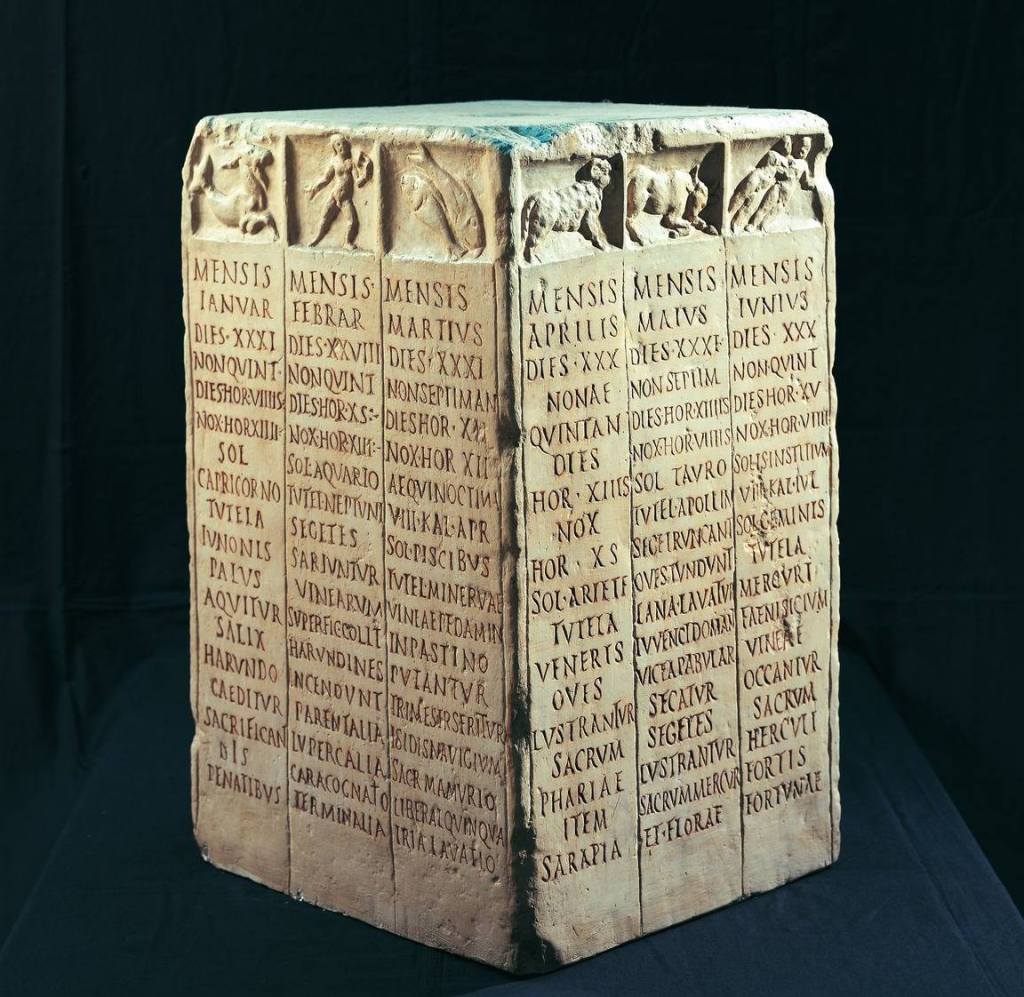
It always amazes me, seeing a sentence like “According to ancient Roman farmers’ almanacs, Juno was mistaken as the tutelary deity of the month of January, but Juno is the tutelary deity of the month of June” being bandied about the place.
Not simply because it’s – itself – frankly incorrect, but because it has some modern commenter presume to know the relevant traditions and theology of the Romans better than the Romans themselves (also projecting via its citation of Scullard’s scholarly text for this claim, something which simply isn’t there, either).
And hence we find ourselves in the present position wherein some words fired off upon Wikipedia (the source for the above quote) apparently carry more weight than a literal block of marble engraved almost two thousand years ago with the attestation to the contrary (this being the Menologium Rusticum Colotianum, a replica of which is in the picture below). Which then spreads like some ex-cathedra contagion across the infosphere, springing up as proffered ‘insight’ seemingly almost everywhere one might go (other than back to the actual source-materials) to exercise a curiosity (i.e. twitter, reddit, quora, &c.) – a situation only exacerbated (indeed, in terms of impact, likely outright superceded) via the contribution from that recently arrived synthetic ‘colleague’ of these more analogue ‘annotators’, the ‘AI Overview’ function of Google, which just bluntly asserts Janus as tutelary deity for January right there beneath the search-bar before one even gets into the search results.
There are several points to be made here, in terms of correcting the record.
The first, of course, being that you can have a Month being strongly associated to a given God (even bearing the name directly resonant therewith) … and another Deity ascribed the position of Tutelary to said Month, as well. Just look at March – the ‘Mensis Martius’ (‘Month of Mars’) – which, as its Tutelary, has Minerva (as you can see mid-way down our big marble block of attestation here, on the right hand of the three columns on the left). There is no contradiction nor contraindication within this – indeed, it is exactly as it should be, in light of the underpinning archaic Indo-European theology (wherein, just as with our (Hindu) Chaitra NavRatri – there is the Goddess … and there is the God ‘brought forth’ therethrough in the course of these War Rites).
A similar scenario ought be anticipated for January. Janus is, of course, strongly associated to the Month of January – as one can readily tell via the name, for a start (in both senses, viz. ‘for a start’).
However, here’s the thing – there is a quite integral role (observable both in pertinent myths referenced in Roman texts, as well as the theology upon a more ‘freestanding’ basis) for Juno with relation to Janus, wherein She plays the key (an apt term in light of a certain role for a cognate deific in Hellenic – viz. ‘Kleidouchos’ ‘Κλειδοῦχος’ ) function in, so to speak, ‘potentiating’ He; what comes across in the texts as, effectively, ‘opening the Gate / Door’ for Him to come on through. I have a rather … lengthier work that examines this (and which I really should get around to publishing), but for the moment we might content ourselves, perhaps, with the annotation found at VII 610 of Servius’ Aeneid commentary:
” idem Iunonius; inde pulchre Iuno portas aperire inducitur.”
Which, per Fowler’s translation:
“Again, he is called ‘Iunonius’, and it is for this reason a fine touch that Juno is brought in to open the gates.”
In terms of that which is being referred to … to quote from my aforementioned draft yet-in-progress :
“Virgil, in his Aeneid [VII , 620-23], declares the following:
“Tum regina deum caelo delapsa morantis
impulit ipsa manu portas, et cardine verso
belli ferratos rumpit Saturnia postes.
Ardet inexcita Ausonia atque immobilis ante;”
Which, in a language we might all be able to understand –
“Then from the skies
the Queen of gods stooped down, and her sole hand
the lingering portal moved; Saturnia
swung on their hinges the barred gates of war.
ausonia from its old tranquillity
bursts forth in flame.”
[Williams translation]
For context, the Queen of the Gods is, of course, Juno; referred also to via Her Patronymic, ‘Saturnia’, i.e. ‘Daughter of Saturn’. The ‘Portal’ in question refers to the Gates of the Temple of Janus, earlier eulogized [ 607-610]:
“Sunt geminae belli portae (sic nomine dicunt)
religione sacrae et saevi formidine Martis;
centum aerei claudunt vectes aeternaque ferri
robora, nec custos absistit limine Ianus:”
“Twin Gates of War there be,
of fearful name, to Mars’ fierce godhead vowed:
a hundred brass bars shut them, and the strength
of uncorrupting steel; in sleepless watch
Janus the threshold keeps.”
[Williams translation]
Phrased more succinctly – what we are treated to is the fact that in order to ‘open the Gates’, it is necessary for Juno to undertake to enable this to happen. She is, it would seem, ‘Prothyraia’ through being ‘A-Priori’ to the Doors’ Opening.”
The work-yet-unpublished in question also examines other instances of basically the same phenomenon (most particularly, that directly linked to Janus in January through Ovid’s Fasti I 257-276) – and, of course, the Vedic correlates to ‘go with’, which serve to confirm the essential accuracy thereto. And I have also written rather more extensively in relation to the connexion for Juno and Janus ‘Junonius’ (esp. viz. the Kalends) in my earlier ‘Scythian Tabiti In Her Indo-European Theological Context – [Part One: As To The Claims, An EmPyreical Investigation]‘ , for which that aforementioned draft is one of a series of intended sequels.
A further demonstration for the logical correlation for Juno and January might, potentially, come via John Lydus’ ‘de Mensibus’ [IV 29 in the 1827 Roether edition; IV 42 in the 2013 Hooker-Pearse], wherein we hear of a most intriguing observance undertaken for Juno (Hera in the original – which is, of course, in Greek; even as it describes Roman observances) – occurring upon the First of March (and in the old arrangement, evidently the ‘New Moon’ – that which we Hindus would term the Amāvāsyā, which is linked to Vedic Sinīvālī, a Goddess Form identified with Shiva’s Wife, Umā). The detailing to the day’s undertakings features elements not only expressly those for what would once have been the ‘First Day of the Year’ (March having been, as with Chaitra in more archaic Hindu reckoning, the first month in the earlier iteration of the Roman calendar), such as the re-kindling of the Fires of Vesta (” Huius etiam prima die ignem novum Vestae aris accendebant, ut incipiente anno cura denuo servandi novati ignis inciperet”, per Macrobius’ Saturnalia I 12 6) , but also with observance-elements (part of what Scullard notes “was unofficially called the Matronalia”) directly remarked upon as correlate to those of ‘Saturnalia’ (“matronae servis suis cenas ponerent, sicuti Saturnalibus domini”, per Solinus’ ‘Collectanea Rerum Mirabilium I 35).
That being the Saturnalia which immediately precedes January – and, for that matter, the Northern Hemisphere’s Winter Solstice (whose Julian dating, the 23rd of December, coincided with the last day of Saturnalia); Ovid [Fasti I 163-5] informing us that this ‘New Sun’ and the New Year shared such a dating as their commencement (“bruma novi prima est veterisque novissima solis: principium capiunt Phoebus et annus idem.”). Evidently, when the calendar was altered to move the start of the year from the First of March through to proximate to the beginning of January (albeit slightly afore the Kalends thereof, proper) – a relevant observance vitally correlate for the ‘birth of the Year’ went with it and was reduplicated as the obvious result.
And ‘Birth’ is very much the operative word there. This being a substantive component of the effective logic that explicates such a ‘Tutelary’ position for Juno over the month of Janus, January.
Juno, most particularly as Juno Lucina, is well-attested as presiding vitally over the successful birth (‘bringing forth into the light’, to reference Varro [De Lingua Latina V 69] upon the subject) – in this case, as of the year. We likewise find, upon the March-corresponding ‘Saturnalia’ correlate (the aforementioned 1st March ‘Matronalia’ – a Kalends, an occasion salient to both Janus and Juno : indeed, ‘Janus Junonius’ [Saturnalia I 9 15]), mention for the Natalis of a Temple to Juno (per Varro V 49, Juno Lucina) upon the Esquiline, interestingly specifically where the King (had) lived (commencing, per Livy [Ab Urbe Condita I 44 3], with Servius Tullius) and ‘undertook a vigil’ (“excubias ubi rex Romanus agebat”, Fasti III 245), founded by the Latin (young? ‘recently-‘) married women (‘nurus’) ; and with the incipient rationale of the season’s natalistic saliency all-up (Fasti III 243-4, 251-8).
In Greek terms, such a purview over birth would be ‘Eileithyia’ linked (a hailing and position seemingly Hera’s at Iliad XIX 119, 103-5 & 114-119 – Hera presiding over the Eileithyiai; more frequently ‘Eileithyia’ would be in affixion to Artemis), or ‘Prothyraia’ (προθύραια – ‘Before the Door’; Hekate / Artemis being meant; Juno Lucina being expressly identified with Diana / Trivia in Roman terms – ref. Horace’s Ode III 22 of his ‘Carmen Saeculare’). The latter, as it happens, being complementarily congruent to the ‘Thyraios’ (Θυραῖος) epithet of Apollo which is cited in Macrobius’ Saturnalia [I 9 2] in relation to Janus (‘Thyra’ θύρα being ‘Door’; Apollo Thyraios therefore being more directly of the Door, and incipiently subsequent to the Pro- Thyra- that would be afore the Door).
More immediately illustrative, as applies this interplay – is the alignment exhibited within Proclus’ Hymn VI (To Hekate & Janus); wherein the Mother of the Gods (“θεῶν μῆτερ” – c.f. Hestia hailed as such per Philolaus, and of course the direct occurrence in Orphic Hymn XXVII for ‘Hestia’ in said ‘Mother of the Gods’ oriented liturgy – and consider also the significance of the Roman year originally commencing with the renewal of Vesta’s Sacred Flame), Hekate, bearing said ‘Prothyraia’ epithet (“Ἑκάτη προθύραιε”) , is presented as evident correspondent to Janus (‘Propator’), Who is therein also referred to as Zeus (i.e. Jupiter ; “Ἴανε προπάτορ, Ζεῦ ἄφθιτε· χαῖρ’, ὕπατε Ζεῦ”). The identity of Janus as an expression – indeed, a ‘Masque’ , properly considered – of the Sky Father, we have described (and shall continue to do so in greater depth & detailing) elsewhere. Our point here is, of course, to draw attention towards the eminently logical scenario wherein one finds both Goddess linked to ‘beginnings’ and God, likewise. And therefore – just as we should expect – January, a month thusly correlated for Janus, featuring also the Tutelary position ascribed thereby to Juno.
Just as it should be.
Whether that should happen to make sense per a rather myopically ‘Modern’ frame of reference, or not.
 arya-akasha
I am writing this having only read the introductory paragraph, I just had to express my surprise at not only hearing this clearly incorrect assumption of Juno being the Patron and nominative antecedent of ‘January’ for the very first time, but also my shock at hearing that this is a apparently and often made lapse of the most basic Mythic knowledge.
I mean, and allow me to reiterate that I’m writing this before reading your actual insights lest I appear buffoonish, but like seriously it is quite literally right there in the name! (Not to mention the inherent liminality of the month as one side of the transitionary threshold of our calendar, but I digress) any person with even the most basic knowledge of these matters should immediately see the influences of the Many Faced Lord Of Thresholds and realize the the name “January” derives from, and is presided over, by Janus.
Cutting out the Magus-Speak for a sec, I really gotta ask, is this actually a commonly held misinterpretation? Not doubting it at all, I’m just unceasingly amazed at the common man’s lack of sense.
Anyways (Haha you see what I did there? Gotta love some wordplay lmao) I suppose I should read the rest of the article know. Appreciate your writings good sir! Stay groovy my dude 😉
LikeLike
As applies this – I would, of course, suggest reading the rest of the article beyond said introductory paragraph.
As you will (hopefully) have seen therein – the point of the piece was not to look to negate the notion of Juno as Tutelary deity of January (which does not entail displacing Janus), nor was it to disagree with the strong link of January to Janus. Quite the contrary.
Instead, it was to demonstrate the fundamental accuracy of the Romans’ own relevant theology as applies the situation … and the fact that it is a ‘Both’ rather than ‘Either’ relationship for Juno & Janus to January. With Juno as Tutela for January being a congruent and complementary (indeed, rather vitally underpinning – inceptionary) saliency to that of Janus for January.
Some elements to the whole thing, the interplay, will make more sense if you’ve read this article – https://aryaakasha.com/2024/12/12/scythian-tabiti-in-her-indo-european-theological-context-part-one-as-to-the-claims-an-empyreical-investigation/
It may also be worth noting that there’s a mention in Macrobius’ Saturnalia [I 9 5] for Janus as being, effectively, a God & Goddess Together – although I think we’ve explored that and its pertinence here in the above link, so I shall not expound upon its saliency here.
(Also, while I didn’t include it in this article – it may be of illustrative use to note that in other contexts, one might encounter a conjoint invoking for *both* the Tutelary deity *and* the Genius deity, with these presenting a Goddess & God pair [see commentary in Axtell’s ‘Deification of Abstract Ideas in Roman Literature’]. This is, as I say, something which we find attested for a different context – and with the ambits of terms being, whilst evidently overlapping, nevertheless not *quite* coterminous (hence why we can quite readily have *male* divinities as Tutela deifics for particular Months …). But it nevertheless helps to demonstrate the more ‘nuanced’ and ‘co-operative'(?) nature of a Tutelary status in Roman religion than one might otherwise anticipate given a translation like ‘Patron’ (which, whilst not necessarily incorrect, in and of itself, may be ‘incomplete’ in just such a fashion). )
If various of that makes sense .. ?
[-C.A.R.]
LikeLike