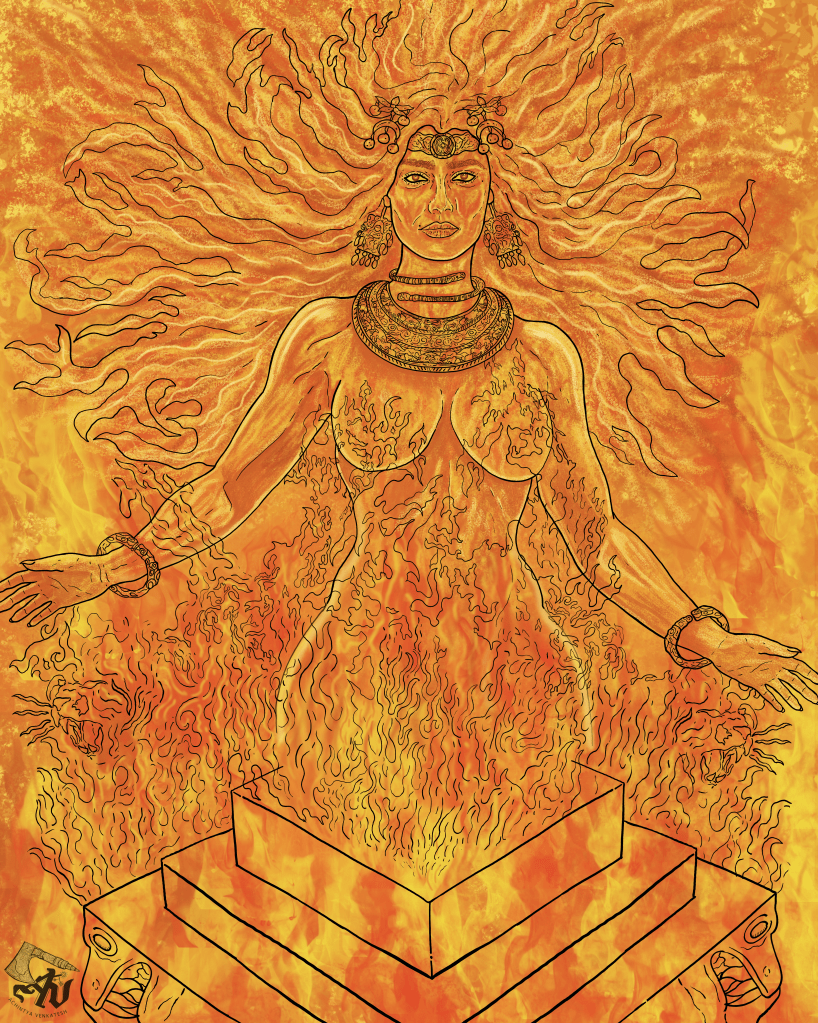
A few months ago, an associate raised with me a curious concept. Namely, the idea that a) the archaic Indo-European divinity of the Fire was Female, with this being attested via b) the Scythian figure of Tabiti identified with Hestia by Herodotus, and therefore indicating that c) the Vedic figure of Agni was an ‘innovation’ or a switching of the gender of the divinity associated with this most essential of Flames.
While it’s not (so far as I know) where he’d gotten it from, you can find this particular notion in a few places these days – Wikipedia, for instance. There, a section of the wiki entry for Tabiti reads:
“Tabiti was thus similar to the Vedic Agni and the Greek Hestia, therefore being connected to the common Iranian cult and concept of fire, […] although she belonged to an older period in the development of Indo-Iranian religion compared to the other Iranian peoples and the Indo-Aryans, among whom she had been respectively replaced by the male fire-gods Ātar and Agni, making her the only attested female Indo-Iranian fire-deity. […] Herodotus of Halicarnassus equates Tabiti with the Greek goddess of the hearth, Hestia, […] and lists Tabiti at the head of the Scythian pantheon, which might be a reflection of the role of the fire-deity among the Indo-European peoples, and parallels the Greek tradition of beginning and ending every sacrificial rite with the sacrifice to Hestia, and every appeal to the gods starting by mentioning her name; another parallel is found in the Indo-Aryan Rigveda, which begins and ends with a hymn addressed to Agni […]”
There are several curious notions contained within that short suite of sentences.
Not least of which being how one is actually intended to reconcile the above with our (Hindu) actually-existing theology.
Which features a rather prominent (Hindu) Goddess addressed via a well-known hymn, the Durgāsūktam, that is built around hailing Her as ‘Agni’.
She Who is depicted within Her major scripture, the Devīmāhātmyam (II 12) as emerging or emanating from the great Fire (‘atīva tejasaḥ kūṭaṁ’ – an ‘immense’ (अतीव) ‘piling’ or even ‘house / dwelling’ (कूटं) ‘of fire’ or ‘of fiery energy’ (तत्तेजः), ‘jvalantamiva parvatam’ – ‘blazing’ or ‘burning’ [and of scale] ‘akin to a’ (ज्वलन्तमिव) ‘mountain’ (पर्वतम्) – to quote and translate the relevant half-verse directly), and hailed also as the Ruler (‘Prabhuḥ’) of unmatched / unparalleled (‘atulāṃ’) Fire-power within the opening verse to the renowned Tantroktaṃ Rātrisūktam hymnal also of that Śrī Durgā Saptaśatī (I 54-68 / I 73-87, etc., contingent upon edition).
And Who, in a verse of Vedic antiquity (viz. MahaNarayana Upanishad II 2 , Taittiriya Aranyaka X I 42-47) which is also utilized by the Gods Themselves to eulogize this Devī (Devī Bhāgavatam VII 31 44), is declared to be [of] the ‘Appearance / Quality of Fire’ (‘AgniVarṇāṃ’), ‘Burning with the [Heat/Fire of] Tapas’ (‘Tapasā Jvalantīṃ’; ‘Tapas’ pertaining to heat, light, energy and devotional ardor … the word’s direct Scythian cognate underpinning the theonym ‘Tabiti’ ), ‘of Bright Radiance’ (‘Vairocanīṃ’ – which can also be taken as a statement of origins, somewhat like a patronymic or matronymic would be), and Who is ‘Worshipped / Adored’ (‘Juṣṭām’) as the executor-vector via which the objectives of pious conduct (‘Phaleṣu’) are obtained (the sense to this last pair of terms being attested via Sāyaṇa’s commentary, so the insightful Nyāyaratnasiṃha has informed me; the Swami Vimalananda translation for the MahaNarayana Upanishad would appear to concur, viz. – “the Power that is supplicated to by the devotees for the fruition of their work” ), something which should seem at least potentially reminiscent of the role of Hestia.
Now, from where I’m sitting – this would begin to look rather like the outlines for an “attested female Indo-Iranian fire-deity”. Indeed, in light of what is to come in the ensuing sections – I would go so far as to state that this is that female Indo-Iranian fire deity, observed in Her major contemporary-familiar Indo-Aryan manifestation. No ‘replacement’ by Agni (or, for that matter, replacement of Agni) required.
Something of a contrast, as you can readily see, with that position staked out within the Wiki-quote with which we pretty much began (and which is, I might add, reasonably closely paraphrasing the works of the two academics which it draws from therein).
However our purpose in putting all of this together is not with a view toward merely brow-beating the contents of everybody’s favourite online-cyclopedia for questionable theological accuracy. Nor is it an effort undertaken with the firmly focused intent of ‘correcting the record’ as applies the evident omission of a pertinent Hindu Goddess from a reconstructive typology.
Instead, it is to engage in something much more broadly illuminating.
I suppose we might term it an ‘expedition’ – insofar as we intend to explore and ‘map’ a significant swathe as to the Indo-European theology which both characterizes and contextualizes the IE deific that the Scythians knew as ‘Tabiti’.
And that entails going off into somewhat ‘uncharted territory’. Insofar as we do not intend to meekly content ourselves with perfunctorily name-checking Hestia, Vesta, and Agni; making some vague and decontextualized reference to an ‘opening and closing offering’ and then blandly presenting the etymology and linguistic cognates for the theonymic of ‘Tabiti’, as if that makes everything effectively self-evident.
No, we intend to go both broader and deeper (and I suppose, given ‘Tabiti’, that “दीप” would most certainly be the operative word).
In essence, our objective must be to draw together an effective ‘working model’ for the underlying theological complex.
Not simply the individual deific – and especially not merely in Her Scythian salience as Tabiti alone.
After all, due to the incredibly fragmentarily attested circumstance of said Scythian religion, we are basically left in a position even worse than that of Herodotus – as whilst he, at least, could work from accounts of a still-living culture that had made its way to him and then find his way to expressing their core concepts via analogy of the familiar (and also then-living) Greek religion … previous academic analysis has been working largely from a combination of vicarious materials (such as the aforementioned Herodotus, which constitutes our principal source), conjectural interpretation (some of which reads rather … imaginatively, upon the basis of little evidence, and yet with this being presented as effective ‘fact’), and drawing from other Indo-European religions in order to try and ‘reconstruct’ more as to Tabiti via presumptions as to analogy.
That last avenue of approach being somewhat problematic, on grounds that the major materials utilized for such reconstructive purposes are seemingly invariably themselves somewhat ‘misunderstood’ by those who would seek to make use of them.
Hence, it’s not that the time-worn trajectory of Herodotus’ own ‘interpretatio’ (viz. Hestia – and therefore, through well-attested further equivalency, Vesta) is ‘incorrect’, per se. But rather that it is rendered ‘incomplete’ via both a) a limited application of what we know about the relevant Classical religious conceptry, and b) insufficient (and often just plain incorrect, it would appear) application of what we have available to us from other Indo-European religious spheres. Such as – without intending to put too fine a point upon it – the most comprehensively actually-attested (and still-living!) one, the (Indo-Aryan) Vedic religion that also happens to be a much closer cousin to the Iranic ‘Scythian’ sphere than the Hellenic sphere of Herodotus. And that entails going rather further than just mentioning Agni, conjecturing about His purportedly being a ‘later’ development (than the Scythian deific attested more than a thousand years later as compared to the archaic Vedic layer of texts, no less) and calling it a night !
The benefit to this approach is not only to be observed in a more viable (in our estimation, at least) comparative theology for Tabiti, and also for pertinent dimension as to the Proto-Indo-European religion from which all of this descends … but also, and flowing not least from this, the manner in which we may gain a greater understanding for particular points connected to the relevant complex within other of those descendant Indo-European spheres. And you shall most definitely see more of that which we mean via such in due course.
Now, to speak in terms of substantive matters – this work had been initially intended as a single work of writing. However, due to the rather extensive array of analysis and evidence drawn together therein, we have elected instead to run it as a series; with this serving as an introduction and providing a synopsis of some of the key points for the more casual reader. This has the added advantage of enabling us to accompany this beautiful (indeed – ‘radiant’ seems the operative term) illustration by Achintya Venkatesh (whom we would like to sincerely thank both for his artistry … and also his patience and forbearance as we have taken somewhat longer than anticipated in putting together the corresponding writing to ‘go with’) with a textual commentary that’s actually of a length able to be shared by us on social media. As much as I like providing the con-text, I’m sure his work is worth well more than a thousand words of mine in that regard, anyhow.
(Of course, toward the latter phases of my ‘drawing together’ of materials to demonstrate various of the ‘myth in motion’, as you can see from the … expanding length of the numbered sections, we would appear to have failed at keeping only to the bare basics in this inceptive presentation. Whilst I might have therefore sat down and reworked everything a third time so as to remain in abidance with the proffered schema aforesaid … the time this would have taken would have forestalled this piece’s publication even further. And, in any case, given we have occasionally encountered a perhaps not entirely un-understandable presumption that some of my more surprising assertions are basically the result of me “making things up” – it is perhaps a Good Thing for me to ‘show some working’ in this cause, even if it enlengthens the resulting output rather considerably)
As applies that synopsis, the key points are the following:
1) The Scythian figure of Tabiti does indeed have a strong Vedic correlate … only this isn’t Agni, but rather Vāc – Aditi ; She Who is Queen of the Gods (‘Rāṣṭrī Devānāṃ’, per RV VIII 100 10), and First and Foremost of ‘Those To Be Sacrificed To’ (‘Prathamā Yajñiyānām’, per RV X 125 3; First Share of Offering going to Her – even before Agni – being attested via, for instance, SBr III 5 1 22-23, SBr III 5 2 8-9, SBr IV 5 1 1-4, TS VI 2 7 1, TS VI 1 5 1, TS VI 1 7 5, Ait. Br. I 7, and so forth; various of these – e.g. TS VI 1 7 5 – having both the “opening and the concluding oblations of the sacrifices” (per the Keith translation) belonging to Aditi, the “double-headed”).
2) The reasoning for this priority as applies Offering is, in fact, quite logical – the Goddess presides over the rather ‘foundational’ elements without which there cannot be a Rite. Its successful outcome is also in Her Hands and ‘bestowed’, per RV X 125 2, (“ahaṃ dadhāmi draviṇaṃ” – ‘I give the wealth / power / desire’) to the undertaker of the Rite (“haviṣmate suprāvye yajamānāya sunvate” – “the zealous sacrificer who pours the juice and offers his oblation”, as Griffith translates it) through Her Great Power; c.f. Homeric Hymn XXIX – to Hestia, 4-6 – “For without You mortals hold no banquet […]” (Evelyn-White translation).
Thus, of course, quite logically explicating why it is that Herodotus [IV 59] declares that Scythians propitiate (“ἱλάσκονται”) ‘Hestia’ (“Ἱστίην”), i.e. Tabiti, “μὲν μάλιστα” ‘accordingly the most’ (whether in the sense of ‘the highest’ or in the sense of ‘most frequently’).
Ref. also Hekate at Theogony 416-421: “For even now, whenever someone of men on earth sacrifices fine things and prays in due ritual [“νόμον” – ‘lawful, customary’], he invokes Hekate; much honor comes to him very easily, whose prayers the Goddess favorably receives, and She grants him wealth [“ὄλβον” – also ‘happiness’, inf. ‘successful outcome of Rite’ here] , since this is Her power. For as many were born of Gaia and Ouranos and obtained honor [“τιμὴν” – “offering”, ‘tribute’], among Them All [i.e. all The Gods] She has Her due” (Caldwell translation).
The Evelyn-White translation has “ἐπεὶ δύναμίς γε πάρεστιν” [419] as “for the power surely is with Her”, said ‘power’ clearly being of broader ambit than the very specific dimension of (monetary) wealth bestowal and instead connoting the general potency to deliver successful and supportive outcomes to ritual conduct (or, for that matter, other forms of endeavour should She be so inclined, as we hear [429-447] amidst the more extensive array of arenas and contexts where Her Favour might be felt by those She chooses to help); the phrasing immediately following, wherein She is declared to have “a share of the privileges of all the Gods” (‘privileges’ being, of course, ” τιμὴν”) per the Trzaskoma, Scott Smith, and Brunet translation, more easily conveys the Vāc-like entailment that a portion of the offerings put toward the ritual operations of all the other Gods are Hers – and for, as we have seen, functionally the same reason.
Just as the Gods (in Hindu reckoning) are able to accomplish Their ‘iconic’ mighty potencies … through the underpinning empowerment of the Devi (ref., for instance, the major subject of the Kena Upanishad, which also has the situation directly demonstrated when Vayu & Agni are unable to affect via blowing or burning even a mere blade of grass when She does not permit Them to), perhaps the broad enumeration of particular avenues, arenas, and sought-for availments which She can prove decisively involved in at lines 429-447 is intended to subtly convey that whilst various of these are customarily (even iconically) the powers and portfolio-areas of other Gods – it is not simply that She aids in conveying petitions and the distribution of some outcomes thereto as only intermediary, but that She has a substantive and foundational role to play in these powers even as they are wielded by the rest of the Pantheon all up. But that is speculation upon my part, and I accept that other readings are, of course, possible.
It would, of course, help to explain just why it is that Zeus makes sure to properly honour Her in advance of the immense war-effort and, in a sense, ‘restructuring of the Cosmos’ which is the Titanomachy. And we would also observe the intriguing co-occurrence for Hekate alongside Zeus, per Proclus’ VIth Hymnal – see points Six and Eleven further in. “He Who is about to engage in a conflict should offer an oblation to Aditi; Aditi is this (Earth)”, indeed, as the Taittiriya Samhita [II 2 6, Keith translation] puts it. A ‘Foundational Element’, you see. One which ‘Opens the Way’ for further (phases as to the) undertakings.
We would also, perhaps, make mention for the intriguing line of inquiry highlighted by Professor Bachvarova, viz. Hekate in relation to the Anatolian IE complex of “Underworld Sun” Goddess – something that, now that I think upon it, we had previously sought to link to the phenomena of Aditi (and, for that matter, Freyja) in this regard [ref. SBr VIII 4 3 7; TS VI 3 10].
3) These ‘foundational elements’ linked to the Goddess pointedly include the Fire-Altar (‘Hearth’) itself which serves as ‘Portal’ or ‘Entranceway’ for both ‘Living Fire’ (which is also a ‘Portal’ of a sort) and, through this, further Divine Arrivals to the Rite. The Goddess therefore recurrently has an association with Doors or Gates, whether literal or metaphorical – ref. Hekate Propylaia, the ‘Prothyraia’ epithet, and the Hekataion outside an Ancient Greek house; also the Kleidouchos (κλειδοῦχος – ‘Key-Bearer’) hailing. It is through such (and the ‘Pathways’ leading / anchored thereto) that She is described in the Devīsūktam [RV X 125 1] as ‘causing to move/appear’ (‘carāmy’) and ‘bringing’ (‘bibharmy’) the Gods to the Rite.
4) The altar(-space) itself is made of Earth and the rite is undertaken upon and within the (consecrated, ‘separated out’) Earth of the Ritual Enclosure; hence She is also identified with or as (the) Earth (viz. SBr I 3 1 15-17, etc., Vesta at Fasti VI 267). The sanctified space of the Ritual Enclosure, this ‘secure foundation’, is also protected – both through ’emplaced’ metaphysical bounds and Her great protection (a frequent motif when Aditi is invoked in Vedic liturgy), as well as via a most particular ‘Protector’ Whom we shall be meeting in due course. That ‘Gaia’ – ‘Earth’ – occurs in such direct proximity to both Tabiti and Zeus / Papaios, within Herodotus’ brief parsing of Scythian religion [IV 59] is almost certainly entirely uncoincidental.
That said, whilst both broadly prevalent and of clear (particularly ritualine) importance, these ‘Earth’ identifications (and, for that matter, other key ‘Elemental’ associations) are also vulnerable to being rather ‘over-read’. That is to say – they get seized upon precisely due to their prominence, prevalence, and the relatively ‘concrete’ seeming-nature of such an association, and then utilized in far broader terms than they had, perhaps, been initially intended for to try and ‘explain’ the divinity in question all up. It can rather readily become almost ‘reductionist’ in scope – for instance, the insistent (re-)phrasing of Hera, etc. as ‘just’ an “Earth Mother” sort of figure, which ignores the rather vital suite of actually-existing Ancient Greek theology that would posit Hera as a Goddess (also) of the Air (see Her Orphic Hymnal, for instance), the Mid-Atmosphere (we would infer, to speak briefly in Vedic terms). Goddesses (and, indeed, human people) are complex, They are both nuanced and inherently multifaceted. One chooses to presume that a given ‘elemental association’ is the ‘be all and end all’, or overarching conceptualization as to Their Essence, rather than a ‘Facing’ and a particular ‘Facet’ of immediate pertinence for a given context, at one’s peril !
A particular saliency for the Earth in Vedic ritualine terms is to be found as the “Lap of Aditi”, wherein a ‘hole’ or small ‘trench’ is dug so as to form the place of the fire’s kindling – the ‘womb’, indeed, for the Living Fire of the Conduit, Agni [ref. VS 11 56 onward, c.f. TS IV 1 5 – note presence of Sinīvālī; here it’s Aditi digging the pit; TS I 5 3 has Agni emplaced “in Thy Lap, O Goddess Aditi” – interestingly following a triple hailing, for Earth (“Bhumir”), Sky (“Dyaur”), and Atmosphere (“Antarikṣam”), something eminently logical considering the Triplanar Cosmology of the archaic Indo-Europeans finding resonance also in both the Triple Layers of the Yajna-Kunda ‘Fire-Altar’ and the ‘Triple World’ situation for the relevant Goddess, viz. Hekate as a very prominent exemplar; VS I 11 features emplacement, to quote the Griffith translation: “Upon the navel of the earth […] on Aditi’s lap”, following a similar tri-planar reference featuring “doors” situated “on the Earth securely”, ref. my ‘Delphi’ comment at point 9 below].
We mention said situation as it should seem particularly resonant with the detailing reported by Plutarch (in a fragment preserved amidst the ‘Praeparatio Evangelica’ [III 1 3-5] of the Christian propagandist, Eusebius – for which we are indebted to him, no doubt to his most considerable consternation) for a situation of the Wife of the Sky Father (in this case, Hera … co-identified with Leto, and worshipped via the same Altar and Temple; the whole thing taking place very much in the context of a (re-)Marriage with Zeus), to Whom “preliminary sacrifice is made to” (to quote the Sandbach translation), under the identity of “Leto of the Nook” (mychios), although some say “of the Night” (nychios).” (again, to quote the Sandbach translation – Gifford has “Leto Μυχία, that is, ‘of the inner shrine’; but some call her Νυχία, ‘Goddess of night.'”) [III 1 3]
With Hera being asserted to be ‘Earth’ in the very next section [III 1 4], and Leto, here, seemingly the ‘Air’ (and we shall refrain from remarking here upon the potential for the Lethe amid the ‘Mid-Atmosphere’ in light of certain other ritually salient Rivers of identical cosmological situation, inter alia, for a start !), mention for the Sun being ‘Under the Earth’, and a Lunar – specifically ‘Dark Moon’ – occurrence (see point 7 below), we should identify several areas of easy coterminity with our ongoing-emergent typology. The reported detailing for the ‘mythic template’ ‘original occurrence’ where the ‘encounter’ of Zeus & His Wife is likewise said to take place within just such a “μυχός” atop Mount Cithaeron (here a clear symbolic resonancy for the ‘pyramidal’ shape of a raised fire-altar, replete with ‘nook’ – or, as we would say in Sanskrit, ‘Kuṇḍa’ … and my indebtedness to N. Mukhopādhyāyaḥ for pointing out a potential Germanic cognate to this term which would be fairly exactly ‘on point’ ) is very much the ‘Myth In Motion’ for the core of the relevant ritualistic understanding.
5) To reach the Rite, Divinity traverses a ‘Path’, anchored upon the altar and its ‘portal’, and also under Her aegis. Hence, in part, Her ‘Opening’ & ‘Closing’ propitiations – viz. the ‘Prāyaṇīya’ & ‘Udayanīya’ (effectively the ‘before-going’ and ‘after-going’) offerings for Aditi (an acknowledgement is due for Nyāyaratnasiṃha here for significant assistance rendered in relation to this point). She is encountered under the theonym of Pathyā (rather directly, a theonymic relating to the Road – SBr IV 5 1 3-4, Ait. Br. I 7-9, seemingly RV X 63 15-16, etc.; per Haug’s Ait. Br. “only another name of Aditi” is the attestation of Sāyaṇa), with this also being connected to the ‘earthen foundation’ for the Rite – this being the name under which, especially, the concluding Aditi-offering is made (“Pathyā Svasti” – viz. SBr IV 5 1 3-4, which handily also has Pathyā Svasti identified expressly as Vāc, Aditi being ‘Earth’ there as well;).
This is further attested via Macrobius’ remarking upon Diana / Trivia (i.e. Hekate) presiding over roads (“viarum”, I 9 6) in the context of Her relationship to Janus (whether as ‘part’ of Janus, or as the female counterpart to He, I 9 5-8); and c.f. further saliencies for Hekate in relation to ‘guiding’ upon said ‘roads’ or journeys – hence the bearing of Torches to this purpose. The Sacred Liturgies and Metres also resonate as ‘Pathways’ or ‘Vehicles’ via which the Divine is conveyed to us ‘down here’ at our Rite (ref. potentially RV I 88 1 for an instance ‘in motion’), hence in part the immense importance of Vāc (see SBr IV 5 1 3, wherein a ‘guidance’ role for Her as applies the Gods is expressed and understood as mandating the Opening Share to Her as ‘Pathyā Svasti’) – and the specific blessing sought of Hestia at the conclusion of Homeric Hymn XXIV: χάριν δ᾽ ἅμ᾽ ὄπασσον ἀοιδῇ, the bestowal of ‘[Divine] Grace’ upon the ‘Hymnal’ or ‘Song’ of the invoker. After all – how else is one to ‘Open’ the Conduit in the first instance (or ‘Close’ it properly at the end of proceedings): the Empowered Speech makes it so.
6) This enabling for Divine ‘arrival’ is described in terms of Motherhood (the altar-space being a ‘Garbha’ or ‘Womb’, ref. TS IV 1 5 k; TS VI 1 3; SBr III 2 1; etc.; Δελφοί (Delphoi) is a cognate) – the Goddess being ‘Mother of the Gods’ (‘θεῶν μῆτερ’, per Proclus’ VIth Hymnal – to Hekate & Janus; c.f. also Philolaus’ hailing for Hestia in such terms, as preserved via Stobaeus) through enabling Divinities to become ‘Born’ into the ‘down here’ world in order to attend the Rite in Their Honour (c.f. Vāc at SBr III 2 1 19, 25-26, particularly). (As an aside, Ovid’s remark at Fasti VI 291-2 which should seem to somewhat counter this in relation to Vesta and Living Flame … is clearly not to be interpreted ‘at face value’, as such a reading is directly contradicted later in the same book, viz. VI 627-634 and the conception of Servius Tullius ).
These elements are expressed via the Prothyraia (προθύραια – ‘Before the Door’) epithet utilized for Hekate / Artemis in relation to childbirth; and also underpin relevant Juno (esp. ‘Lucina’) / Diana / Trivia understandings (ref. Catullus’ ‘Hymn to Diana’ [XXXIV], Horace’s Ode III 22 from his Carmen Saeculare). This may also be effectively understood as ‘Midwifery’ – aiding the ‘birth’ (of Gods) – which is how various of these Forms are engaged with in other terms as applies the pregnancies of human supplicants.
As it happens, this conceptual correlation for the Rite and Altar in relation to human procreation and pregnancy / childbirth is also true in reverse. That is to say – one finds the terms, concepts, and metaphysical resonancies of the Vedic Fire-Rite and its Altar also being utilized not merely to ‘speak of’ nor ‘conceptualize’ the processes involved in conception and reproduction … but also to actively (metaphysically) engage with that which is unfolding in order to influence it accordingly (Brihadaranyaka VI 4 15-18 detail ways in which either a son or a daughter is able to be ‘selected for’, and of particular qualities likewise thusly engendered of both appearance and ritual-metaphysical potency in their life to come; ‘oblations’ are a key vector for this, consumed by the participants just as they would be the flames of the Rite) – with this pointedly including the gentleman and his wife taking on the designations of our relevant deifics and forces.
To illustrate more directly, good examples for the ‘general concept’ can be found at Chandogya Upanishad V 8 and Brihadaranyaka Upanishad IV 3. To quote from the Nikhilananda translation –
“Woman, O Gautama, is the fire, her sexual organ is the fuel, what invites is the smoke, the vulva is the flame, what is done inside is the embers, the pleasures are the sparks.
“In this fire the gods offer semen as libation. Out of that offering the foetus is formed.”
[Chandogya Upanishad V 8 1-2 – basically repeated at Brihadaranyaka Upanishad VI 2 13]
“Her lap is the sacrificial altar, her hair the sacrificial grass, her skin within the organ the lighted fire; the two labia of the vulva are the two stones of the soma—press.”
[Brihadaranyaka Upanishad VI 4 3]
And as applies the husband and wife taking on the ‘resonation’ of divine figures and ritualine forces, this is attested at Brihadaranyaka Upanishad VI 4 20 – with much to the verse in question also, and entirely uncoincidentally, showing up in the (Saunakiya) Atharvanic iteration for the Marriage Liturgy [AV-S XIV 2 71]. To quote from the Müller translation for the Upanishadic iteration aforementioned:
“Then he embraces her, and says: ‘I am Ama (breath), thou art Sâ (speech). Thou art Sâ (speech), I am Ama (breath). I am the Sâman, thou art the Rik. I am the sky [‘Dyaus’], thou art the earth [‘Pṛthivī’]. Come, let us strive together, that a male child may be begotten.”
This concept of a ‘marriage’ of Sky and Earth should also seemingly find attestation within Herodotus’ ‘interpretatio’ rendition for Scythian religion [IV 59] – “νομίζοντες τὴν Γῆν τοῦ Διὸς εἶναι γυναῖκα”. Effectively, that the Scythian iteration of ‘Gaia’ [‘Earth’ – ‘Prithvi’] was regarded by them as the Wife of their perception of ‘Zeus’ [‘Sky/Heaven’ – ‘Dyaus’].
Needless to say, there is much more to the Upanishadic operation than just that small suite of lines quoted immediately above – however both because it gets rather lengthy and also because it gets rather … lurid, I shall spare the reader extended quoting of that which comes next. Suffice to say the relevant deific invocations for the ritual operation are made (including for the Sinīvālī Whom we shall be meeting momentarily), the similarly familiar concept that “Earth contains the germ of Fire (agni)” (to this time quote from Hume’s translation for VI 4 22) is referenced, and the concluding hailings are for “Speech” (thrice – goes with the Tri-Loka ’emplacement’ immediately following) and then the Mother, Herself. Who, as it happens, had actually taken on the saliency not only of Earth (Prthvi), but also of Heaven (Dyu – there being a rather under-remarked upon prevalence of female ‘Heaven’ occurrences in the RV, as it happens) … and inferentially (for reasons that I won’t go into the description of here) also the Mid-Atmosphere (Antariksha) as well , at the outset of the more ‘active’ phase to these relevant operations (commencement of VI 4 21). She is therefore, as with Hekate, evidently salient in each of the Three Worlds – and, of course, likewise linked with the nurturing of children (the term encountered at Theogony 450 & 453 – κουροτρόφος – actually being a rather good fit for the nourishing of the child which is the penultimate stage to the Rite).
Why have I mentioned all of that?
Partially because it’s useful to have the ‘confirmation’ for the relevant metaphysical understanding which we have advanced, and doubly so in that it comes from an ‘adjacent’ sphere ‘resonating’ it back so nicely.
But also because it does a very nice job of illustrating with remarkable directness just why this concept for Agni “replacing” the Goddess makes such functional non-sense.
And, indeed, with both Man and Woman getting ‘matching’ sets of ‘described via Fire & Rite’ conceptry (Brihadaranyaka Upanishad VI 2 12 & 13; Chandogya Upanishad V 7 1-2 & 8 1-2) … well, it really does go very harmoniously with our core point.
We would additionally make reference to the circumstances for Hera both presiding over the Eileithyiai and seemingly acting as an ‘Eileithyia’, Herself [ref. Iliad XIX 119, 103-5 & 114-119], as well as the saliency for such an identification viz. Artemis; and, of course, the suite of detailings reported for us via Varro in his ‘De Lingua Latina’ [V 69] with relation to Juno Lucina, the Moon-linked Goddess iteration (that is also the ‘Earth’ – ‘Terra’ – even as She ‘Shines’ – ‘Lucet’) prominently called upon with relation to aid in Childbirth.
7) A Lunar correlation is present, specifically manifesting on or immediately adjacent to the New Moon (‘Amāvāsyā’ / the Kalends), expressed via Vedic Sinīvālī & Kuhū (Goddess Form(s) of the time of the New Moon and its immediate following period; associated particularly with childbirth, and ref. SBr VI 5 1 19-20 for connexion with Vāc Aditi, VS XI 55-56 having this in express relation for Sinivali to the preparation of the fire-space for Agni; Sinivali, interestingly, also identified with Shiva’s Wife, Umā) and Roman Juno Covella (occasionally interpreted to have more archaically been ‘Juno Novella’, and more expressly pertaining to the ‘New Moon’; the ‘Covella’ perhaps otherwise either for the ‘concave’ shape of the New Moon or the ‘Calling’ action salient to the occasion) to Whom the Kalends were sacred (and note the saliency in conjoint for Her in relation to these for Janus ‘Junonius’) [c.f. also the aforementioned linkage of Juno Lucina to the Moon as cited by Varro, V 69]. Again, the same principle underpins both the ‘Childbirth’ and ‘time of especial ritual significance’ thematics – the latter being, of course, something rather salient for both ‘Moon’ and the notion of this alignment enabling the ‘pathway’ to be (more?) ‘open’.
This association is also expressed, in a not entirely dissimilar fashion to that which we had covered at point 6 viz. the human oriented ritual customs which ‘confirm’ the Divine / Mythic oriented ritual elements we have proposed, via Kerényi’s attestation that “Proklos in his scholium compared […] the timing of Athenian weddings in the days nearest to the coniunctio of Sun and Moon (New Moon)”. Kerényi likewise had remarked that the Wedding of Zeus & Hera in the Heraion of Argos would take place “shortly after the appearance of the New Moon”, and additionally contextualized key elements of the Daedala sacred marriage observance in Lunar terms. We would also note with interest the work of Iversen in this area (building from references at Thucydides III 65 2 & II 4 2), likewise situating the “Daidala festival” with reference to the ‘ἱερομηνία’, which in context, he renders as “the sacred-moon day” – i.e. that time where “there would have been no moon.”
It is for good reason that Lord Shiva, in the course of the explanation for the metaphysical saliency and potency of the sixteen phases of the Moon in Hindu ritualine terms (ref. ‘Tithi’) at Skanda Purana VII 1 19 4 hails His Wife as being this (named here as “Amā”), “the greatest and subtlest Śakti.” (Tagare translation) That is to say, the ’empowerment’ afforded via the occasion – also named several verses [VII 1 19 2] earlier as the “Mahākalā” (‘Great Time’, indeed) amidst these Sixteen.
The notion of the ‘Rite Timing’ – or Right Timing – we might speculate to additionally have some bearing in terms of the underpinning to the theonym of ‘Hera’ Herself – as expressed, for instance, viz. a potential shared element with the ‘Horae’ (Ὡραι) [see the work of García Ramón, no doubt inter alia, in this area – although we would take things in a perhaps different direction to the “Goddess of Timeliness” concept that scholar had initially intended.], with Whom She makes associated appearances.
8) The Ritual Enclosure and Altar-Space ‘Portal’ of the archaic Indo-Europeans was by no means a ‘permanent’ construction – but rather, a temporarily ‘enclosed’ area ‘separated out’ from the mundane world (c.f. Ancient Greek ‘τέμενος’ – i.e. a ‘temple precinct’, or more accurately a ‘sacred enclosure’, ‘holy space’ coming per Beekes from PIE *temh₁-, meaning to ‘cut’; a similar conceptual understanding, with notable emphasis upon the ‘consecration’, also underpinned the Roman ‘Templum’, itself a slightly more ‘specialized’ iteration to the type [see Varro – De Lingua Latina VII 10 for its ‘overlap’ with the more ‘modern’ sense], to the point of the ‘Tabernaculum’ in fact having originally been a tent).
In the archaic Vedic context, ‘Vāstu’ is used to refer to the ‘Yajña-Bhūmi’, or ‘Ritual Ground’ (per Sāyaṇa’s commentary upon SBr V 2 4 13; which also includes the ‘Shmashana’, or ‘Cremation Ground’, ‘Ādir’ – ‘etc.’. We are once again indebted to Nyāyaratnasiṃha for his assistance upon this point). This is, likewise, a temporarily consecrated and constructed space, essentially referring to a place of ‘dwelling’ or ‘remaining’ (‘Vas’ – वस्; Monier-Williams emphasizing the “overnight” characteristic for this in Vedic usage … the ‘Vas’ (वस्) referring to ‘Shining’, esp. viz. the Dawn, being a homophone).
The PIE root to Vāstu, *h₂wes- (*u̯es-1 per Pokorny) is reconstructed by Ringe to mean “to stay the night”, “camp” (he adds that this was effectively a ‘strong’ verb iteration of ‘being’, and thus ‘staying’ or ‘remaining’ rather than simply ‘existing’ in a potentially rather passive or abstract / less-definitive sense). The Proto-Indo-European foremother to the Vedic Vāstu would therefore likewise be characterized via i) there being a ‘Dweller’ located therein, ii) this being a temporary residency, iii) incepted via invitational invocation to the Deity to enter into the space (ref. Sanskrit ‘Āveśa’ (आवेश) : ‘Aa-‘ (आ) – ‘At-‘ or ‘Toward-‘ + ‘-Viśa’ (विश्) – ‘Entering’ or ‘Household’; Visha being from PIE *weyḱ-, which is also the root to Ancient Greek ‘οἶκος’) and likely accompanied by a ‘first offering’ as honouring, fuel, and inducement , iv) and with corresponding ‘farewelling’ (‘evocation’, in a sense – calling *out* of the space, rather than calling in to such) ritualistic phase when time for Them to be leaving the space, accompanied with further (‘Last’ / ‘Conclusionary’) Offering in gratitude and as the proverbial ‘One For The Road’.
Whilst the linguistic linkage for Ancient Greek ‘Hestia’ and Latin ‘Vesta’ to PIE *h₂wes- is no longer entirely uncontested, the *conceptual* resonancy remains most markedly in force. That space hailed as the ‘Hestia’ (i.e. ‘ἑστία’ – ‘hearth’) or the ‘Vesta’ is, as with Vāstu, the place of ‘dwelling’ for the invoked & emplaced Divinity. The ‘Opening’ and ‘Closing’ Offerings made unto Her (and yes, Vesta does find attestation as receiving Opening propitiations – Fasti VI 303-4; immediately prior to the ‘Vestibule’ figurative connotation which Ovid contemplates) , viz. the ‘Prāyaṇīya’ & ‘Udayanīya’ accorded to Aditi, etc., should therefore connote to us the honouring efforts via which the Goddess would be properly ’emplaced’ (via invitation) upon the one hand, and ‘displaced’ is not the right word for it – but ‘gratefully farewelled’ upon the other.
That ‘Vāstu’ would transition, with the passing of the ages, to more overtly signify a permanent structure, a house, a home – is likewise in parallel with the shifting observed for Hestia … Who has undergone quite the ‘domestication’, both as applies the ‘focus’ (in both the modern and the latinate sense) seemingly shifting more simply into the literally domestic environment of the (fixed, human) household in the popular conception – and the corresponding de-emphasis of Her formerly more ‘august’ role as the centre-fire of entire civilizations or cities (or, for that matter, the universe at large … with due deference to Philolaus et co.) ; and thus rendering the situation of Her particular ‘Household’ ascriptions in Homeric Hymnal XXIV, for instance, a subject of serious incomprehension for some scholars. But I digress.
9) We highlight the Vāstu also for another saliency – that being the ‘Rudraḥ khalu vāstubhavaḥ’ (as Nyāyaratnasiṃha had rendered it – Rudra “arising from [the] Vāstu”) per the description in Sāyaṇa’s SBr commentary [V 2 4 13]. He is Agni (and, in addition to the standard suite of co-identificationary materials, one need look no further than TS III 4 10 3, wherein one finds Agni (described earlier at the first line viz. “svāveśo” – “preserver”, per both Sāyaṇa and Bhaṭṭabhāska, although taken by Keith as “kind entrance”) taking on the wrathful visage of Rudra in order to ensure fiery death and ruin for the would-be transgressor upon the propriety of the sacred space. Something also attested, as applies this most sacred of duties, at RV X 61 7 – wherein the ‘Vāstoṣ Patiṃ’ is brought forth via invocation by the Gods so as to act as “Vratapāṃ”, the ‘Protector’ (“Pā”) of the ‘Law’ / ‘Proper Conduct’ / ‘Binding Undertaking’ (‘Vrata’ – like ‘Word’) in specific relation to an act of attempted violation against a certain Goddess (here identified, to the bamboozlement of Jamison/Brereton, via “kṣmayā” – ‘Earth’) by Prajapati; said verse’s underpinning narrative context being a very archaic Indo-European myth wherein the Sky Father acts to defend His Wife ‘gainst a most unwholesome interloper – Hellenic refractions for this occurrence including Zeus’ protective-retributive efforts for each of Semele (‘Earth’) or Artemis against Actaeon, as we have detailed elsewhere at some length.
Speaking in terms of this ‘Protector’ amidst the Classical world – we would note that at the opening of Homeric Hymn XXIV, the “holy house” (as Evelyn-White’s translation has it, for “ἱερὸν δόμον”) which Hestia is said to look after (“ἀμφιπολεύεις”) is that of “ἄνακτος Ἀπόλλωνος ἑκάτοιο Πυθοῖ ἐν ἠγαθέῃ”. That is to say – the (W)Anax (i.e. ‘Lord’, and particularly ‘War-Leader’ in more archaic times), Apollo the ‘Far-Shooting’, and also said to be ‘in Pytho most-divine’. Pytho being Delphi and Δελφοί being a cognate for ‘Garbha’ … in effect one might most readily contemplate this formidable Archer of the (most) sacred space as standing sentinel in similar fashion to the dread Rudra – Vāstoṣpati.
And, for that matter, the somewhat enigmatic situation occurrent at the Letoön near Xanthos, wherein the famed trilingual inscription of that site mentions Apollo as ḤŠTRPTY (functionally, it would seem, cognate to Hindu ‘Kshetrapati’ – i.e. the Lord / Defender of the ‘Kṣetra’, the ‘Temple’ or ‘Field’) in the context of dread warnings to any foolish enough to transgress upon the propriety of religious custom and functionaries within that sacred precinct – Leto, meanwhile, that Mother of the Gods (‘Ẽni Mahanahi’ in Lycian : ‘ẽni’ – ‘Mother’, ‘maha(na)’ – ‘God’), is also ‘Ẽni Qlahi Ebiyehi’ (“Mother of this Sanctuary / Precinct”, following Bryce. c.f. Aditi in the context of the Vedic ritual enclosure, etc.)
10) This should logically raise the question of where one might find such a figure’s Scythian co-expression. The answer being, as it should happen, within the very immediate next sentences to Hestia / Tabiti within Herodotus [IV 59]. Wherein we hear of “Δία καὶ Γῆν” (‘Heaven’ and ‘Earth’, to render directly – Dia, viz. Dios – Zeus), with this ‘Dios’ being reportedly married to Earth (“νομίζοντες τὴν Γῆν τοῦ Διὸς εἶναι γυναῖκα” – more literally, Earth is Heaven’s Woman), and being named in Scythian terms as ‘Papaios’ (“Παπαῖος” – viz. “Ζεὺς δὲ ὀρθότατα κατὰ γνώμην γε τὴν ἐμὴν καλεόμενος Παπαῖος”), whilst Earth is known as “Api” (“Ἀπί” – “Γῆ δὲ Ἀπί”).
The interpretation which you shall find upon Wikipedia proclaims ‘Papaios’ (or ‘Papaeus’) to simply be the ‘Sky Father’, with the name effectively speaking toward the “Father” side to that titling and position. Certainly, we do not disagree that Papaios, viz. Zeus, is in fact said Sky Father (just as Rudra is) … however, the simplistic interpretation that it effectively means “Daddy” (as Bruce Lincoln presents it) seems questionable. Both as applies the notion that a diminunative of (over-)familiarity a la ‘Daddy’ rather than ‘Father’ would be how a deific was communicated out across cultures (let alone utilized in an actual religious context of formalized invocation) … but also with relation to the idea that it renders, in effect, as ‘Father’ all up.
The Soviet and post-Soviet Russian (etc.) academic sphere has long had another awareness – although the extent to which this has filtered across into the Anglosphere is, unfortunately, rather limited. Bemusingly, the very same article ( Э. А. Грантовский, Д. С. Раевский – ОБ ИРАНОЯЗЫЧНОМ И «ИНДОАРИЙСКОМ» НАСЕЛЕНИИ СЕВЕРНОГО ПРИЧЕРНОМОРЬЯ В АНТИЧНУЮ ЭПОХУ ) which Wikipedia lists as its citation for ‘Papaios’ to mean ‘Father’ also, in the very same paragraph, affirms another interpretation entirely as viable. Yet only ‘Father’ is actually mentioned upon Wiki – and thus, anyone whose major impression is such a source (or other English-language materials which only have ‘Father’ or ‘Daddy’ style interpretations) gets a similarly limited view. Such is the power of the Wiki-Gatekeeping.
Said Russian-language source parses ‘Papaios’ as “‘покровитель’ — к рā(у)- ‘охранять’ от основы papa- и проч. (ср. авест. pāpō. vačah; pāyu — эпитет Ахурамазды и др.).” The “pāpō. vačah” being the term encountered at Yasna 57 20 (or 19 in other editions), viz. “pâpô-vacå” , “pāpō.vacā̊.”, etc. contingent upon which transliteration we are utilizing (the former being that available on avesta dot org ; the latter, occurrent within the Corpus Avesticum Berolinense, etc.). The root for the term, therefore, being *peh₂-, whence Sanskrit Pā- (पा – ‘Protecting’), Pāyu (‘Protector’), and (as Nyāyaratnasiṃha had noticed), Pāpāya (effectively ‘protected, as completed action, in the past, repeatedly’) etc.
This notion for the Sky Father as Protector – more specifically, as Protector for His Wife, the ‘Earth’ – is exactly in-line with that which we anticipate based around our Vedic comparanda.
Meanwhile, as applies ‘Api’, we would quote from a rather remarkable piece by one Momir Nikić, who informs us for ‘Papaios’ that he had “explained it in our earlier works by papu, m. skt. “protector” < pa, Vedic “to guard, defend, protect”, before going on to suggest that ‘Api’ “is undoubtedly āpi, “friend, companion, ally” < api, “unite, connect, make near, intimate”; additionally draws from Yaska in his footnoting at that point – “See also apā, “to go in or near; approach (also in copulation; apyam, “friendship” < āp (Yaska, 2002: 6.14) and [sic]). In Rig Veda the deities of Heaven and Earth are very often worshipped as duality (dyāvā-pr̥thivī).”
We would surmise: What is ‘Protected’ ? The ‘Earth’ – of the Ritual Enclosure and the Altar , just as it is in Vedic terms. What is ‘Joined With’ ? The feminine deific at the heart of the Rite – assumedly somewhat coterminous with that understanding archaically entailed via that “θυμὸν ἔχουσα σὺν Διὶ” (Thumos held / shared / borne with Dios / Zeus) for Hestia at the aforementioned Homeric Hymnal [XXIV 4-5], and similarly aligned with Vedic understanding (viz. SBr III 2 1 25, inter alia).
And whilst there are a few other Sanskrit ‘Api’ style terms which we would contemplate … we shall leave those for the full(er) length piece (as, perhaps, with some potential ‘river’ dimensions to the hailing). And instead move back toward that which is rather more explicitly and expressly attested for us within the archaic materials themselves.
Suffice to say there is a most intriguing resonancy to that dimension proffered via Nikić. That being the aforequoted – “āpi, “friend, companion, ally” < api, “unite, connect, make near, intimate”. How so? Well, you see …
11) The theonym of Vāstoṣpati itself is often translated slightly incorrectly as “Protector of the [Vāstu]”. This He most certainly is – however the actual direct meaning for ‘Pati’ (पति ; from PIE *póti- ) should prove quite significant. It *can* mean ‘Lord’ … and it can also mean ‘Husband’. Why is this important ? Because in relation to the operative metaphysics as set out above for the Goddess of the Altar / Enclosure as ‘Mother of the Gods’ (Her ‘Garbha’ – where the Living Fire is emplaced – enabling the Gods to become ‘born’ into the ‘down here’ world in order to attend our Rites in Their Honour) … the fact of there being a Mother and Birth fairly axiomatically entails the potentiality of a Father proving also involved, as well. This being a role which is, at once, that of the God (the Sky Father, aptly enough – ‘Father of the Gods’, in the reconstructed Salian Hymn for Janus; ‘Pro-Pator’ in Proclus’ aforementioned VIth Hymnal, again to Hekate & Janus; “Janus Pater”, and “Consivius” – ‘sowing’ – both at Macrobius I 9 15), and yet also that of a human priest who acts in His mantle in sidereal terms.
12) That last phrasing being rather literal – at least, in the Roman case; wherein we hear of the “Quirinali trabea” being donned by the [Aeneid VII 612] by the Consul whose literally sacred responsibility it is to bring forth dread War through the Gate at the place of Janus Geminus (something which is accomplished, it would appear, with the availment of Juno – as we shall elaborate upon in subsequent installment), and we likewise also observe the very name of ‘Quirinus’ to find utilization to mean ‘Romulus’ (as at Aeneid I 292, various points in Fasti I & II, etc.) – Romulus, cognate with Vedic Manu (inter alia), being not only ‘First Man’ (one of a pair, as is well known) and ‘First King (of the Living) / Lawgiver’, but also (as with Manu et co), ‘First Priest’, and hence quite naturally having evidently borne the title as would befit the ‘archetype’ for future Roman lordship to aspire to. The actual meaning for the term, perhaps, proving ‘Spear’ [ref. Saturnalia I 9 15, Fasti II 477, etc.] – a rather apt hailing with relation to He Who, in various Indo-European spheres, is the ‘Spear-God’ (also the Archer God – the Spear and the Arrow-with-Bow being of obvious coterminity).
For a Vedic attestation wherein not only is the human priest in the role of Agni, but Vāc is to be found within the Altar and on fire, as the culmination of a ‘courtship’ (described expressly in terms of a marriage) between Priest and Divinity, and with this enabling the ‘birth’ of a God into the world, SBr III 2 1 19-23 & 25-27 should prove sufficient. (And, as we had sought to illustrate through our extended drawings from the Chandogya & Brihadaranyaka Upanishads up above at ‘6’ – the actual situation of human husband and wife is, for the metaphysically engaged Vedic Aryas in question, also running on quite coterminous conceptry. The main difference being certain … actions being of a more particularly ‘physical’ rather than more ‘metaphysical’ ambit)
13) And, to speak in terms of ‘Marriage Proposals’ – it is significant to note that substantive as to the ‘Terms’ set forth in the Sky Father’s efforts to ensure the Goddess comes (back) to the Side of the Gods (as applies Vāc Aditi and Hekate, most overtly) are also correlate with those bestowals ‘Zeus the Father’ (“πατὴρ Ζεὺς”) grants to Hestia per Her section of Aphrodite’s Homeric Hymn [V – culminating at line 31].
It is true that the earlier lines seem to attest Hestia turning down the marriage propositions of Apollo and Poseidon, before pledging Herself in binding to Zeus (“ἁψαμένη κεφαλῆς πατρὸς Διὸς αἰγιόχοιο” – as in, binding to the Head of Father Zeus, Who-Bears-The-Aegis, as part of Her Oath) to remain a ‘maiden’ (“παρθένος” – ‘Parthenos’) ‘all Her days’ (“πάντ᾽ ἤματα”). However, as Allen & Sikes’ commentary confirms for us, there is no such myth attested for a failed “wooing of Hestia by Poseidon and Apollo” – and, further, they go so far as remarking that in the absence of any corroboration, the “myth, as Gemoll suggests, may be an invention of the poet himself.”
However, that which had caught my eye was the text’s declaration that the “high honor[s]” (“καλὸν γέρας”) pledged by Zeus the Father to Hestia there are “ἀντὶ γάμοιο” – that is to say ‘ἀντὶ’ (‘anti’) ‘of marriage’. Which people have generally taken to mean “instead of marriage”. Yet ‘ἀντὶ’ can also mean something quite different. Slater’s lexicon presents “in return for, in consideration of” as the first of its two definitions, “instead of” being second. Liddell & Scott feature “to denote exchange, at the price of, in return for” and “often to denote equivalence” in amidst theirs.
One thinks instantly of the exchange – of both words, and also of most potent bestowals in consequence – between Agni and Vāc(-Aditi) in Vedic occurrence when He is endeavouring to win Her (re-)joining with Him (the essential requirement as to the Rite … and also to the ongoing secure position of the Gods), viz. “Being willing to go over to the Gods, She [Vāc] said, ‘What would be Mine, if I were to come over to You?’” [SBr III 5 1 22, inter alia, etc.]
It would therefore be an interesting idea to contemplate whether the “appealing gifts” (“καλὸν”, indeed, rendering most readily in terms of beauty and appeal) set forth by Zeus the Father for Hestia (Who is, as we have noted, both ‘Mother of the Gods’ by cognate and functional conceptry, as well as somewhat rarely in direct textual attestation) … might, in fact, have been “ἀντὶ γάμοιο” – as in the price of marriage. Even as applies Hestia directly and upon the surface of things, these should seem the ‘consideration’ (in the legal sense) to what is quite overtly a “binding relationship” arguably somewhat ‘equivalent’ to such a union (albeit with a .. rather different sort of ‘marriage oath’, per the conventional interpretation to the liturgy in question). They do, after all, share ‘bear together’ ‘Thumos’ (“θυμὸν”), per the 4th line of Hestia’s first Homeric Hymnal (XXIV) – which follows on directly from the invitation for Hestia to enter into a certain “οἶκος” whilst ‘bearing’ (“ἔχουσα”) that ‘Thumos’ with He (as the Allen & Sikes commentary attests – She is “invoked to make her home, with Zeus, in a building”; unlikely to be a “private house”, but in their view more plausibly “the dedication of a temple”).
And, speaking in terms of both ‘Thumos’ and ‘Oikos’ … and relationships which might be rather aptly described in terms of “getting on like a house on fire” (whether in the ‘warm’ idiomatic sense – or the ‘have you ever actually been inside a house on fire??’ rather less positive alternative) …
14) We would find just exactly that as the ‘focus’ to the Daedala rites observed in Euboea, atop mount Cithaeron (see point 4 above). There, the prominent Rite which ‘re-enacted’ the (re-)unification of Zeus & His Wife which was said to have mythically occurred there, culminated through a (wooden) Fire Altar constructed to resemble a ‘stone building’ (we would infer a ‘house’ – οἰκοδομία, indeed, having “οἰκο-” as ‘inhabited space’ at its root; ‘temple’ also would fit, c.f. Pirenne-Delforge & Pironti for the overlap), and an immense holocaust undertaken therethrough to both Hera and Zeus. This implicitly being the Hera co-identified with Leto (and, indeed, sharing “Her Altar and Her Temple with Her”, per Sandbach’s translation for the relevant Plutarch fragment [III 1 3]) to Whom “preliminary sacrifice is made” [ibid.].
We have a … fairly extensive treatment of this Rite and its foundations both metaphysical and mythic – that I have chosen to excise and leave for a subsequent installment (no doubt to the general relief of those who have battled stoically through to this point in our parodos).
In the interim, we shall simply observe that this important festival with its immensely archaic underpinnings (indeed, to quote Kerényi as applies the undertaking, its “Hera was the supreme goddess of a religion that still used portable idols for its rites”) should feel significantly ‘familiar’.
It features, after all, a Goddess Who receives First Share (ref. Hera-Leto as briefly outlined above), invited into an ‘οἶκος’ [the ‘altar-building’], with a ‘θύμος’ [‘smoke’, as well as ‘soul’ / ‘mind’, and ‘appetite’ or ‘desire’ (per Liddell & Scott, as for “meat and drink”) etc.] shared with Zeus, as we hear of for Hestia viz. Homeric Hymn XXIV, for a start.
We are also reminded of that ritualine circumstance attested at Shatapatha Brahmana III 2 1 wherein Vāc (the Goddess Who receives First Share, and is sine qua non integral for a rite’s undertaking), having been ‘courted’ in a manner expressly resonant to that of marriage (ref. the Hellenic myth and ritualine expressions for the Daedala) is united with Agni (Sky Father deific expression – viz. Rudra) within the place of the Yajña, the Goddess entering (being invoked / invited – ref. again Homeric Hymn XXIV) into what the Eggeling translation renders as “a well-trimmed (house)” (verse 22).
The result of which, per the next verse of the SBr [III 2 1 23], and in evident coterminity with the Daedala, being that the Gods / ritual officiants “enveloped Her completely in fire, they offered Her up as a holocaust, it being an offering of the Gods”. That ‘Holocaust’ phrasing being utilized quite aptly to communicate exactly the same thing as its archaic Greek utilization would (to quote Eggeling’s footnoting: it is the sort of full-scale incineration wherein the entire thing goes within the flames, “And therefore requiring no priests’ portion &c. to be taken from it.”) – hence its utilization in such a Hellenic context as the labelling (viz. Pirenne-Delforge & Pironte) for the style of offering made via this ‘House-Altar’ within the context of the Daedala.
The text’s phrasing is somewhat figurative as applies how one might otherwise perhaps read a statement about a figure becoming “enveloped […] completely in fire” and “offered […] up as a holocaust” [III 2 1 23], etc. – hence why, for instance, two verses later [III 2 1 25] the narrative can quite comfortably pick up again featuring the gestation of the incarnate deific via said union of God and Goddess.
Intriguingly, the identity of said deific acting as the ‘template’ for such a vector (for prospective ‘incarnation’) in the SBr’s accounting is Indra – and it is the role of the human priest to become ‘reborn’ along just such a pathway, implicitly (we would infer) as Indra (for the purposes of the rite), given both the clearly and directly stated ‘parallel’ within the Brahmana itself, plus the SBr’s recurrent skein of conceptry in this area [ref. SBr VIII 5 3, V 1 4 2-3, IV 5 4 8, V 3 5 2 & 27, V 1 3 4, etc.]. This has important implications – given that Semele (‘Earth’) had Her immolation ostensibly in relation to Mt Cithaeron (Avagioanou references Scholia upon Euripides’ Phoenician Women [1752] as attesting Semele’s ‘τάφος’ (‘tomb’ or ‘grave’, ‘burial-site’) to be situated upon the Mountain (Kithairon) in question; with, as Topalidis notes, “the implication being that She died there.”).
It is through such an immolation that Dionysus is ‘incarnated’. That deific (a further Form or Facing of the Sky Father – and yet also described as ‘His Son’) so well-renowned for inducing a state wherein a significant operator of the Rite could become “θεὸς λαμβάνει” [ref. Herodotus IV 79] (‘Seized by the God’ – we would suggest ‘imbued’ with the persona / essence thereof, the relevant Sanskrit term … replete with theonym … would be Rudrāveśa – the ‘Avesha’, in fact, being of that same PIE *weyḱ which produces ‘οἶκος’), and don the Masque of the (Raging, in that case) Sky Father (c.f. elements at point 12, above, wherein we find a Roman example featuring the officiant rather directly donning the mantle correlate to the warlike Sky Father deific expression that should fit with Agni-Rudra, etc.; c.f. also my thoughts on Vejovis / Vediovis). Given the evident plausible overlaps here, we may indeed postulate a further parallel of ‘ritual output’, so to speak, between Hellenic and Hindu understandings for the cognate expressions of this archaic Indo-European rite – albeit with, in the case of the Shatapatha Brahmana’s specific Yajurvedic recension (with its general preference for countenancing the Priest as Indra, as noted above), some difference as to *which* IE mantle of ritual-context divinity (Striker/Thunderer rather than Sky Father) was thusly imbued. (Although we shall refrain from further in-depth comment upon this particular skein for now)
Returning to Semele & Kithairon, Apollodorus’ Bibliotheka (III 4 4) has the mountain as the site of Actaeon having been rent asunder in Deer form via the Hound-delivered Divine Vengeance of Zeus due to his having sought to interfere with the God’s Wife, Semele (or, as Apollodorus reports at the same juncture, in relation to impropriety against Artemis). This being the very same archaic Indo-European myth which informs the aforesaid scenario at RV X 61 7 featuring Rudra as Vāstoṣ Patiṃ (see point 9 above, concerning the ‘Protector of the Enclosure’) amidst various other Vedic and post-Vedic presentations (including, interestingly, the similarly incandescent situation of Sati at the ill-starred Sacrifice of Daksha), this too fits the pattern for a loka-lization of our typology – and the Sky Father as ‘Papaios’, understood as ‘Protector’ (of the Rite, the Ritual Space, and of His Wife).
15) We would also draw attention to the evident patterns of association for the Hera of Mount Kithairon with warfare – specifically, the famous petitioning by the Spartan general Pausanias (not to be confused with the homonymous travelogue writer of later times) and his forces of the Hera of Mount Kithairon (Iversen references Herodotus IX 52 & 61, Plutarch’s Aristides XI 3 & XVIII 1) prior to the pivotal battle at Plataea against the Persians in 479 BC (as Iversen puts it – “in Greece’s darkest moment”). Why so? Because this, too, should prove a concord with our constellative Indo-European correlates.
Amidst the Greeks, per the Theogony : Zeus propitiates Hekate afore the victorious onslaught of the Titanomachy (and with recognizably similar conceptry associated, per Hesiod, to Vāc-Aditi – see point 2 above), Divine [414-415] and human petitioners looking to Her “when men arm themselves for the battle that destroys men, [for] then the Goddess is at hand to give Victory and grant Glory readily to whom She will.” [Theogony 431-33, Evelyn-White translation].
From the Yajurveda : The Gods (represented by Agni as Priest / ‘Messenger’) pledge to Vāc-Aditi the sacrifice’s first share, and so are ensured to triumph over Their (demonic) foes in combat – the human priest likewise vouchsafed (whether his opponents be literally demonic or of the more human variety) Victory via Her, with ensuing passages attesting an array of other potent boons to be delivered in a manner commensurate with that attested for Hekate (ref. Theogony 416-421) and of similar breadth [SBr III 5 1-2; TS VI 2 7-8], culminating in Her Bringing Forth the Gods [SBr III 5 2 13; TS VI 2 8 2-3].
Among the Romans : Juno, working to bring forth Janus can be regarded likewise, the Opening of the Gates of War resulting from invocation made by a Consul acting in (high) priestly fashion (adorned even with literal mantle of Quirinus – see point 12 above) and with Maurus Servius Honoratus’ commentary upon the Aeneid [VII 610] remarking viz. Janus’ epithet of ‘Junonius’ (“Iunonius”) that “it is for this reason a fine touch that Juno is brought in to open the gates [of War].” [Fowler translation] (We shall expand considerably upon this with reference to Fasti I 259-76, Saturnalia I 9 17, and the relevant sectors of Aeneid VII, in our subsequent iterations to this series – read together, these present a fine syzygy for our Yajurvedic materials, and even house a co-expression for Agni Nabhas [ref. SBr III 5 1 32, c.f. the Goddess’ association with “burning water” against the foe at SBr III 5 2 8; TS VI 2 7] viz. the boiling torrent via which the Sabines were driven back therefrom).
And within the Nordic textual corpus, the enigmatic figure(s) of Gullveig & Heiðr found harbouring within the Völuspá, ‘thrice immolated’ imminently prior to the “folkvíg fyrst í heimi” (‘First War [‘Folk-Battle’] in the World’). Figures with Names of Fire (‘Gold-Power/Essence’ and ‘Bright’, respectively), a Triple-Immolation (which does not destroy the Divinity therein) occurrent within the “höll Hárs” (the ‘Hall of Odin’ – whether as ‘High One’ or as ‘Hairy’). Immediately one begins to see how the by-now-surely-familiar conceptry begins to ‘fit together’.
There is, of course, much more which we intend to say about those evident occurrences for our typology in amidst my own more immediately ancestral Indo-European sphere … and, for that matter, much more which we have already brought together as applies almost every salient exemplar and trenchant thematic which we have sought to constellate thus far herein.
For now, it is enough to forthrightly state – No ‘Replacement’ Has Occurred.
Just – A Re-Illumination !
Jai Mata Di !


Pingback: The Anniversary Of Arya Akasha – And Our Purpose | arya-akasha
Pingback: Prometheus & Ithax, Saboteur of Sacrifice – Part One: The Emissary of the Anti-Divine | arya-akasha
Pingback: The Crows of Juno | arya-akasha
Pingback: January – Under Juno’s Tutelage | arya-akasha