The 6th of April marks the Anniversary of Arya Akasha – both of the Research Institute’s founding proper, in 2016, as well as our successfully taking things ‘public’ upon this date some two years later.
Now, when we have observed this occasion in the past, it has been an incandescent illustration of Agni with which we have accompanied our anniversary annotation – and, indeed, called upon to convey the effective ‘characterization’ to our commemoration, and our communication for what we endeavour to try and do.
As I’d (in part) phrased it at the time :
“Hailed as Illuminator and Hallower – the direct pathway via which we over here in the Hindu sphere of Indo-European religion often make offerings, and the key portal via which we ritually interact with the Gods.
To us, Fire represents many things. It is an expression of Piety and Purity. It is Will and Wisdom. An agent of Communion with the Divine. A revealer of knowledge (see what I said about poetic-literal “Illumination”?), a force which purifies, and a means to unlock energy from the material – as well as being the energy itself. Fire is also a weapon. […]”
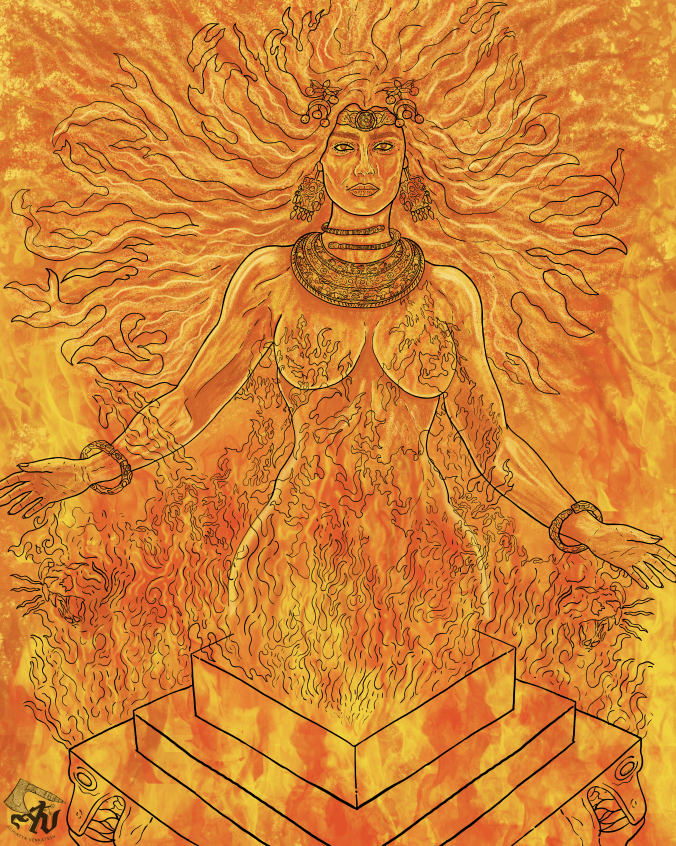
Of course, the beautiful evocation you see before you for this year’s anniversary isn’t Agni.
Instead, I’d chosen to go with the glorious illumination of the Goddess that Achintya Venkatesh had immanentized for us to incept the ‘Tabiti’ themed (A)Arti-cle(-series) which we began (finally!) publishing late last year.
In part, it had felt apt given tonight’s (Hindu) religious observance – the final Night of Chaitrā Navarātri, the Nine Nights of the Goddess within the month of Chaitra (and ‘Chitra’ – well, a radiance running right through this post, most certainly).
In part, also, it’s because I really do very much like this art; and its salience here serves also to stand for the sorts of improvements in ‘technical’ capabilities we’ve been fortunate (blessed) to make over the past few years – as well as a tangible reminder that it’s not only me [-C.A.R.] who puts in effort to make all of this even vaguely possible.
This transition – from the Agni rendition to the Devī – also resonates (to me, at any rate) something even more integral to our steadily evolving efforts, and which was a fairly major dimension as to the ‘Tabiti’ article both for which and from which this art has been drawn.
Think of it this way. The Flame is absolutely still there – and still very much actively engaged (and, we hope, engaging, likewise). And yet – we now see something much more, in a word, ‘deepa’ (as well as, in varying senses – ‘broader’, into the bargain).
It is ‘deepa’ both because I am once again indulging myself in a bilingual pun (‘दीप’ – ‘Illumination’, utilized for light and lamp that provides such, particularly in our offering context), but also because that ‘illumination’ has, indeed, been that of seeing deeper as to the concept thusly brought to light. More foundational, in fact – insofar as, as we have detailed within the aforesaid ‘Tabiti’ effort, we have now attained a far more comprehensive understanding for what you might call the ‘Flame-in–context’ : and, in this case (with particular deference towards Vedic ritual operations), how it is to be kindled, what it is which forms the necessary predicate that the ‘Alive Fire’ might be and become ’emplaced’, so that it may more truly be the Conduit to the Divine, and also the correct manner with which this ‘correlates’ to the similar expressions to be identified within other (parallel) Indo-European spheres and ritualine contexts to draw from (within) same (and I shall spare the reader’s patience by actually extolling all of these points directly in the course of what is supposed to be a relatively brief Anniversary post – they’re in the ‘Tabiti’ (A)Arti-cle if you’re interested). (You can see how all of that becomes quite pertinent as applies the more ‘operationalized’ side to that which we seek to do … )
These elements, of course, being rather specifically keyed to the Goddess which is so pervasive, so integral … and yet so seemingly ‘easily overlooked’ in favour of the more immediately (visually) apparent, instead. Hence why – to my ongoing incredulity – one finds both scholars and sightseers saying things like, as Wikipedia does at present: the Scythian figure of Tabiti having purportedly been “replaced by the male fire-gods Ātar and Agni, making her the only attested female Indo-Iranian fire-deity.”
And that is despite the circumstance for said Goddess – in Hindu terms – turning up very pointedly … (and not least, in the course of the occurrence which we’ve been celebrating via the Chaitra NavaRatri observance (in part), as it should happen), with the (to quote myself upon the subject): “‘Appearance / Quality of Fire’ (‘AgniVarṇāṃ’), ‘Burning with the [Heat/Fire of] Tapas’ (‘Tapasā Jvalantīṃ’; ‘Tapas’ pertaining to heat, light, energy and devotional ardor … the word’s direct Scythian cognate underpinning the theonym ‘Tabiti’ ), ‘of Bright Radiance’ (‘Vairocanīṃ’ – which can also be taken as a statement of origins, somewhat like a patronymic or matronymic would be), and” – rather extra-pertinently to our purpose – “Who is ‘Worshipped / Adored’ (‘Juṣṭām’) as the executor-vector via which the objectives of pious conduct (‘Phaleṣu’) are obtained (the sense to this last pair of terms being attested via Sāyaṇa’s commentary, so the insightful Nyāyaratnasiṃha has informed me; the Swami Vimalananda translation for the MahaNarayana Upanishad would appear to concur, viz. – “the Power that is supplicated to by the devotees for the fruition of their work” )” .
I reference all this as the other sense I mean when I speak toward a ‘broader’ appreciation & perception – it is not simply observing the coterminities between co-expressions identified between different Indo-European spheres (e.g. the Hindu and the Hellenic or Roman). It is also the competency to extend one’s view within an individual IE sphere – and thereby seek to more fulsomely engage with and understand that which is already there, both upon its own terms as well as within the comparative Indo-European context.
And not be afraid to just move on right past the ‘Established Wisdoms’ of the field to more fruitfully engage with That Which Is Actually There instead.
And, to speak of ‘That Which Is Actually There’, instead –
Arya Akasha came into being due to my having been Told to (begin) bring(ing) it about, whilst in front of the blessed Durgā Mūrti at around this time in 2016. I was there to offer thanks for something – something rather miraculous – which had been Done for me (inter alia).
I mention this point of ‘ignition’ as to our sacred project – precisely because it forms the as-yet under-mentioned (within this piece, and its presaging annual forerunners, at any rate) ‘rationale’ for why I had felt that, this time around, a Goddess ‘Chitra’ (‘चित्र’) should be there in pride-of-place for this year’s commemoration.
Because this is the ‘Source’ – and we are, as ever, Returning Thereto.
I mean this, of course, in multiple senses – but for now, and to bring things full-circle in another manner, once again … we had earlier made mention for “tonight’s (Hindu) religious observance – the final Night of Chaitrā Navarātri, the Nine Nights of the Goddess within the month of Chaitra”.
Now, that date – the Ninth of Chaitra – it is significant and it is significantly mentioned at several junctures within the relevant scriptures. One of these is for detailing the occasion of the Goddess being (Re-)Born as Pārvatī at the Court of the King of the Himalayas (in, as we may have made allusion to earlier, quite the ‘incendiary’ and outright ‘incandescent’ panoply – as befits such a Goddess ! ) [this is at Devi Bhagavata Purana VII 31 26] ; however, another – and, again, rather more ‘foundational’ in many respects – parodos is to be found for Her , occurrent also upon the same ‘9th of Chaitra’ placement [Devi Bhagavata Purana XII 8 51 – c.f. Shiva Purana V 49 22], for the (at first) enigmatic figure featured within the famous episode from the Kena Upanishad, wherein following a great victory in the long-running War of the Gods against the Demons [‘A’Suras’] : it is made readily apparent that the true cause to Their Victory, Their Empowerment, Their Rule … is Her. (Something with, as it happens, some measure of co-occurrent expression in terms of inferential concept within the Hellenic sphere, as one major ‘elsewhere’ Indo-European example, as well)
Thus it is, also – with us.
The ‘foundational act’ in various IE spheres for Indo-European civilization is, in essence, the Recognition and the duly requisite Reverence to Her – the prime propitiation through which all else can (begin to) be (re-)immanentized, (re-)established, (re-)bestowed … even in the wake of quite literally ‘cataclysmic’ erasure of that which had existed afore.
It is said of Phoroneus (the ‘Bearer’ – ‘Bharata’ – of Fire and Bringer of Law) that it was precisely through such an act – indeed, being he who “Iunoni sacra primus fecit” (‘to Juno the Rites first carried out’ ) [Hyginus, Fabulae 143], assumedly utilizing that First Fire which he had obtained and which burned still at the heart of his first-founded city [Pausanias II 19 5] – that Phoroneus was bestowed the inception of rulership as boon (“[…] exordium regnandi tradidit Phoroneo, beneficium […]”) [Fabulae 143].
Yet it was not just any form of worship – even a first and foundational one – that he made … we would say with the Goddess. Hyginus’ recounting (inter various alia) is more specific. It was that he – “arma Iunoni primus fecit, qui eam causam primus regnandi potestatem habuit” [Fabulae, 274] : that is to say, he “made” (or “did” – “fēcit”) “arma” (‘armaments’ – but also, ‘army’, ‘battle, warfare’, ‘implements’) – ostensibly ‘to / for’ Her (‘Jūnōnī’ – dative case). And hence the not entirely unreasonable supposition that he was making some form of ‘weapons-offering’.
And yes … yes he was – except not an offering of a weapon to the Goddess – rather, this is the offering as Weapon. Something which we are well familiar with (indeed, ‘familiar’ is the operative term for some of these) in Vedic terms. [viz. for instance SBr III 5 1 21-25 31-36, III 5 2 8-14, for a start … and, above all, RV X 125 6, because this would be woefully incomplete without the justly-famed Devīsūktam]
In essence, we may say – there is the offering undertaken to the Goddess : this igniting the (operationalizing) outcome undertaken with the Goddess. We are reminded of that maxim of Aesop : ” Σὺν Ἀθηνᾷ καὶ σὺ χεῖρα κινεῖ ” – “[Together] With Athena, Also You[r] Hand[s] Move”.
And how better to do so than to be the Weapon in Her Hand. Perhaps this is the underpinning essence to Phoroneus’ exemplary act of piety in terms of the ‘Arma’ – that he offered himself … not as the sacrifice in the way of the swiftly-to-be-consumed mortal-material vessel through which energy is to be transferred Upstairs (most frequently of animal variety … sometimes of the human animal variety … ) through that Fire – but, instead, offering himself as the Weapon. The Instrument. The Conduit.
He is thus consecrated to be the ‘Bearer’ – both of that Vision, and of various of the tools bestowed to him through which it is to be operationalized.
(An interesting example for which, as it happens, being the ‘First Sword’ bestowed to Manu and his successors, as described within the Mahabharata [XII 160]. There, we hear of the Sword’s ‘birth’ from the Fire of the foundational Rite conducted within the course of the First War Of The World by Gods and Ṛṣis so as to protect the immanency of ‘Dharma’ from the onslaughts of the Demons.
This Blade is wielded first by Rudra Himself, and to terrific effect (in both senses). It is very much in keeping to His placement as Vāstoṣpati and Vratapā – the Protector of the Flame and the (Divine) Law’s Upholding; inferentially as empowered by the Devī, as at RV X 125 6, so as to smite (“hantavā”) the hater of religion (“brahmadviṣe”). Not least given Vāstoṣpati’s hailing as “Arjuna Sārameya” [RV VII 2], effectively the ‘Silver Canid’, would we consider the placement [per Pausanias II 19 5] of Phoroneus’ First Fire within the sacred space of Apollo Lykeios (both ‘Wolf-Apollo’ and ‘Light-Apollo’) within what would become Argos (cognate to ‘Arjuna’, we infer the city named for the site) to prove entirely uncoincidental. A most Famous Wolf, indeed!
He then, with due reverence (“satkṛtya”) hands the Weapon (“Asiṃ” – Sword), this Protector of Religion (as various translations have it : “Dharmasya Goptāraṃ”), whetted and tempered via the blood of the slain demons that still cover it (“dānavakṣatajokṣitam” – ‘dānavas’ being the demons, ‘kṣataja’ being the blood, and ‘ukṣitam’ being ‘wetted with’ or ‘cleansed / purified’ but also potentially connoting ’empowering’ and ‘enabling to grow’) to Vishnu [MBh XII 160 64].
He does this so that it may be bestowed, in turn, through Marīci & the MahaRṣis [i.e. the Priests – the Seers Whose divinings constitute the foundations of our ‘operationalized’ faith], to Vāsava [which we would read potentially in relation to the Nakṣatra of Dhaniṣṭhā (in Western terms, Delphinus, Apollo-linked, per Hyginus’ Fabulae 194 and etymology viz. ‘Delphi’) – after all, the Mbh [XIII 89 12] attests that via Śrāddha (Rites) performance under that Nakshatra, a (heroic) man (“naraḥ”) obtains (“prāpnuyānnāpadaṃ”) ‘the experience of sovereignty / rulership’ (“rājyabhāgī”), i.e. becomes a King. It is also (fittingly) ruled by the Graha / Planet of Mars, and these days is customarily conceptualized as connected to Rudra in His Aspect of the ‘Nataraja’ … this being, as it should happen, The ‘Order-Bringer’ par-excellence : regulating the Universe Entire through the rhythm of His Drum, which nowadays the asterism is also held to symbolize. Additionally, one finds mention within the Vedāṅga Jyotiṣa texts for an archaic cycling of time commencing with such an asterism … but let us move forward, in earnest)
All of which might sound somewhat ‘aggrandizing’ – yet whilst it is, indeed, a mantle of empowering honour … it is also worth considering just what it is which a Weapon is called upon to do. A Spear, for instance, or a Sword – it carries out its essential role in reshaping the world afront of it … via the head being thrust or swung with significant force, directly into whatever (or whomever) should so happen to prove the immediately proximate obstacle (“Vṛtra”) to its wielder’s will.
To carry out such a role, then, as Her Weapon – means effectively (and one hopes it is /effectively/ ) bashing one’s head into the obstinate antagonisms of the disenchanted and disOrdered realms which we inhabit … over, and over, and over again until the World improves (“gets the Point”, you might say). And then, because this is an inhabited realm rather than a block of marble – over and over again further, to ensure that whatever has become Ordered stays that way : fending back those despoiling efforts both subtle and superliminal that are marshalled near-constantly via both Demon and Disaffected Human alike.
Between this, and the evident enormity of our appointed area of operations (encompassing an entire spectra of Indo-European spheres of heritage, encompassing extensive spans of both geography and chronology apiece), it should prove no difficulty to observe why I have found it a trenchant necessity to continue pouring forth from my life, the light of one’s eyes, and the ever-extending suite of star-lumined hours post-midnight within which those otherwise-hidden insights may otherwise choose to reveal themselves.
Yet lest I be accused that ‘the only thing larger than his typical word-count is his ego’ … I should clarify that through my efforts I would not cast myself a contemporary Phoroneus. It would be patently inaccurate – and, in fact, downright solipsistic – to seek to do so.
Phoroneus’ great operation was a ‘foundational’ one. He did the thing first (implicitly – for within that cycle of creation); just as King Suratha (otherwise known as ‘Manu Sāvarṇi’) likewise undertook what we can infer to have been the first (amidst humanity, at any rate) similarly styled propitiation (that being the inception to our mortal observance for Chaitra NavaRatri – the outcome of which was also to be made the ‘First King’ of Men, as the result).
This is not my role.
That being, generally speaking, the re-illuminating that which is already there, instead of charting out things for the first (and functionally entirely unprecedented) time. Indeed, even where one can identify rather groundbreaking saliencies to our major ritualine undertakings – these have very much been situatable within the context of established tradition (particularly through the steady oversight or direct operational involvement from persons expertly proficient and accredited within the living IE sphere).
But to return, in various ways, to our core theme – there is a particular section of Latin text which I had intended to quote with regard to all of this, as it fairly beautifully resonates with that which we are herein, attesting that we do.
It comes, oddly enough, from a Christian writer – a man named Cassiodorus, penning these stirring orders within the 6th century AD, whilst in the service of the Gothic king Theodoric (himself a rather unanticipated ‘restorer’ of various features of Rome’s physical aspect, if not, lamentably, its spiritual). These words come from one of his ‘letters’ of state – entitled ‘Formula De Armifactoribus’ , the ‘Directive to the Weaponsmiths’ .
I am being slightly figurative there, viz. my choice of rendering ‘-factoribus’ (i.e. ‘-factores’) as ‘-smiths’, but with true purpose. ‘Manufacturers’ would be more direct – ‘Factory’, is indeed, from this root; but it feels so ‘impersonal’, ‘en-masse’, and ‘indirect’. ‘Armourer’ would do as a translation, in the sense of the ‘Makers of Armaments’. But we shall here indulge my preference for ‘Smith’. Why so? Well, (fully aware my concluding paragraph(s) are likely about to undertake a detour of perhaps even Odyssean proportions … ) in essence, it is to with the fact that for the archaic Indo-European, significant of the operations of the metaphysically potent Priest (whether man or God) were conceptualized as bearing strong coterminity to the undertakings of the Smith. (Not least, I think we may safely infer, as applies the rather obvious fact that both professions’ prominent activities feature highly skilled (and no doubt highly secretive) men labouring for hours upon end over a great fire, accompanied via the steady rhythm of percussive beats)
The Ynglinga Saga furnishes us with a fine illustration for the perspective – therein, we hear it attested that both Odin and His ‘hofgoðar’ (i.e. ‘Temple-Priests’) are known as “ljóðasmiðir”. This, we might render, perhaps, as ‘Verse-Smiths’ (or, perhaps, given the prospective Latin cognate, viz. ‘Laus’ & ‘Laudāre’, ‘Hymn-Smiths’). Sturluson’s text suggests the title flows from Their being responsible for the inception of this skill or potency (“íþrótt”), inferentially of “ljóð”, amidst the ‘Northern Countries’ (“norðrlöndum”) (“Hann ok hofgoðar hans heita ljóðasmiðir, því at sú íþrótt hófst af þeim í norðrlöndum.”). Of course, my own inference would be that this accolade declared the bearers to have been responsible for the introducing of ljóð in another fashion – namely, via crafting (‘smithing’, you might say) significant of these ‘charged’ vocalizations, specifically for such employment – basically, acting in the manner (and position) of the Vedic Ṛṣis responsible for the Hymns (and Mantras) of the Vedas (c.f. Odin’s hailing as ‘Galdrs föður’, ‘Father of Galdr’, as at Baldrs draumar III).
And that parallelism with Vedic is not only of such an ‘authorial’ dimension (not quite the right word to utilize for Shruti elements, but it shall do). Later within the same text we observe something of the sense for ‘ljóð’ that should evidently be entailed when speaking of such as the finely-wrought artifice of these ‘ljóðasmiðir’. One prominent exemplar but briefly recounted therein features Odin utilizing such “ljóð” to open up the Earth, Mountains, Stones, Mounds (“er upp laukst fyrir honum jörðin, ok björg ok steinar, ok haugarnir”), in order to retrieve a hidden wealth of Cows (“jarðfé”) which had been secreted therein, binding with His Words alone (“ok batt hann með orðum einum”) that which was therein which would have opposed Him.
This being a fairly direct correlate to what, in Vedic terms, we would find familiar as the prominent mythic deed of Bṛhaspati (also a Sky Father deific expression, linked with Rudra, and the planet Jupiter), the Lord of the ‘High Speech’ (‘Bṛh-‘ ( बृह् ) meaning ‘Prayer’ (c.f. ‘Brahman’ ब्रह्मन् in its ancient sense as ‘devotional element’, such as a ‘hymn’ or ‘theological understanding’ or ‘(the energy of a) ritual operator’), although it can also mean ‘Roar’; the ultimate root being, per Mayrhofer, from the same PIE *bʰerǵʰ- which underpins, for instance, that familiar Germanic word for ‘mountain’ – ‘Berg’, etc., and, for that matter, Skt. ‘Brahman’ in its *later* sense, as in ‘Absolute’, that which is highest;), accomplished via just such means.
Indeed, there is a rather beautiful phrasing at RV X 68 4, which describes His radiant incantation (“Arka” as like (“iva”) the hurling forth (“avakṣipann”) of a blazing meteor (or torch) from Heaven (“ulkām […] dyoḥ”); a mechanism given Force, we would infer, through the proper propitiation to the Source of the Divine Order that is the Goddess-inhabited Fire-Altar (“āpruṣāyan madhuna ṛtasya yonim”) cited immediately aforehand. Thus it is that His ‘comprehension’ (“amata” – ‘to-mind’), for the ‘secret name’ (“nāma […] guhā”) of these ‘resounding’ (“āsāṃ […] svarīṇāṃ”) elements within that space (“sadane”) [RV X 68 7], is enabled, as Griffith renders it , to “cleft the earth’s skin as it were with water” [RV X 68 4] so as to bring forth the stolen Cows “from the Mountain, like a bird’s young after the egg’s disclosure” [RV X 68 7]; the demon-dragon antagonist which had sought to occlude these Cows, Vala, left helpless to stop Him.
Oh, and continuing with our (my)theme – those Cows? ‘Dawn’ (“Soṣām”, i.e. Uṣas), ‘Sun’ or ‘Bright Sky’ (“Svaḥ” – ‘Svar’), and ‘Fire’ (“Agniṃ”).
As you can see – Bṛhaspati, too, is in the business of enabling both Illumination and restored perceptibility for Indo-European Divinity … something which He, too, undertakes through the sustained use of overwhelming bombardment of both Words and Fire-Power.
And which, going via elements drawn from the immediately preceding RV X 67, He should seem eminently amenable toward conducting in collaboration with an assembled cohort of entrusted and instructed comrades. Which brings us back to Odin within the course of the Ynglinga Saga once more.
It is stated (“með rúnum ok ljóðum, þeim er galdrar heita”) therein that, along with Runes, ljóð of a particular styling – known as ‘Galdr’ (going upon etymology, ‘forceful’ (viz. ‘shouting’), ‘chanting’, or ‘calling’ song, the latter potentially connoting ‘invocation’, i.e. ‘calling (to)’) – form a primary vector for Odin’s (or, for that matter, any other capable wielder) metaphysical potencies; both competencies (“íþróttir”) being being ‘taught’ by Him (“kendi hann”) – inferentially, one might presume, to the Æsir, given Sturluson’s assertion within the next clause to the sentence that it’s ‘for that’ (“fyrir því eru”) that the Æsir are called (“kallaðir”) ‘galdrasmiðir’.
That said, I would – perhaps predictably by now – proffer a potential alternative view. One hinging around the decided ambiguity at various junctures within the relevant (early) sectors of the Ynglinga Saga as to whether Gods or mortals are being referred to – a phenomenon partially, but not entirely, linked to Sturluson’s insistent euhemericism, wherein he recurrently presents Gods as ancient mortals, and what we might shorthand as ‘extraplanar locales’ to instead be likewise terrestrial human realms, with correlate ‘adjustments’ for terms which more authentically designate groupings of divinity to instead encompass groups of humans ethnonymically. (As applies ‘Aesir’ specifically, one also recalls the (Latinized) Gothic cognate for this of ‘Ansis’ (‘*Anses’ in original Gothic, per Lehmann – who also notes Polomé’s interpretation viz. “control of anses, whose chief is Odin, over magical powers”), viz. Jordanes’ detailing that the war-leaders / nobles (“proceres”) of the Goths, for having won a great victory over the Romans, were acclaimed “non puros homines, Semideos id est Ansis” – as Mierow’s translation phrases it: “not mere men, but demigods, that is Ansis”. It is not our purpose to delve heavily into what Jordanes *may* have been, in actuality, referring to there, as there are several worthwhile potentialities – but suffice to say, for our purposes herein, viz. ‘Aesir’ at that Ynglinga Saga section specifically : one is cognizant of the scholarship suggesting the potential for Sturluson to have read or otherwise had some familiarity with Jordanes.)
We also find the seemingly Irish-origin loanword, ‘díar’, which etymologically should mean ‘God’ (and very much, it would seem, applied to what we either know, or can reasonably infer to have been Gods), being utilized almost as a byword for ‘priests’ – the twelve “hofgoðar” of Asgard that are ‘called Díar’ (“díar kallaðir”) and hailed as ‘Dróttnar’ (i.e. ‘Lords’), and the situation of Njörð & Frey being appointed “blótgoða” (‘sacrifice-priests’), with this correlating to reported status as “Díar með Ásum” (‘Díar with(in) the Aesir’); there is also the case of “gyðja” – a term that, at once, might designate a Goddess and/or a Priestess … not least due to its appearance in relation to Freyja as “blótgyðja” (and I have my own thoughts about that, via way of Gullveig, Hestia, Tabiti, and Vāc, in the Altar-Fire), and notwithstanding its later appearance in (dative) plural (“gyðjunum”) with reference to the reserved potency of ‘seiðr’.
One way in which we might ‘square the circle’ is to observe the prospect that for ‘Eddic’ IE religion, just as with Vedic (and with good evidence to suggest similar might have arisen within archaic Roman – inter various alia – IE spheres), an elite clade of human ritualists could, as in Vedic, be understood to ‘step into the roles of’ or even outright ‘bear the essence(s) of’ particular Deities.
We would therefore hazard, not least in light of the aforementioned, the likelihood that rather than “Æsir kallaðir galdrasmiðir” truthfully indicating that it is The Aesir, as in The Gods Who are to be hailed as Galdr-Smiths, that this title should instead be understood to refer to the sorts of metaphysically potent operator capable of making use of this Odin-taught proficiency (perhaps a ‘people of the Gods’ in more figurative terms) … with the ‘Smith’ component, here, not referring to the initial forging of the hymnals or ‘incantations’ in question (i.e. not the ‘Ṛṣi’ type role) – but rather, that other and judiciously aforementioned iteration of undertaking, featuring intensive effort carried out utilizing a Fire, of the actively engaged Priest. That is – the Galdr, here, are that which are forged using said fire (assumedly to pre-wrought templating) and likewise thusly deployed, in similar manner to how a Vedic Priest would conduct our correlate iteration as to same.
Remarkable what one can do with the availment of the Living Flame !
Of course, why I mention all of this is due to my own (perhaps slightly over-wrought) sense of indignation in reaction to a certain rather affronting occasional academic (and/or otherwise astrally challenged) insistent diminuation wherein Phoroneus is effectively reduced to literally being but a physical, materialist smith (or, as Amzallag called him – a “metallurgist”, likewise relegating his role to one of “providing “divine knowledge” to humankind”, replete with the scare-quotes around “divine knowledge”, and with a rather dismalizing redefinition of “divine knowledge”, to apparently simply mean ‘slightly more advanced metalworking techniques, and a different kind of smelting’) engaged substantively in the production of mundane physical rather than (vastly more potent) metaphysical weaponry. As we can see – quite another understanding is not just possible, but vital.
And hence, as I quote the following from the much-vaunted (via me at least) “Formula De Armifactoribus”, one also perceives my intended broader scoping ambit for “Armifactor” therein, likewise. It is not how the Christian, Cassiodorus, would have intended it – but we are ‘taking it back’, back into the mists of the proto-mythic heritage-supernal past, even.
The letter, in its full breadth reads:
“Considera quid suscipis, et intellegis locum te dare non debere peccatis. arma enim bene construere hoc est salutem velle omnium custodire, quia prima facie ipsis terretur inimicus et incipit animo cedere, si se cognoscit similia non habere. atque ideo ab indictione illa militibus te at fabris armorum, invitati morum tuorum opinione, praefecimus, ut tale opus ab artificibus exigas, quale nobis placere posse cognoscis. securitas te nostrae non inducat absentiae. quicquid feceris nos videmus. age qui usu ipso subtilissima perquisitionis errores artificum possumus prima fronte deprehendere et laudabiliter operata iudicare.
Vide ergo qua diligentia, quo studio faciendum est quod ad nostrum venturum constat examen. age itaque ut nulla te venalitas, nulla culpa demergat, quia veniale esse non potest quod in tali causa delinquitur, ne inde puniaris de qua parte peccaveris. opus quod mortem generat et salutem, interitus peccantium, custodia bonorum, contra improbos necessarium semper auxilium. hoc primum Phoroneus Iunoni dicitur obtulisse, ut inventum suum numinis, ut putabant, auspicio consecraret. haec in bello necessaria, in pace decora sunt: haec denique imbecilles fragilesque mortales cunctis beluis efficiunt fortiores.”
Which, per Bjornlie’s translation:
“Consider what you undertake and you will know that there is no room for you to be in error. For the intent to construct arms well provides the safety of all, since an enemy is terrified at the first appearance of these very instruments and he begins to lose spirit, if he knows that he does not possess similar equipment. And so for that reason, encouraged by the reputation of your character, from the present indiction we place you in charge of the soldiers and workmen of the arms factories, so that you may compel such important work from the craftsmen as you know would please us. Do not lead our security by your absence. We shall see whatever you accomplish. Know that we are able to detect at first glance the defects of craftsmen through the exercise of the very weapon, and by the subtlest investigation we are able to judge the best-wrought works with praise.
Behold, therefore, with what diligence, and with what care, that which is the test of our future must be made. Act, therefore, so that you become mired in no corruption, no blame, since what is neglected in such an important matter is not pardonable, and you would be punished in proportion to how much you have sinned. This work begets death and salvation, the destruction of those sinning, the protection of the good, and always necessary assistance against the wicked. Phoroneus is said to have first offered this craft to Juno, so that, as the ancients supposed, he had dedicated his invention to divine majesty at the very beginning. Such weapons are necessary in war and comely in peace; furthermore, they make fragile and weak mortals stronger than any beast.”
It is only those last few sentences that I had originally intended to close with – but the whole thing bears within it such apt sentiment as pertains our Mission (and its Inception, which we are choosing to commemorate through this work tonight), that I have chosen to include it here in full.
For you see, we are also (essentially) in the business of forging weapons (and certainly, Upholding Order). Very apt for a Chitra.
Some of these – which you mostly don’t get to see – entail the more active (metaphysical) proficiencies of the Priest.
Others, they are efforts for ‘illumination’. For that which has been, that which can be, and for that which is. They act in tandem with the mind, potentiating or pointing for the ‘Kratu’ (क्रतु, a cognate for Ancient Greek κράτος); which, in so doing, they play their role to begin to “make fragile and weak mortals stronger than any beast.”
“This work”, indeed, “begets death and salvation, the destruction of those sinning, the protection of the good, and always necessary assistance against the wicked.”
Terms which are not, here, read in the Christian sense with which Cassiodorus had sought to invest his invocation – but instead, in duly reverent resonance for conceptry of a rather more foundational essence.
Elements which would once have been encapsulated through the Latin ‘Fās’ (‘In Accordance With Divine Law’) – a term whose archaic underpinning is, effectively, “That Which Is Said”, and from (per de Vaan) PIE *bʰeh₂-os.
And as we have previously had cause to both observe and to explicate – this particular PIE root appears either foundationally coterminous with, or at the very least closely intentionally resonant with, that which entails ‘Illumination’ (indeed, Mayrhofer [KEWA II 497-8] has ‘bhāṣ-‘ and ‘bhās-‘, i.e. terms for speech and shining, respectively, in Sanskrit, to be of the same root directly, and featuring an intentional slight differentiation upon that last syllable).
As Terry Pratchett once put it:
“Sometimes it’s better to light a flamethrower than [merely] curse the darkness.”
And as we, ourselves, have often phrased the matter:
“Bravery will take you into the most dangerous of places.
Overwhelming fire-*páh₂wr shall see you safely through them.”
So shall it be.
Jai Mata Di.
 arya-akasha
Pingback: Durgā Interpretatio For The Present Devotional Season | arya-akasha