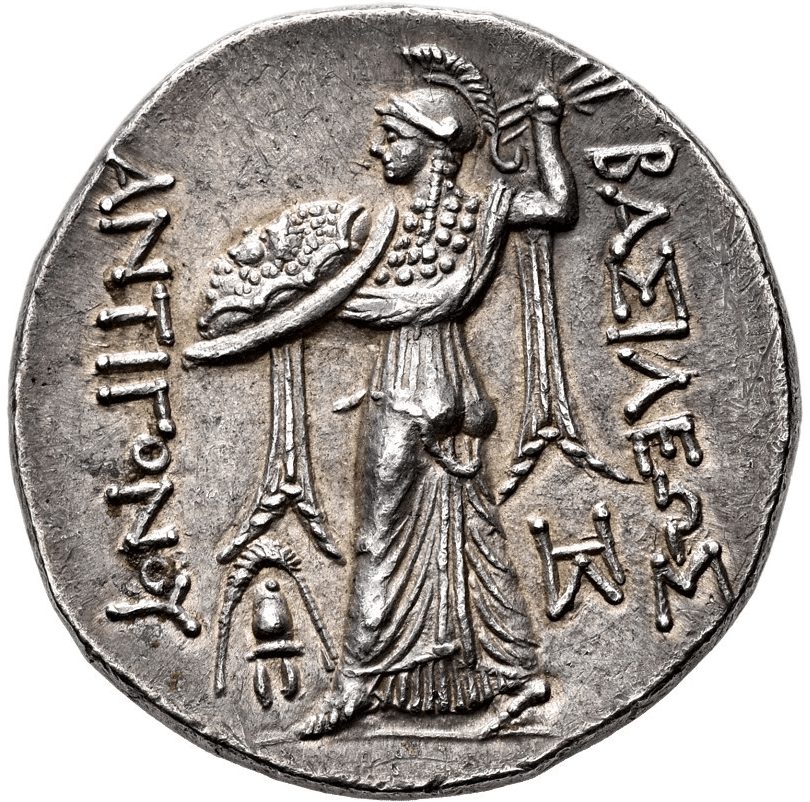
Recently, we’d had somebody write in via the site with relation to the ‘Storm’ characteristic in association with Athena. It’s something which one should think would enjoy more prominence in the perception as to the Goddess – but despite various attestations from around the Classical legendaria, as well as the strong implicit sense to such a prospect … it’s often overlooked.
So, as it may prove of a greater general interest … a slightly edited iteration of one of my replies to the gentleman in question. It is not complete, of course – but it is perhaps useful to have a bit of a ’roundup’ for some of the pertinent conceptry as the basis for future expansion within this area.
We begin with that which illustrates this piece – namely, that rather adroit skein of artistic representation prominent amidst the (post-)Macedonian Hellenic sphere particularly to the East; specifically, numismatic presentations of Athena Alkidemos [which I would in this context parse as ‘Protector of the Nation’], assumedly templated upon a style and salience at Pella where She was, it would seem, what in Sanskrit we would term the ‘Nagara Devata’. This example which we have chosen to illustrate the piece being one of Antigonus II Gonatas (somewhere around 271-265 BC), of the eponymous Diadochi-descended dynasty (who basically kept the Hellenic ‘core’ of the old Macedonian imperium built up under Philip II, Alexander’s famously one-eyed father), and issued from within Macedonia itself (Amphipolis, added to the Macedonian sphere mid-4th century BC, and a rather important center thereof following).
These numismatic iterations tend to feature Athena wielding Thunderbolt(s) (other representations for the same Aspect elsewhere in the Hellenic world tended to have a Spear there – and this cross-pollinated with the Macedonian iconography so you did also get almost exactly the same posing / stylistic features as the thunderbolt-wielding Athena Alkidemos, but wielding a Spear, on some of post-Macedonian successor coinage issues as well). This is also, as it happens, the same basic type (in terms of Athena Aspect) to those glorious renditions of the Seleucids – most prominently, Seleucus I Nikator – which could feature Her riding in an elephant quadriga chariot (Seleucus really liked those War-Elephants he got off Chandragupta Maurya .. and for good reason).
My favourite electrifying evocation of Her in such tempestuous panoply, however, would have to be that wonderful passage from Quintus Smyrnaeus’ ‘Fall of Troy’ :
“Then down before the aweless Maid He [Zeus] cast
Swift Lightning, Thunder, and deadly Thunderbolt;
And Her Heart leapt, and Gladdened was Her Soul.
She donned the Stormy Aegis flashing far,
Adamantine, massy, a marvel to the Gods,
Whereon was wrought Medusa’s ghastly head,
Fearful : strong serpents breathing forth the blast of ravening fire were on the face thereof.
Crashed on the Queen’s Breast all the Aegis-links,
As after Lightning crashes the Firmament.
Then grasped She Her Father’s Weapons, which no God save Zeus can lift, and wide Olympus shook.
Then swept She clouds and mist together on high;
Night over Earth was poured, Haze o’er the Sea.
Zeus Watched, and was right Glad as broad Heaven’s Floor
Rocked ‘neath the Goddess’s Feet, and crashed the Sky,
As though Invincible Zeus rushed forth to War.”
[Book XIV, 449-465, Way translation]
Beyond this, there are some other attestations from the textual canon for Her wielding thunderbolts – the most prominent which springs to mind being the recountings in, if memory serves, Hyginus’ ‘Fabulae’ and Apollodorus’ Epitome, for the fate meted out to Ajax The Lesser upon his way home from Troy. [other accounts have the proverbial swing of the headsman’s axe, so to speak, carried out by Poseidon – in concert with Athena’s wrath; but I digress]
As applies the former:
“After Ilium had been taken and the spoils divvied up, the Danaans set out for home. Because the Gods were angry at their desecration of the temples and Locrian Ajax’s forceful removal of Cassandra from Pallas’ icon, a hostile storm with adverse winds arose, and they were shipwrecked on the Capharean Rocks. In the storm Locrian Ajax was struck by lightning from Minerva’s Hand and dashed against the rocks by the surf; this is where the name Ajax’s Rocks comes from. […] “
[Hyginus, Fabulae, 116, Smith translation]
The latin, in case you were wondering – “[…] in qua tempestate Aiax Locrus fulmine est a Minerva ictus […]”
And, for the latter:
“And Athena threw a thunderbolt at the ship of Ajax; and when the ship went to pieces he made his way safe to a rock, and declared that he was saved in spite of the intention of Athena. But Poseidon smote the rock with his trident and split it, and Ajax fell into the sea and perished; and his body, being washed up, was buried by Thetis in Myconos.”
[Frazer translation, E VI 7]
The Greek:
“Ἀθηνᾶ δὲ ἐπὶ τὴν Αἴαντος ναῦν κεραυνὸν βάλλει, ὁ δὲ τῆς νεὼς διαλυθείσης ἐπί τινα πέτραν διασωθεὶς παρὰ τὴν θεοῦ ἔφη πρόνοιαν σεσῶσθαι. Ποσειδῶν δὲ πλήξας τῇ τριαίνῃ τὴν πέτραν ἔσχισεν, ὁ δὲ πεσὼν εἰς τὴν θάλασσαν τελευτᾷ, καὶ ἐκβρασθέντα θάπτει Θέτις ἐν Μυκόνῳ.”
Key word there, of course, being “κεραυνὸν”
Also, whilst it might be taken to be ‘poetic’ – Pindar’s VII Olympian Ode features the following [about line 42-43, I think?]
“ὡς ἂν θεᾷ πρῶτοι κτίσαιεν βωμὸν ἐναργέα, καὶ σεμνὰν θυσίαν θέμενοι
πατρί τε θυμὸν ἰάναιεν κόρᾳ τ᾽ ἐγχειβρόμῳ.”
It is rendered in the Svarlein translation:
” that they should be the first to build for the Goddess an altar visible to all men, and by founding a sacred burnt-offering warm the Spirit of the Father and of the Daughter Who Thunders with Her Spear.”
The relevant word there being ἐγχειβρόμῳ [you may recognize the ‘bromo-‘, as in ‘bromos’ (“βρόμος”), ‘thunder’ – the root quite handily goes with a ‘Roaring’ saliency; the front part, ‘enkhei-‘ is a form of ‘enkhos’ (“ἔγχος”) , archaically ‘spear’ ; ] (and two dictionaries both attest that yes, ‘Thundering With Her Spear’ is the right perception of it; an epithet, indeed), which the commentary notes is “Formed like ἐγχεικέραυνος” (i.e. “Hurling the Thunderbolt” – at Pindar’s IVth Pythian Ode, around line 194, this being evocatively translated, it would seem, as Zeus “Whose Spear Is The Thunderbolt”).
I have tended to feel that the ‘resonance’ between Zeus and Athena is rather pointedly invoked, there. And whilst the major thrust of this commentary has been more toward the ‘equivalent’ in terms of Armament (She Wields “Her Father’s Weapons” ( ‘λάζετο δ᾽ ἔντεα πατρός ‘), as Quintus Smyrnaeus puts it – those which “No God [other than] Zeus can lift” ( ‘ἅπερ θεὸς οὔτις ἀείρει νόσφι Διὸς μεγάλοιο’ ), with Her inexorable advance outright stated to be “As though Invincible Zeus rushed forth to War” (‘ὡς Διὸς ἀκαμάτοιο ποτὶ κλόνον ἐμμεμαῶτος.’), no less !) … it is perhaps also worth noting the other style of connexion to be found at 827-8 of Aeschylus’ Eumenides, viz. Athena declaring in relation to Zeus :
“and I alone of the Gods know the keys to the house where His Thunderbolt is sealed”
[Smyth translation]
The Bannon & Nagy revisions present it as:
“and I alone of the Gods know where the keys are to the house where His Thunderbolt is kept safe, under a seal sphrāgīs.”
“καὶ κλῇδας οἶδα δώματος μόνη θεῶν,
ἐν ᾧ κεραυνός ἐστιν ἐσφραγισμένος:”
[for the original Greek]
In effect, as we have elucidated at slightly greater length elsewhere, this speaks toward the ‘duality’ inherent in Athena / Minerva when viewed from a Vedic standpoint – insofar as She has within Her both the Rudra (and ‘Sky Father’) AND Vāc deific complexes … the latter being of rather particular saliency for reasons which are both overt and ‘esoteric’ as applies the ‘manifestation’ for such implacable weaponry . (We would also, just briefly, note that it is specifically a Triple Thunderbolt which we tend to find within various of these artistic displays for Athena wielding the Thunderbolt – in-line with the similar typology in evidence for not only Zeus during the Titanomachy with the First such Weapon, but also quite pointedly the TriKanda of Rudra in the cognate Vedic perception. What does it mean? Weaponry which is powerful across All Three realms of the Indo-European Cosmos. Quite literally Omni-Potent, we may say !)
I shall not spend paragraphs elaborating upon this theological situation herein, as applies Athena in relation to the Sky Father deific complex – suffice to say it is something we have written upon at great length elsewhere.
Meanwhile, the most prominent ‘Storm’ saliency for Her is most likely the Aegis / Gorgoneion … and not least because αἰγίς can also, quite literally, mean ‘Storm’.
Effectively, the Gorgoneion device may be conceptualized (in part) relative to the ‘Ghora’ [‘Terrific’, ‘Wrathful’] Facings / Visages of Rudra (and His Wife) – the key difference being that this was rendered as an ‘artefact’ or element of panoply / equipment within the Hellenic contemplation instead of simply being, well, a Divine Facing’s overt expression more ‘organically’, we might say. (There is also a ‘Trophy’ dimension – of a sort – to be found inherent in the ‘Skull / Severed-Head Bearing’ description accorded to (Kaal) Bhairava … which matches up in other aspects to what we should seem to observe with the Gorgon’s Head dynamic, if this is held to be linked to the figure whose flayed skin Athena / Minerva comes to bear – but more upon that in a forthcoming work)
Other than in Her Use, the Aegis is most prominent – indeed eponymous – for Zeus; hence Zeus Aigokhos [ Αἰγίοχος ], “Zeus Who Holds The Aegis”, the ‘Διὸς αἰγιόχοιο’ encountered in Hesiod, etc. Which, other than the ‘Goat-Skin’ interpretation (something also visible in various of the numismatic presentations for Athena, I would infer – and c.f. that prominent iconographic feature as to Vejovis), should have the ‘Gorgon’ dynamic also there linked – as confirmed via, for instance, Hyginus’ Astronomica [II XIII 7], wherein we hear of this particular constellation (as in, it’s literally also linked to a constellation – but I mean the term as in the two elements, ‘goat skin’ and ‘gorgon head / face’ are ‘in constellation’ with each other to produce the singular affect in question) being borne by Jupiter within the course of the Titanomachy. We do not, however, intend to get into the in-depth interpretation (and, dare I suggest – ‘correction’) for the Classical skeins of myth via the light of Vedic comparanda and archaeo-astronomy (the latter for which we are, in part, indebted to the work of N. Robertson in this very specifica area as applies the Hellenic) , herein.
Although we would also note that with the onset of Storms accompanying Sirius – the empowering circumstance of Athena imbuing what in Sanskrit we would perhaps term an ‘Amsha’ (via ‘Avesha’) correlate to that Dread Star (ref. Ardra / Rudra / The Manyu) which attests such a linkage for Her therewith, should likewise therefore underscore such an association of Storms and Thunderbolts to Her, as well. And not least when we consider the mechanism via which the Vedic correlate – Rudra (as Ardra, in Jyotisha terms – that is, Sirius) hunts and vanquishes the figure correlate to Pallas (note: not here an epithet of Athena / Minerva … rather, it is Her father in a somewhat ‘alternate’ telling, preserved for us largely through Ovid (viz. Fasti IV 373 & Metamorphoses IX 421) via way of Cicero [De Natura Deorum III 59], that concords more closely with the Vedic situation) … that being that certain tripartite Thunderbolt which we have earlier briefly extolled. Doing so, I might add, whilst most definitely in what would be termed a ‘Terrific’ Facing; and with the end-result, viz. the Tryambakah rite of the Yajurveda, of a dark animal skin (an antelope, here – likely something closer to a goat or sheepskin more archaically and to the West) being given to the God (Rudra) at a time of year correlate to what Roberts has pointed out should be ‘Goat'(-star) religious observance within the Hellenic sphere.
But let us briefly return to the Aegis / Gorgoneion.
As it happens, the device also shows up both a) ‘on loan’ (as presented in the texts) to Apollo [in Iliad XV], and b) with a ‘Melanaegis’ [i.e. Black Aegis] epithet for Dionysus, as well as c) with such a ‘Melanaegis’ borne by (the) Erinys (the attestation is from Aeschylus’ Seven Against Thebes, line 700 or thereabouts; and it’s the Erinys Singular, per translation – i.e. something along the lines of Demeter Erinys / Melaina , &c. ).
As applies the first two – Apollo & Dionysus – we would observe that these, too, are Sky Father Deific Expressions … and would further note the Goat-skin iconographically salient for the Roman figure of Vejovis / Vediovis / Vedius … that being ‘Baleful Jove’ (or, perhaps, ‘Young Jupiter’, viz. Ovid’s comments and the prospect for ‘Ve-‘ as a diminunative’, and, of course, Vedic Rudra [ref. ‘Kumara’] in His Emergence, as we keep meaning to write an article upon!, not least as it also relates to Athena / Minerva, viz. Kaal-Bhairava , and how this squares with relation to ‘Pallas’ .. I digress somewhat). Therefore, an Aegis (or, indeed, Melanaegis) saliency is somewhat anticipated – even if it’s treated as a rare and ‘on loan’ thing in one of the texts.
As applies the Goddess – the Erinys, I mean, a Dread Avenger Aspect of the Wife of the Sky Father, viz. Kali or Nirrti (or Skadi) – well, yes, that. Again, as anticipated. Interestingly, there is an association for Athena and the Erinyes, as we have briefly remarked upon elsewhere.
Oh, and further, there is the description for Hector in Book VIII of the Iliad as “Γοργοῦς ὄμματ᾽ ἔχων ἠδὲ βροτολοιγοῦ Ἄρηος.” – i.e. “wearing the stark eyes of a Gorgon, or murderous Ares” [Lattimore translation], or “and his eyes were as the eyes of the Gorgon or of Ares, bane of mortals” [Murray translation]; something we had connected to certain both Nordic and Hindu conceptry. [The context for Hector being hailed thusly – well, it is immediately before an Athena occurrence which features Her being armoured for war; quite the juxtaposition, and not least due to the ‘Ares’ referencey]
An interesting detail occurs at Iliad XXI 400-1 – wherein (as describing Ares’ attack upon Athena in attempted ‘payback’ for the grievous injury He’d suffered when She aided Diomedes … ) a blow is described as impacting “upon her tasselled aegis—the awful aegis against which not even the lightning of Zeus can prevail” [Murray translation] (“ὣς εἰπὼν οὔτησε κατ᾽ αἰγίδα θυσσανόεσσαν / σμερδαλέην, ἣν οὐδὲ Διὸς δάμνησι κεραυνός: ” for the original).
In any case, and to bring things, perhaps, ‘full circle’ back toward the iconography with which we had begun … the rationale which had infused my mind in choosing to culminate a previous year’s elocution upon Athena / Minerva within the context of the Quinquatria (as availed in illumination via our own [i.e. Hindu] Chaitra NavaRatri, most particularly), with the following:
“Yet given that Navaratra is, overtly, per the Devi Bhagavatam etc. that we had cited earlier, a Chandika oriented observance – well, especially given Ovid’s concluding line viz. the Aegis of Athena and Her well-known association with the Thunderbolt and Storm …
Vajrahastā ca me rakṣetprāṇaṃ kalyāṇaśobhanā”
Jai Mata Di.

