As promised, we begin our series of subsequent commentaries seeking to add illumination to ‘what went where’ – and, more especially as applies some detailings, ‘why‘ – for our TRI-LOKA charting of the archaic Indo-European cosmology. For the first installment, we delve into various of the considerations pertaining to the Middle Realm extant between the ‘Down Here’ of Earth / This World, and the higher ‘Up There’ of Heaven. And how and why there’s not so much of a contradiction as one might anticipate between the schemas which situate a ‘Sea’ in this intermediate zone, and those which have the comparatively ‘open air’ en route to the higher plane.
On the face of it, one would perhaps be forgiven for presuming that the presence of ‘Thalassa’ (‘θάλασσα’), the Sea, where we might otherwise anticipate the open and ‘airy’ space of the ‘Mid-Atmosphere’ (‘Antarikṣa’ अन्तरिक्ष (‘Between [Heaven & Earth] Visibility’, per SBr VII 1 2; although Shabda-Sagara suggests “in which are the Stars” (“Rikṣa” / “Ṛkṣa” as ‘Stars’) – we would instead suggest ‘through which the Stars [can be seen]’, if going down that route), ‘Loftin’ (‘The [Above] Airs’) – ‘Meðalheimr’ (‘Middle-Realm’) should prove a ‘displacement’ rather than a ‘development’.
Yet that is not the case.
As any weatherman can tell you, the Atmosphere is also a realm of Water. This is most prominently to be found within the form of Clouds (ref. PIE *nébʰ-os – whence ‘Nebula’, etc.).
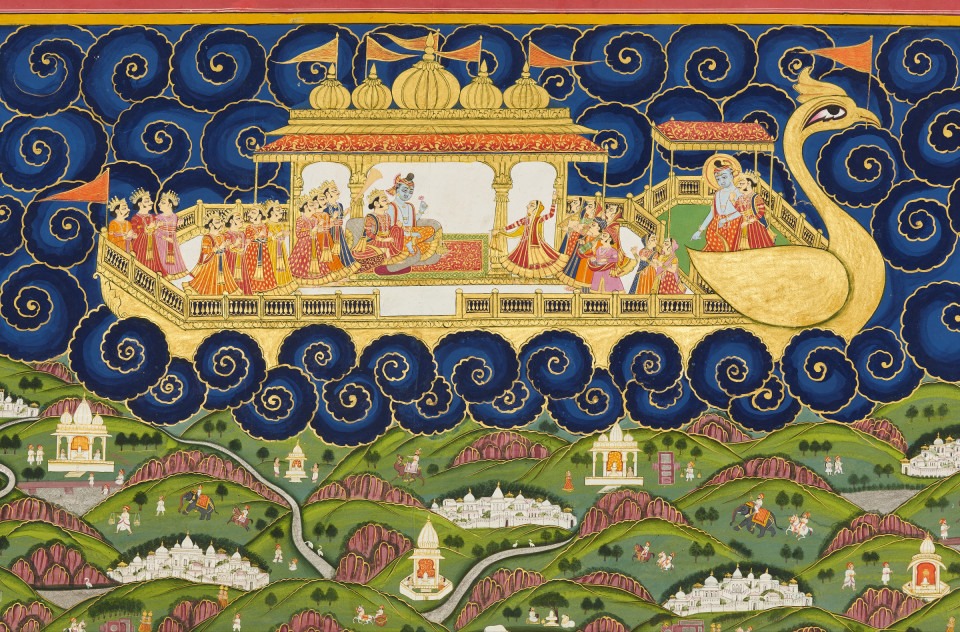
Although one also finds the space regarded as (bearing – or at the very least, heavily resembling – c.f. VS XXXVIII 7 which jointly invokes ‘Vāta’ as ‘Samudra’ & ‘Sarira’) a body of water in the more liquid sense – indeed seemingly traversable via boat (at least … of the right kind – the ‘Ritual Enclosure as Ship’ understanding springs instantly to mind; as does, with deference to both the colouration and apparent adjacent-elemental characterization for the space in question, that line from The Muppets’ Treasure Island: “Sailing For Adventure On The Big Blue Wet Thing”).
The ‘Sky’, it would appear, was also ‘Sea’.
This ‘dual nature’ (at least, from our perspective) is overtly recalled within the Vedic sphere, wherein we find the both a Samudra (‘Ocean’) [c.f. Yāska’s Nirukta II 10, inter alia] and the ostensible river Sarasvatī [RV VI 61 11 – and c.f. Sāyaṇa’s commentary upon RV I 188 8 & I 142 9] expressly situated with relation to the Antarikṣa. It has long seemed possible to me that the Styx might prove similar, not least given Her situation amidst silver pillars reaching to Ouranos [Theogony 778-9], the ‘sidereal’ Styx within Arcadia running down, as Pausanias puts it “a high cliff; I know of none other that rises to so great a height” [VIII 17 6, Jones & Ormerod translation], and of course, that dread Oath of the Immortals featuring the Styx arrayed alongside (between?) Ouranos & Gaia as the Third integral binding locus [Iliad XV 36, Odyssey V 184-5, etc.] almost as a seeming alternate ‘Three Worlds’ styling.
M.L. West had also observed the, in his words, “puzzling epithet” which “Homeric rivers sometimes have” of διειπετής / διιπετής, i.e. a compound for either “falling” or indeed “flying” , and with an “apparent locative διί”. Said ‘Diī’, he renders (not incorrectly) as “in the sky” – however we would draw out the more ‘Heavenly’ meaning (it is a curious form for that same root giving rise to ‘Zeus’). The supposition advanced by Schmitt is that this is a very archaic hailing – as Hooker paraphrases him, “a word which descended from [Proto-]Indo-European poetry; but its original sense had disappeared by the time of Homer, who employed it as a meaningless epithet of rivers.” Or, as West himself had phrased it – “It is evidently an old, stereotyped formula that may reflect an obsolete piece of cosmology.”
As we can quite readily begin to appreciate – the Hellenic ‘speciation’ for the ‘Middle Realm’ is not nearly so divergent as it first appears. Assumedly it quite logically flowed in concord to the great engagement with the (terrestrial, sidereal) Sea that the Greeks frequently had as a civilization. This corresponding significant emphasis upon the ‘Sea’ part to ‘Sea of Sky’ eventually leading to a substantive fading out for the ‘Sky’ part entirely – at least, from that particular Realm of the tripartite division. And, as part of this, something of a ‘descent’ also from contemplating either a body of water above or the above as a ‘body of water’ (figuratively or otherwise) … through to the affixion for various of the pertinent conceptry via the terrestrial sea – which is, of course, literally ‘down here’ at sea-level.
Hence, for instance, the rather remarkable ability one potentially has within the (later) Greek legendarium to literally sail to the afterlife – not through the air, but upon the (‘down here’) Sea.
Which is, to be sure, something of a ‘conceptual development’ – as whilst Odysseus might have managed such a feat within the Tenth Book of the eponymous Odyssey … per his own testimony therein, it was an unprecedented feat (“To Hades no man ever yet went in a black ship”, per the Murray translation for “εἰς Ἄϊδος δ᾽ οὔ πώ τις ἀφίκετο νηὶ μελαίνῃ.” [X, 502]). And one that required the traversing of not the ocean – but the Oceanus (Okeanos – Ὠκεανός), another liquid liminality which rings the world(s) in the similar fashion to the River Rasā of Vedic attestation (more upon this, perhaps, in due course).
In any case, notwithstanding the ‘mundanification’ (‘Disenchantment’?) for the metempsychotic journey to the afterworld to have it prospectively supplanted via a mere voyaging out West into the Atlantic a certain distance beyond Africa (if the rough positionings proffered by some early Common Era Greek sources are pursued) … even here we can perceive points of resonance with the more archaic tradition.
Most pertinently, the manner with which one would more conservatively make one’s way into the dread demesne of Hades (& His Wife) – would tend to feature crossing a particular River (and/or Marsh), most famously the Styx. In both approaches (the more readily accessible yet far broader sea, or the narrower yet more difficult to cross river) , it is a sufficiently foreboding span of water which is to be traversed – and to one Darkened destination. To this point (and trajectory) we shall return in a moment.
As a brief aside – it should be noted that the phenomenon for formerly ‘Sky’ / ‘(Mid-)Atmospheric’ situated elements steadily ‘shifting’ so as to become much more saliently seen as ‘Sea’ is by no means an exclusively Hellenic phenomenon. One can also observe a somewhat similar transition that has taken place for Varuna – these days popularly thought of in relation to the terrestrial ocean; yet in Vedic pertinence He is associated to that Samudra found above, and even pointedly hailed as (a) Rudra at RV V 70 2-3 to further underscore His Antarikṣa dominion.
Similarly, the Roman figure of Neptune should, by linguistic underpinnings, be a deific of the (Moisture-bearing) Atmosphere. His Theonym is built upon the PIE *Nebʰ- we had briefly encountered above, connoting ‘Clouds’ and ‘[Atmospheric] Moisture’. De Vaan proffers two potential etymologies to produce ‘Neptune’ from this – effectively (and to rather brutishly paraphrase), either ‘Lord of ‘*Nebʰ-ing” (“derivation from an abstract *Nebʰ-tu- ‘moisturing’ with a suffix *-h₃n- for indicating ‘rulers’: hence ‘Lord of moisturing'”, to quote de Vaan directly), with the ‘moisturing’ actively occurring, I would infer, via Clouds and Rainfall; or “Who is with *Nebʰ-” (“a de-instrumental derivative *Nebʰtuh₁-n- ‘who is with moisture'”, again to quote de Vaan directly), which should logically posit the archaic Neptune to have been up there amongst the Clouds which bear the resonancy to His Name (viz. Latin ‘Nimbus’ – ‘Rain-Cloud’ & ‘Imber’ – ‘Rain(Shower)’, both also of *Nebʰ- origination).
We would also observe with interest the repeated remark within the Second ‘Mythographus Vaticanus’ (at II 3 & 11 in the Pepin translation) that, to quote one of these (perhaps aptly, the eleventh … ): “Neptuno deputant mare eumque secunde sortis regnatorem perhibent, quia aqua uicinior est celo quam terra”; which, per Pepin: “Men assign the sea to Neptune. They call Him ruler of the second lot, since water is closer to the sky than earth is”. Exactly in-line with our anticipated situation for the ‘Watery’ realm to be the ‘Middle’ – at once above Earth (“Terra”) and yet beneath the (high) Heavens / Sky (“Celo”).
The last thing which we shall state upon this particular Realm – for now – concerns the Nordic iterations. Which, on the surface, look like they’re fundamentally consistent with what we find attested for this (Mid-)Layer from the Vedas. That is to say – it’s a ‘middle’ space [“Meðalheimr”, as it is also known per Skáldskaparmál 74 – “Madhya-” ( मध्य – ‘Middle’) designating the same space and conceptual understanding at RV X 55 3; I had been impressed to learn something for a change, viz. Shaw pointing out a further cognate, in Ancient Greek – “μεσσηγὺς” [‘Messēgus’] – at Iliad V 569, referring to the space between “γαίης τε καὶ οὐρανοῦ ἀστερόεντος” [Gaia / Earth, and Ouranos the Starry] traversed by Hera] in between Earth and Heaven, with an ‘Atmospheric’ (‘Loftin’ – ‘Air [Above]’) major ‘characterization’.
More to the point, we also find a parallel suite of attestations seeming to describe the third realm not of Earth or Sky in terms of the Sea. This is certainly the case at Gylfaginning 8 – wherein we hear of the Earth [“jörðina”, “Jörðin”] (and associated elements – Mountains [“björgin”] and, as the Brodeur translation puts it, “gravel and stones” [“grjót ok urðir”] – from other ‘bodily’ elements, viz. bones, teeth and molars, and broken bones [“beinunum”, “tönnum ok jöxlum”, “beinum […] brotin”, respectively]) being presented as ‘bodily’ made from Ymir’s corpse by the first of the three Odinic ‘masques’ speaking (Hárr – ‘The High One’); the second (Jafnhárr – ‘Just-As-High’) detailing the aforementioned ‘Sea’ [“sjá”] formation, from the “blood” [“blóði] of said felled adversary; followed by the Third (Þriði) Masque speaking to the situation of the Heaven(s) [“himin”], from the skull [“haus”] (and, to that last locus, we might perhaps contemplate the decapitated head of Prajapati => the asterism of Mṛgaśira (or Mṛgaśīrṣa), the ‘Deer’s Head’, following Rudra’s ‘rendering’ for this; more upon this some other time).
Given that this is from the Prose Edda, we should be unsurprised that there are some ‘complications’ to the more straightforward application to our schema – the First Masque, for instance, speaks not only of Earth, but also adds in a somewhat ‘out of sequence’ mentioning for the “sæinn ok vötnin” [‘Sea and Waters”, as Brodeur’s translation has it] afore returning to the more ‘telluric’ point of discussion once more. Meanwhile, the Second Masque’s annotation for the Sea being in a ‘ring’ [“hring”] about the habitable earth should seem at once to ‘cross the streams’ [I apologize for nothing with that reference] to the aforementioned dimension for the Rasā & Oceanus … i.e. not (quite) the Waters as Mid-Atmosphere, but rather the liminal round external barrier which marks the edge of the World(s) [well, the ‘Civilized’ or ‘Habitable’ such regions, at any rate] and beyond which lies (as we hear later in the same Gylfaginning section – following mention for the “djúpi sjár” [‘Deep Sea’, per Brodeur] … with which the ‘Oceanus’ etc. assumedly somewhat also aligns) the territory of those Demons, the Giants or Rakshasas (as it is in the Mesocosmic arrangement of the Vedic Ritual Enclosure) or Paṇis (as we hear of beyond the Rasa per RV X 108).
There is also the situation for Ginnungagap – which, as noted on the chart, we observe at Skáldskaparmál 74 to occur alongside “Meðalheimr” as heiti for “Loft”, i.e. the Air that is our major Antarikṣa correlate. We can be fairly sure that this should correlate to our ‘Mid-Realm’ for a few reasons. One of which being the detailing at Gylfaginning 8 for the setting of what should appear, depending upon manuscript (given in parentheses), to be the Stars (inter alia) – either “á miðjan Ginnungahimin” [Regius] or “í mitt Ginnungagap á himin” [Trajectinus] or “í mitt Ginnungagap” [Upsaliensis], (admittedly one [Wormianus] instead has them set only “á himin”); with the purpose for this being “bæði ofan ok neðan til at lýsa himin ok jörð” [per three manuscripts – the Regius, Trajectinus, and Wormianus] or “ofan ok neðan á himininn at lýsa jörðina” [per the Wormianus manuscript, the one which mentions for placement only “Ginnungagap”, rather than “Ginnungagap á himin”, “himin”, or “Ginnungahimin”).
Or, to phrase this in English – the Stars are set ‘in the Middle [‘miðja’ – like ‘waist’] Ginnungahimin’, or ” in the midst of the Yawning Void, in the heaven” (to quote Brodeur’s translation for the text drawn from the Trajectinus presentation), or likewise ‘in midst [of] Ginnungagap’, respectively; for the purpose “both above and below, to illumine heaven and earth” (per Brodeur’s translation for the phrasing occurrent in the Regius, Trajectinus, and Wormianus manuscripts). That is to say – they ‘illuminate’ both ‘upwards’ and ‘downwards’ from their ‘middle’ layer position, to be seen from both Heaven above (them) and Earth below (them). Albeit with some evident … confusion introduced via whether ‘Himin’ (Heaven) is supposed to be there as an independent location to ‘Ginnungagap’ for the Stars’ emplacement, as a qualifier for ‘Ginnungagap’ (i.e. ‘Ginnungahimin’), or even there instead of Ginnungagap entirely (as in the Wormianus iteration – which nevertheless preserves the “both above and below, to illumine heaven and earth”).
We would suggest the ambiguity to be resolvable via the supposition that it is the Sun which should go into Heaven (just as it is in Vedic terms), with the Moon meanwhile being in the Middle-Air. As Sturluson later puts it – “sumum á himni, sumar fóru lausar undir himni”, which per Brodeur: “some in heaven, some wandered free under the heavens”. Given stars (or other such celestial luminescences) are not usually known for their proceeding down here upon the ground (unless something has seriously gone wrong and/or very, very right somewhere) … the under “himni” (in fact “Heaven” in dative singular, contra Brodeur’s idiomatic translation there) can therefore only logically refer to the Mid-Realm we have been speaking upon.
Which does not, of course, speak toward those Stars that are to be found in Heaven; and leaves for an interesting question as to just what form of observable skyward illuminations had been intended to be sorted to which stationing. An obvious supposition would be that the Planets were the ‘wandering’ ones (notwithstanding that, per AV-S XIX 7, one should seemingly anticipate these to be ‘moving’ amidst Heaven – “divicarā” therein).
(Although one also contemplates the Avestan occurrence ‘between Earth and Heaven’ [“Antarə Ząm Asanəmca”] within Yasht 8 8 for “stārō kərəmå” [‘Star-Wyrms’ ?] as harried by Tishtrya [Tishtrya, of course, being Tishya / Sirius, i.e. analogous to Rudra]. Following Panaino, we would usually surmise that with these being the adversarial ‘Pairikas’ [“Sorceresses”, ‘Demonesses”], that these ought construe meteor-showers; and therefore, following Haghighi, Najari, & Namiranian, the “Patanti” which describes their motion, instead of ‘Flying’, constituting ‘Falling’ – due to Tishtrya’s “taurvayeiti” [or “tauruuaiieiti”] action of smiting [ref., as I’d put it at the time “Sanskrit Turv (तुर्व्) … overpower, injure, kill”], and “titārayeiti” [which, again, to quote my prior analysis : “seemingly not quite ‘overcome’ but ‘pass over’ – ref. Sanskrit ‘titarti’ [c.f. tárati (तरति) – which also encompasses ‘sailing’, ‘swimming’ or ‘floating’, as well as ‘overcoming’, and ‘running through’”]. Perhaps this has some bearing upon why Odin is so stated to be where the Hrímþursar are within this Mid-Atmosphere region)
Speaking of the Moon and Ginnungagap – we might also make mention for the detailing at Gylfaginning 15 concerning the middle of the three Wells and Roots to be found therein. This being asserted to be Mímisbrunnr – the Well of Mimir – and also, per Sturluson’s citation for it, “hvar þú auga falt” … where [his] Eye [he] “hid / buried / entrusted”. The Sun and Moon are both Eyes of the Sky Father in Vedic understanding (these are joined by Fire to make the Three Eyes of Shiva), with the Moon (Soma) also correlating to that certain empowering elixir. Given the Moon fades from view (becoming ‘hidden’), inferentially perhaps ‘sinking into the (occluding) air’; and that by definition a ‘brunnr’ entails a place of water – it should not prove hard to put all of this together in the manner which we have just done.
That that particular zone is evidently significantly linked with Odin can be readily attested via the utterance of Hárr in response to the query of Gangleri at Gylfaginning 3 concerning where Odin was to be found “before Heaven and Earth were made” [per the Brodeur translation].That being “Þá var hann með hrímþursum” – i.e. “He was then with the Rime-Giants” (per Brodeur, once more) – which is also, it should seem, the similar placement to that ‘root of Yggdrasil’ which locates Mímisbrunnr : “til hrímþursa horfir” [Gylfaginning 15].
All of this, of course, being readily in-line with our familiar Rudra – Himself saliently of the Middle-Space. And c.f., perhaps, the enigmatic underpinnings to the “Mithodin” / “Mithothyn” / ‘Mitothin” one finds at I 7 2 of Saxo Grammaticus – the insistence upon separate offerings for individual Gods rather than ‘mingled’ [“confusis permixtisque” – “confused and mingled”, per Fisher’s translation] sacrifices in a manner suspiciously reminiscent for the Roudran-propitiationary caution at RV II 33 4 [“sahūtī” referring to just exactly that – “mingled invocation” / ” invocation shared (with other Gods)” , per Griffith & Jamison/Brereton, respectively], the situation of disease and the sanctioning of criminals in relation to also being rather iconically Roudran … even if the decapitation dynamic is, instead, that of His Prey (Prajapati – resulting in the Mṛgaśira (Mṛgaśīrṣa) [‘Deer’s Head’] constellation as the result of the quarry’s transfixed body ascending into the sky; ref., perhaps, that which happens to Ymir to produce the Skull-Sky – the dread deed of Rudra which would therefore be correlate with said Ymir-slaying being linked with the (Re-)Ascent of Rudra to Heaven mytheme via, inter alia, the Ṛṣi for the vitally relevant RV X 61, Nābhānediṣṭha Mānava via way of Aitareya Brahmana V 14). The obvious difficulty of the ‘double-up’ viz. both Odin & ‘Mithothyn’ … well, Saxo has form in this area – he does the same thing, with the same underlying IE myth(eme), at III 4 10 with what should seem a ‘Facing’ of Odin, ‘Ollerus’ [‘Ullr’], as we have addressed elsewhere) .
 arya-akasha
Pingback: TRI-LOKA : The Three Worlds Of Indo-European Cosmology – Part Three: The Dead Among The Stars | arya-akasha
Pingback: TRI-LOKA: The Three Worlds of Indo-European Cosmology | arya-akasha | Vermont Folk Troth
Pingback: TRI-LOKA : The Three Worlds Of Indo-European Cosmology – Part Four: Amidst The Glorious & Ancestral Dead | arya-akasha