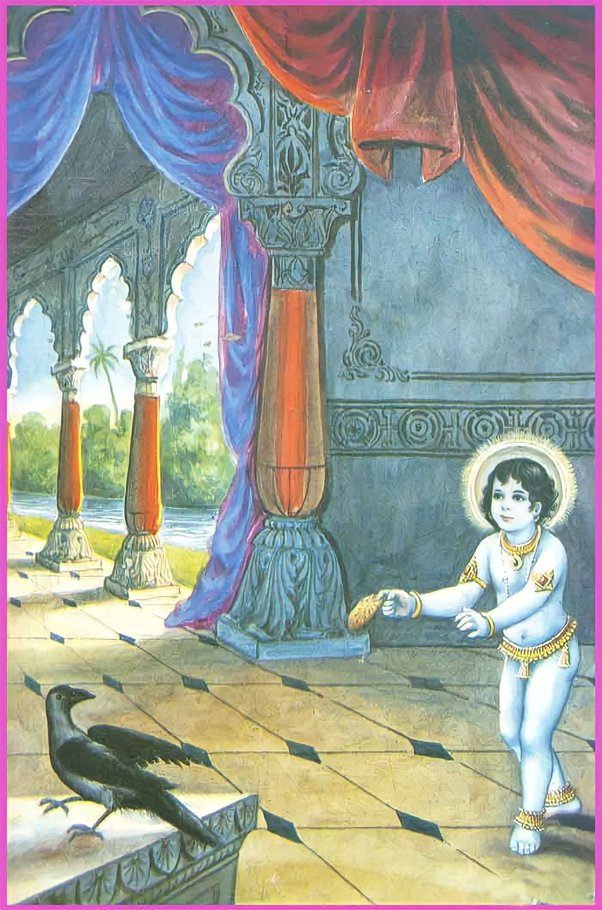
Earlier, an associate, ᛊᚺᛟᚾᚨᚾ ᛏᚨᛚᛈᚨᛞᛖ had written of the vital engagement between Kakabhushundi (the Crow-Sage : काक / kāka being ‘Crow’) and the young Lord Rama which occurs at Ayodhya.
Now, this reminded me of a certain suite of detailing from the Rígsþula (which, effectively, sets out a Nordic/Germanic caste schema) wherein ‘Young Konr’ [‘Konr ungr’ – as Pettit notes, a pun on ‘Konungr’, i.e. ‘King’] , having already begun to develop some rather remarkable (inherited) skills over and above his elder brothers, is out hunting one day … and, I’ll let the text take over [in the Pettit translation]:
Reið Konr ungr
kjörr ok skóga,
kolfi fleygði,
kyrrði fugla.
“Young Konr rode through thickets and forests,
let fly with heavy arrow, silenced birds.”
Þá kvað þat kráka,
sat kvisti ein:
“Hvat skaltu, Konr ungr,
kyrra fugla?
Heldr mætti ér
hestum ríða
[hjǫrum bregða]
ok her fella.
“Then a Crow said this — it sat alone on a branch:
‘Why must you, young Konr, silence birds?
You could rather be riding horses [drawing swords] and felling an army
Á Danr ok Danpr
dýrar hallir,
æðra óðal
en ér hafið;
þeir kunnu vel
kjóli at ríða,
egg at kenna,
undir rjúfa.”
‘Danr and Danpr own costly halls,
nobler inherited properties than you possess;
they know well how to ride in a long ship,
acquaint [others with] the edge, inflict wounds.’”
Whilst we could, potentially, detect just the vaguest possibility of a hint of self-interest in this Crow both a) cajoling the young huntsman to stop ‘silencing’ [‘kyrra’ – ‘to calm/still’, so ‘killing’ ; also used elsewhere in the text for, say, putting out fire : “kyrra elda”] birds … and instead to go and b) start slaying men instead [‘Feed The Crows / Ravens’ means something a bit more … ‘active’ in Nordic idiom than it might in Hindu baseline familiarity. Insofar as while there’s still going to be shades of the dead involved … they uh … weren’t dead up until immediately beforehand] …
… I would instead suggest this proffered counsel to prove much as a certain other prince was told by a ‘Black’ figure, once upon a time … that is, the Divine imperative to Get Up And Attain Glory (by being that which one is supposed to be).
This is especially the case given, you know, just Whose Emissaries the Corvid can prove to be.
And if you answered ‘Odin’ there … well, yes – and also as Rudra [c.f. the ‘Kṛṣṇā’ avian coterie of ‘Aviṣyu’ [‘Voracious’, ‘Vehement’, ‘Violent’, ‘Very Keen’, ‘Wishing’/’Desirous’] characterization encountered at AV-S XI 2 2] : Kakabhushundi as a Shaivite devotee (long story) makes rather logical sense upon additional bases with this in mind.
Of course, I would be both personally as well as professionally remiss if I did not also mention the Corvidae saliency with relation to the Goddess as well as the God.
Within the Kādambari of Bāṇabhaṭṭa (& Son), the Great (And Terrific) Goddess(-Form) Chandika is encountered:
“ārādhyamānāṃ sarvataḥ kaṭhoravāyasagaṇena … stūyamānām”
“Being worshipped from all sides by the Retinue of Crows both razor sharp and unyielding Who sang Her Glories”
[ to quote from my own translation for the verse in question ]
(The term rendered as ‘Crows’ there is ‘Vaayasa’ – also applied in related form [ वयश / Vayaś ] to the Maruts, as at RV V 41 13 &c. )
But it is a rather more pointedly ‘Advisory’ (Angelic?) Corvid occurrence with which, I think, we shall conclude (for now, anyway).
Within the course of Jason’s quest to gain the Golden Fleece of Colchis, and the (guarded) heart of the Priestess of Hekate, Medea the hero is assisted and guided via the truly mighty trio of Hera, Athena, and Aphrodite (Cypris – Κύπρις) [And, of course, Hecate quite strikingly appears, also] :
Apollonius of Rhodes [III, 916-947 ] has Jason accompanied by one Mopsus, a noteworthy augur who carried out his divinations via birds (‘ οἰωνός ‘).
Hera sends a Cawing Crow [“λακέρυζαι […] κορῶναι”] in order to advise Jason – Speaking, indeed, with the Voice of the God(dess) [“ὀμφὴν οἰωνοῖο θεήλατον”] .
Which proceeds to rather roundly insult his ability as a Seer and to get out the way poste haste. Which, as it happens, Mopsus interprets correctly and with what may be additional information thusly rendered via his attrained eye. Thus facilitating further Jason’s successful pursuits therethrough.
All because the hero(es) listened to the Crow.
[As a point of no doubt scintillating interest , following the attendant advice and trebly Blessed via the Goddess & Goddess & Goddess , Jason is described as being like Sirius ( Σείριος ) when he appears to Medea – Sirius, of course, being Ardra … that is to say Rudra (The Hunter, The Archer, The Wolf Himself)… and you see where I am going with That ]
In essence – though the Wisdom of the Corvid does not necessarily always reveal itself easily (indeed, many may prove tempted to ignore it as just so much over-long squawking, or something) : to the right set of ears, the Corvid Sage truly is the Voice of the Divine … an ‘Emissary’, an ‘Angel’ (in the more archaic Hellenic sense to the term), Heavens-sent to incite, to impel, to inspire That Which Is Necessary for the next step to the Divine Design in earnest.
Should you be fortunate enough to be Told to do something by one … best be going along with it.
Lest you, too, should end up ‘Feeding The Crows.’


In regards to the comparison of Jason to Lord Shiva I’m wondering if there is any connection between Jason’s removal of the dragon’s teeth in order to sow them and the belief that Lord Shiva either knocked out the teeth of Pushan or sent a missile into the sacrifice he was about to bite into thereby knocking them out. If so, could there be some correlation between Ophion as borne by Eurynome and Pushan as borne by Vak Devi. I seem to remember a Pelasgian story that Eurynome knocked out the teeth of Ophion and them falling to the earth where they became the first men of the Pelasgi
LikeLike
Pingback: The Crows of Juno | arya-akasha