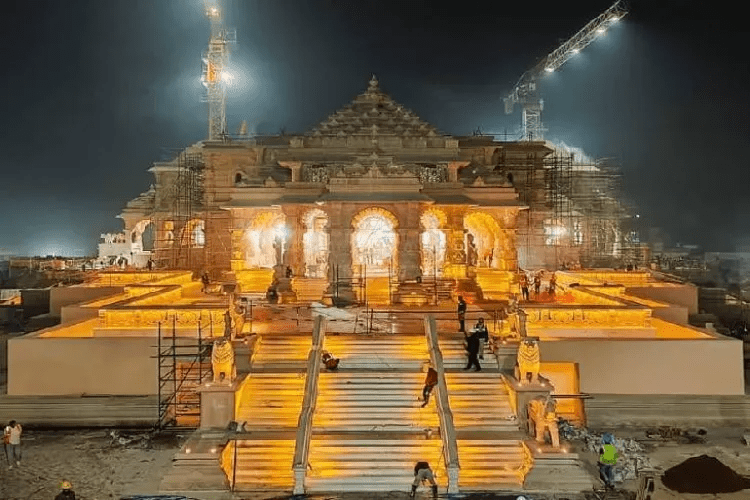
Earlier, a Brahminical associate had asked if I’d be writing anything for today’s occasion – that being the Investiture of the Murti (Prāṇa Pratiṣṭhā – ‘Breath-Installment’) at the newly constructed Ram Mandir in the city of His Birth, Ayodhyah.
To be honest, I hadn’t entirely intended upon it – there are so many glowing tributes of writing out there already. What would I be adding, especially from so far away?
But he was insistent – and urged that an ‘Indo-European’ perspective should be needed. Which, to be sure, is rather unlikely to be something already in circulation.
Now, this is a Hindu occasion – a Hindu victory. It is not my purpose to look to delve into elaborate schemas of cognate conceptry as applies, for instance, how the Investiture of the Murti reminds me of what appear to have been the Germanic understandings in this area; nor how the fact that this is the Child Form for Rama should seem similar to the occurrence for Classical (Greco-Roman) sites of devotion to the ‘Young Zeus’ [ref. Pausanias VII 24 4, etc.]
It doesn’t need them. As with any major religious saliency (whether Hindu, or any of its brother IE faiths) it doesn’t attain value simply because it happens to be Indo-European.
Its strength, its importance, its vitality is because it is Hindu – and because it is Divine.
But it does have a value – symbolically and substantively – also to the broader Indo-European sphere.
When my Brahminical comrade was talking me into talking about this occasion, we had discussed some Western points of comparison for this undertaking, in terms of what it means.
Except here’s the thing – there’s no easy comparison to be made here. Why? Because whilst we can most certainly identify any number of exemplars for the “place of worship taken / demolished / converted / co-opted” side to the equation …
… the corresponding “place of worship taken back & re-consecrated” dimension is more than a little lacking, to say the least. Not just in terms of ‘has happened’ – but also in terms of ‘could happen’. At least, conceivably viably and within our more immediate spans of living.
To situate it within more concretely familiar terms for a European audience –
The Hagia Sophia may one day be converted back from a Mosque into a Museum – but the odds for this structure being returned to its status as a functioning Eastern Orthodox Basilica … well, about the most charitable thing one can say for those prospects is that it’s probably more likely than the site returning to use as the pre-Christian temple it may have been built upon (or, at least, built out of, per the various accounts within the Patria of Constantinople as to where some of the construction-materials are supposed to have been taken from).
Similarly, the Pantheon in Rome – officially the ‘Basilica Santa Maria ad Martyres’ – is rather unlikely to be given up by the Catholic Church at any time within the near future; and as applies something like the sacred precinct at Uppsala – we don’t even have enough information to plausibly begin a restoration process, even if many of my forebears’ countrymen were actually interested and motivated enough to wish to try.
Which is absolutely not to seek to suggest that there’s no scope for revivification efforts amidst the more westerly IE spheres – quite the contrary. Only to observe that these are, via necessity, cases of ‘green shoots’ which must be sown and nurtured in different placements than the immense Sacred Groves of old. Some of it, to be sure, ‘in abstract’ – at least, for now.
All of which brings us back to the Ram Mandir at Ayodhya.
For that is simultaneously both an Ideal … and yet also tangible, real, actually-existing and (through no small amount of effort) actually-attainable, too.
It is, in short, an immense – downright Stellar (or, perhaps, the Moon … which, after all, guides in darkness and subtly yet potently impells and rises the Tides all across this globe of ours, whether one can perceive it or otherwise) – point of Inspiration for all of us, right across the broader Indo-European Sphere.
And not simply due to the fact of the Temple itself being rebuild even amidst the modern age – overcoming an interregnum of near half a millennium through the process – but also in terms of what we all, collectively, beheld both going into it, and at its culmination.
As applies the former – it was not the transitory sacrifice of the moment which could have delivered such a result, no matter how heroic the persons who might have sought to undertake same. Instead, it was the protracted, resolute effort of the years and decades – a commitment which lasts beyond the ‘hot-blood’ of the immediate and even the life-spans of various of those who had actively been involved . That both requires and demonstrates a tenacity and a breadth and depth of vision which must be commended – and emulated – where one is serious about ensuring the continuation, the endurance, the immanence for one’s faith.
This also requires that most literally ‘Arya’ of human virtues (insofar as *h₂er- rather directly refers to ‘putting together’), co-operation – as, again, it is not the heroics of any one individual human which could have brought this all about … but, instead, a multi-generational effort drawing upon the zeal and the skills of persons from all across Hindu society.
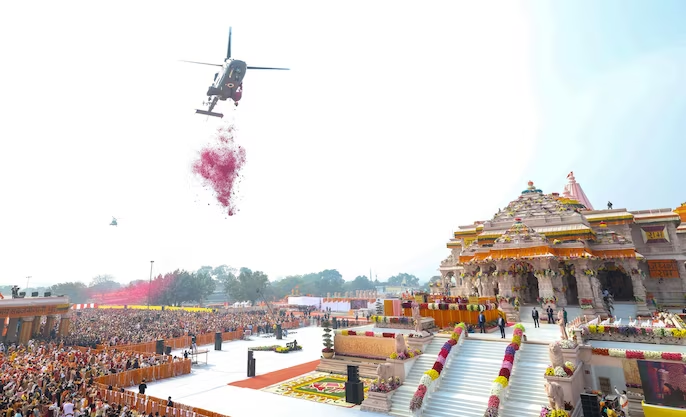
And finally – to speak but briefly toward that splendid ‘culmination’ itself (the aforementioned Prāṇa Pratiṣṭhā) – this was something rather remarkable to be able to witness carried out as it happened, via the magic of livestreaming through the internet. A fine example for the utilization of modern technology to augment an ancient, and traditional core.
Something which also, no doubt, describes the employment of Indian Army helicopters to rain flowers down upon proceedings within the course for the Aarti, as well.
In any case, while I am sure that I could go on at further length for some time … there is, in truth, only one further thing which needs to be said.
And it is, quite simply:
जय सियाराम !
 arya-akasha