An essential component to the Offering we had undertaken for the Goddess, Persephone – Kali, was the Weapons Sacrifice, carried out via Water.
We have previously considered some of the specific characteristics to our own iteration of this – the result of the officiating Brahmin’s remarkable flash of inspiration upon the subject.
And I say “remarkable” – because while there is a degree of tradition in this department within India … its salience in more general Indo-European terms he had not known of. We therefore present a few remarks in relation to this (more general) theme, as a phase and place of transition to the ensuing work to come.
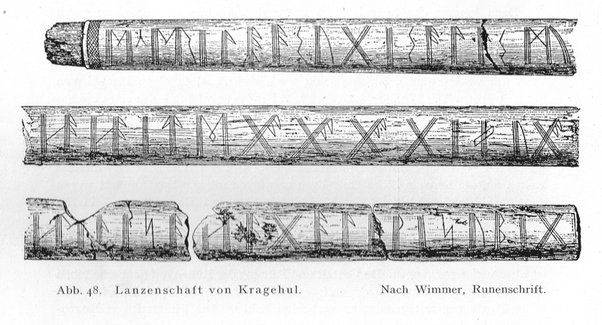
Now, as many shall be aware – there is quite the custom of weapons-sacrifice in Northern Europe, most prominently the Nordic / Germanic sphere. Indeed, the mind (well, my mind, at any rate) near-instantly recollects such justly-famed treasures which have been fished out of Scandinavian peat-bogs as the Kragehul I spear-shaft … which we mention, in part, because the Runic inscription upon the wood thusly preserved should seem to demonstrate that this was not simply an element of ‘war booty’ offered up in the manner of various other weapons-sacrifices found at both this and other of the southern Scandinavian sites in question.
The Nordic / Germanic IE were most certainly not alone in this practice – several famous finds of weapons-hoards immersed in water or bogs from the British Late Bronze Age spring instantly to mind (for instance, those at Duddingston Loch and Peelhill Farm), and we find further exemplars amidst the later Celtic (and, for that matter, Romano-Celtic) spheres as well. These (Romano-)Celtic finds have included not only actual (full-size – and assumedly, in various cases, used) weaponry, but also various miniature replicas, as well. We mention this as whilst various of the full-size (and often pointedly defaced / rendered unusable, it seems) weapons found are conceivably of the “war booty” variety, and given in thanks for the successful defeating of their (now-former … and possibly also offered / immersed bearers) by the sacrificer’s people – miniature weapons-replicas are, for reasons that should prove rather readily apparent, not that. Indeed, Kiernan observes that the likely purpose to various of these ‘miniature’ weapons (frequently these are spears) as often seeming to be what we would regard as the exact opposite : that is to say, correlate with the attributes and potency of Divinity … rather than vanquished mortals.
As applies the aforementioned Kragehul I spear-shaft, this should seem – to my mind, at any rate, to be a plausible explication for the nature of that offering; and both the slightly enigmatic ‘Asugisalas’ (which I shall now cite in an Elder Futhark font, because I like that we can do that: ᚨᛊᚢᚷᛁᛊᚨᛚᚨᛉ – or, more aptly, ᚨᛊᚢᚷᛁᛊᚨᛚᚨᛊ , given it’s in genitive singular) as well as, assumedly, the triplicate-repeated (plus one) series of Gebo-Ansuz Bindrunes thereupon . *Ansuz , after all , not only connoting Divinity … but also, *That Divinity In Particular* Whom we would know as Odin – the Spear-God (c.f. ‘GeirTyr’, which means just exactly that – ‘-Tyr’ cognate with ‘Deva’, ‘Deus’; and c.f. also the various Roudran saliencies viz. His Mighty (Three)Spear, ‘ShulaPani’, etc.). Indeed, I have occasionally pondered whether the ‘Gebo-Ansuz’ (i.e. ‘GA’ – or, here, GAGAGA GINU GA) pairing, perhaps in this case non-exclusively with the more conventional reading of ‘Gift-Divine’ [i.e., assumedly, “Sacrifice” – although other readings, along the lines of ‘Bestow(ed)-Empowerment’ may also prove plausible … which is, I suppose, the ‘other limb’ to the ‘Do Ut Des’ / ‘Dehi Me Dadami Te’ “Gifting Cycle” of Sacrifice], may in fact stand somewhat phonetically for ‘Spear’ – this being *Gaiza- in Proto-Germanic, and producing not only ‘Geirr’ but also Old English ‘Gār’ , and with apparently directly related (Kroonen specifies a “Germanic-Celtic isogloss”, potentially from the Germanic into Celtic spheres) ‘Gae’ & ‘Ga’ in Old Irish and its successor.
I should restrain myself from further elaboration here – except to say that as tempting as it might be to take up Looijenga’s supposition for ‘Asugisalas’ to be *A(n)su(z) plus a *gīsalas which he identifies as meaning “sprout, shoot, offspring” (and with a contemplation of my own upon it of taking ‘Shoot’ / ‘Sprout’ in the same sense as the ‘Weaponized’ sense to growing plants still observable with ‘Blades’ of Grass or ‘Spears’ of Asparagus even in modern English – and very much a pervasive phenomenon in archaic Indo-European terms … as admirably demonstrated via His Wife, Shakambhari – She Bearing Shoots … and shooting Demons, too) … the more likely is surely *gīsla- : either the one meaning ‘hostage’ and which appears to be from a root (whether Proto-Celtic or otherwise – Kroonen again has a “Germanic-Celtic isogloss” noted) which produces Celtic terms for “Pledge / Swear / Vow” (whether something which *is* pledged, or in terms of service), that being PIE *gheidh-, per Pokorny, meaning “to yearn for” ; OR the *other* PG *gīsla- that Kroonen identifies, with a meaning of “shaft” (as in, in this case, ‘spear-shaft’ (c.f. the Old High German ‘Gīsil’ as ‘Arrow’ which he mentions) – although with Icelandic ‘Gísli’ meaning a shaft of light … as well as being a complete homophone for *another* Old Norse / Icelandic Gísli, which is that aforementioned ‘Hostage’ back again.). In essence rendering ‘Ek Erilaz Asugisalas Muha Haite’ as “I, Erilaz [Commander / Priest] of the [Asugisalas]” – with ‘Asugisalas’ therefore being either the ‘pledged to Ansuz (Divinity or Odin)’ or simply the ‘Spear-God (i.e. Odin)’; Muha either being a term for a collection of people, as Mees has it (“seemingly a cognomen, ‘one of our mob’, and as with hagustaldaR, plausibly a nickname of a military retainer”) … or, given it can mean a “heap”, perhaps the weapons-hoard thusly offered; and Haitan as ‘Called (Upon)’ / ‘Known As’.
And ‘Ginu’ – often interpreted to be ‘Ginnu’ and therefore an ‘intensifier’, ‘very’, ‘broad’, that sort of thing (c.f. van der Woude’s annotation upon it) – also having other prospects: I’d contemplated something from PG *gīnan- , as in ‘To Gape’ , whether in relation to Odin Himself , or perhaps to the water-body into which the offering is to be made ; and I was interested to see Grønvik apparently head in a similar direction, suggesting that with the addition of the final ‘GA’, the term might properly read “gin(n)u(n)ga” … not least due to the prospect for a double-meaning inherent in the coterminous portion to the instantly-familiar ‘Ginnungagap’ as ‘beginning’ (ref. Kroonen’s *ginnan- for just such an inception), but also, per de Vries, pertaining to ‘Magic’ (ostensibly ‘Ginn’, where it doesn’t mean ‘excellent’, should mean ‘Deceiving’ – however, as de Vries notes as applies that Odinic theonymic of ‘Ginnarr’, it should seem ‘Zauberer’ (Sorcerer, Wizard) also fits (ref., perhaps, the ‘Ganna’ cited by Cassius Dio as an ‘Ουεληδα’ / Οὐελήδαν – (O)Ueleta ostensibly being a ‘Seer’, from PIE *Wel, which is also where ‘Wuldor’ (itself a term of metaphysical potency as we see viz. its utilization to describe the ‘Thunderbolt’ conjured by Odin within the Anglo-Saxon ‘Nine Herbs Cham’), ‘glory’, likely comes from). We would compare Sanskrit ‘Maya’ and the manner in which, whilst often taken to mean ‘Illusion’ (especially in later textual occurrences) – it *also* means ‘supernatural potency’ more foundationally, and is even utilized in RV X 177 for the seeming shining light of the Sun).
Curiously, whilst the Hellenic sphere did feature both ‘full-scale’ weapons-offerings of the “war-booty” / triumphal variety (most dramatically in some of the Tropaia ‘victory-monument’ constructions) and also the offering of miniature weapons-replicas, I am unaware of any substantive tradition of offering these into water in the manner of the more northerly European peoples; and certainly, we do not seem to find anything like the same level of enthusiasm for it amidst the Romans (notwithstanding some rather rare potential elements at a number of more northerly Spring sites … which are, of course, generally within the aforementioned Celtic-ish regions in any case). About the closest which I can think of are some occasional attestations for arrowheads (as seen at the Sacred Spring of Corinth) – or are older Etrurian exemplars.
And as for why that is “curious” – the pervasive Indo-European awareness for water(s) as ‘liminal space’ via which one might reach (or send) to a Divine Realm was most certainly present amidst these Classical spheres. We can tell that due to the well-attested existence of other kinds of votive offering in watery depositions (often of terracotta of various stylings – including ‘ritual substitutions’ for human etc. sacrifice) – showing that the ‘mesocosmic’ understanding for bodies of water in this way was very much a thing; as well as, I would suggest, the prominent situations of eschatology and cosmology wherein one quite directly hears that the Divine Realm, or Realm of the Dead, is across a river … or, for that matter, may even be sailed to – as accomplished by Odysseus, for example.
It is not our purpose to delve too deeply into the question as to why these two of the major Classical IE civilizations seem to have not been very enthused about weapons-offerings into water – although I suppose it is possible that, at least in some locales, Cave-based depositions came to constitute a preferred alternative, with sacrificial pits also well attested likewise; or perhaps these cultures with their prominent Temples and Cult Sanctuaries where the Gods were felt to dwell, came to prefer simply offering weapons (along with other goods) directly (in)to the Gods’ / God’s House (where they could often still be seen – particularly the more ostentatious style gifts) rather than entrusting such high-value elements to the waters. Who can say.
It does bear noting, of course, that the existence of Sacred Groves and Temples didn’t appear to stop those more northerly IE groups of Europe from persisting with water-mediated weapons offerings; nor did it stop, as we have briefly identified above, various Classical communities from also carrying out (votive) offerings into water – indeed, quite the contrary, on some occasions we find relevant water-bodies to be effectively ‘on-site’. Something which we would also make reference to as applies my own Hindu (religious) demesne – wherein the longstanding existence of Temples with exquisitely carved and adorned Murtis of stone … has not resulted in an abandoning of the concurrent approaches wherein both offerings and indeed the ’embodiments’ for the Gods Themselves are to be immersed as appropriate.
A phenomenon, as applies that last point, which is not exclusive to the Hindusphere – wherein our custom of immersing the temporary depictions of, say, Ganesha and Devi which had been utilized for the multi-day / multi-night Ganesh and NavRatri observances when we are ‘sending back Home’ the Divine Essences inside … finds seeming resonance amidst Eastern European folk-customs around the changing as to the seasons. In various cases, this being the baleful ‘Marzana’ female figure which is sent out into a nearby river or water-body to be “drowned” to bring Winter to a close. Clearly, this is a post-Christianization ‘distortion’ of what could not be fully suppressed – and we can tell this not only due to the fact that a Goddess is rather … unlikely to be vulnerable to ‘death’ at the hands of a few village-men and standing water , but also due to the suite of materials coming down to us from both Celtic folklore and Classical-era Greek / Roman materials (as, of course, resonantly ‘checked / confirmed’ with direct Hindu co-equivalents) for a ‘ritual bathing’ to be (at least part of) the original and more archaic occurrence.


Pingback: The Cyan Paṭh To Tartarus Via Way Of Kashmir [The Indo-European Propitiation Of Persephone-Kali – Part Three] | arya-akasha
Pingback: The Divine Roadway of the Underworld – Oaths, Liminality & Law [The Indo-European Propitiation Of Persephone-Kali – Part Four] | arya-akasha