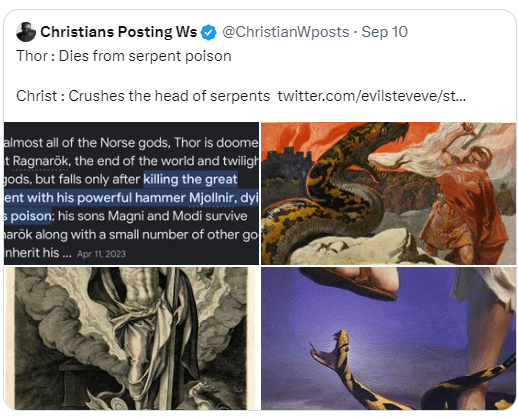
Earlier yesterday evening I happened to the capped/linked post from a twitter handle – “Christians Posting Ws” – which bore the legend “Thor : Dies from serpent poison”, with direct comparison to Christ in a manner that you can probably surmise. And I feel it worthy of comment.
Not because of the usual “Pagan-Christian animosity” bit – but rather because the pertinent part, viz. Thor dying due to Jormungandr is something many believe.
Except it isn’t true.
Now, the reason why people think Jormungandr kills Thor … well, there are two, really. The first one is because of something Sturluson says in the Gylfaginning – and the second is because, in light of Drengr, it makes for a powerfully resonant tale.
Here’s the relevant Gylfaginning bit [Brodeur translation] – which, as you can see, presents two different ‘endings’ to the encounter. Sturluson acknowledges that it’s oft said that Thor decapitates the beast – Sturluson, however, disagrees.
“In the very moment when Thor clutched his hammer and raised it on high, then the giant fumbled for his fish-knife and hacked off Thor’s line at the gunwale, and the Serpent sank down into the sea. Thor hurled his hammer after it; and men say that he struck off its head against the bottom; but I think it were true to tell thee that the Midgard Serpent yet lives and lies in the encompassing sea. But ‘Thor swung his fist and brought it against Hymir’s ear, so that he plunged overboard, and Thor saw the soles of his feet. And Thor waded to land.”
Meanwhile, both the Húsdrápa, and a verse of Gamli Gnævaðarskáld both attest this view of Thor successfully having slain via decapitation the Serpent.
As applies the former –
“Víðgymnir laust Vimrar
vaðs af frônum naðri
hlusta grunn við hrǫnnum.”
“The Wide-Wader of the ford of Vimur struck the ground of the ears [i.e. the Head] off the gleaming serpent into the waves.”
[Unsure as to translator – first part is assumedly Richard North]
And the latter –
“Meðan gramr, hinns svik samðit,
snart Bilskirnis, hjarta,
grundar fisk með grandi
gljúfrskeljungs nam rjúfa.”
“While the ruler of Bilskirnir [i.e. Thor], the one who did not plan treachery in his heart, quickly smashed the fish of the sea-bed [i.e. Jormungand] with the destruction of the gully-whale [i.e. Mjolnir].”
[This looks to be the Clunies Ross rendition]
Why do we mention this?
Because, of course, the notion of Thor slaying the demon-dragon-of-the-waters via decapitation especially, is a resonance of a very archaic Indo-European mytheme … Thor correlates to Herakles / Hercules – and, of course, to Indra of the Vedic understanding.
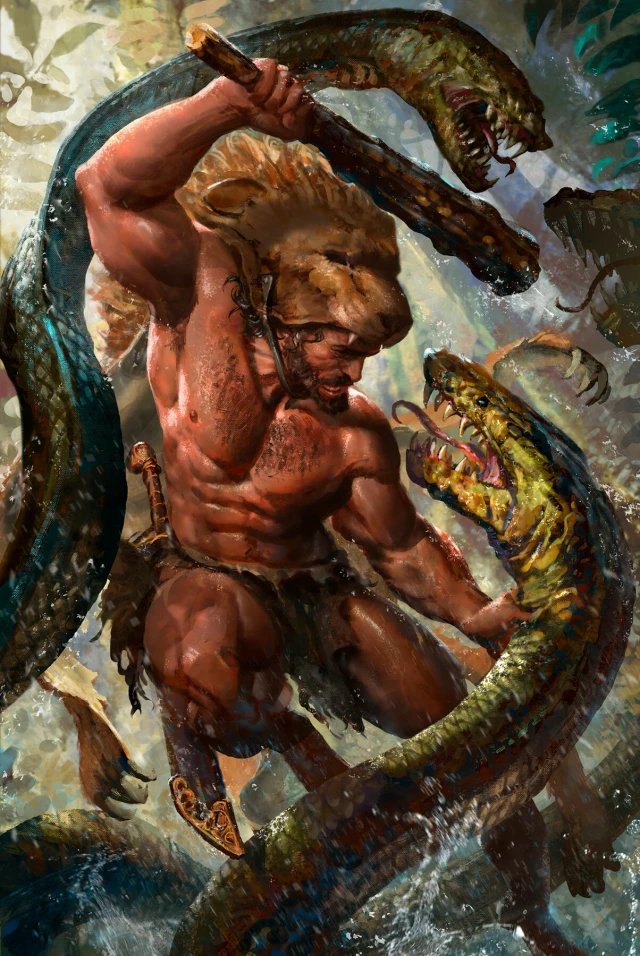
Why is that relevant? Well, in part, for the obvious dimension – in none of these combats do the Striker/Thunderer deific expression end up dead as the result of the encounter. Quite the contrary, in fact !
However, there is a ‘twist’ …
Somebody out there will be mentioning the Völuspá presentation of the Combat … and yes, that’s the Ragnarök-situated one, wherein, it looks like the Dragon does indeed do in our Thor …
Or does he …
Let’s take a closer look:
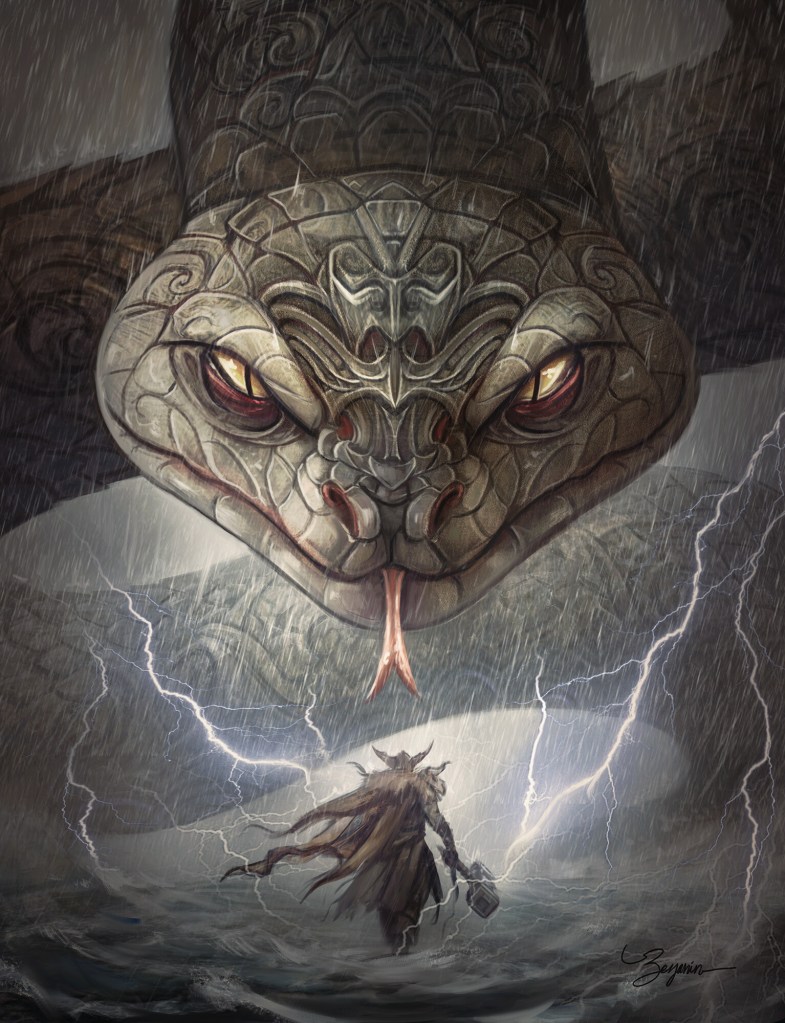
The Völuspá [56] has “gengr fet níu / Fjörgynjar burr neppr frá naðri níðs ókvíðnum.”
This is translated by Bellows as:
“Nine paces fares | the son of Fjorgyn,
And, slain by the serpent, | fearless he sinks.”
So, open & shut case, yes?
Not so fast.
The word for ‘slain’ there – or, at least, the word being interpreted as ‘slain’ – appears to be níðs.
Which, yes, a ‘fallen’ state – but it is more usually one of ‘sin’ … albeit potentially correlate with ‘death’ in some settings, rather like our own ‘Nirrti’.
There is some debate as to whether the ‘fearless’ is supposed to be Thor or the Serpent, although our attention should be upon the whole cluster of conceptry densely encountered therein.
Why?
Take a look at Rigveda I 32 14:
“Whom did you see, Indra, as the avenger of the serpent when fear came into your heart after you smashed him,
and when you crossed over the ninety-nine flowing rivers, like a frightened falcon through the airy realms?”
[translation is Jamison / Brereton … not that I would usually preference theirs, but hey, modern for a change, eh?]
“Whom sawest thou to avenge the Dragon, Indra, that fear possessed thy heart when thou hadst slain him;
That, like a hawk affrighted through the regions, thou crossedst nine-and-ninety flowing rivers?”
[Griffith translation]
And, for good measure, from Horace Hayman Wilson:
“When fear entered, Indra, into your heart when about to slay Ahi, what other destroyer of him did you look for, that, alarmed, you did traverse ninety and nine streams like a (swift) hawk?”
Which we mention due to his (handy) inclusion of the pertinent Sayana commentary:
“When fear entered Indra: his fear was the uncertainty whether he should destroy Vṛtra or not”
Now, what’s going on there – well, Indra is poised to slay … a Brahmin (for such, perhaps to some readers’ surprise, Vritra nonetheless technically is) – and hence, to incur the grave sin of Brahmahatya. Which is ‘personified’ in a similar fashion to the Erinyes of Hellenic mythos [seen here engaged in pursuit of Orestes – for another ‘necessary evil’ act].

So, to recap – RV I 32 14 has Indra fleeing across ‘Nine and Ninety Rivers’ ;
The Voluspa has Thor going back “gengr fet níu” .. walk[ing] nine feet / paces.
Given that ‘Foot[-Step] / Pace’ as a general descriptor for a salient span is a thing [c.f. Three Footsteps of Vishnu for 3 Worlds] , I do not think it necessary to take this Nine Foot notation literally. Perhaps it is across the Nine Worlds – just as with Vishnu’s 3-Step as the striding span across the triplanar Vedic cosmos.
In any case – what we have here viz. the Völuspá presentation is NOT a statement that Thor dies following the confrontation with Jormungandr therein.
Rather, it is said: “gengr fet níu |
Fjörgynjar burr neppr frá naðri níðs ókvíðnum. ||”
Or, [mostly] translated with reasonable directness:
“walk paces nine |
Fjörgyn’s Son only from the Serpent [ níðs ókvíðnum ]. ||”
And as for ‘níðs ókvíðnum’ – ‘of Nið’ and ‘ókvíðnum’ should be dative case ‘Fearless’, ‘Unworrying’ : ‘kvíðinn’ as ‘anxious’, ‘ó’ as negation.
How I would parse that, I think, is Thor doing the right thing, knowing that it’s going to incur that Nið /Nith status … but choosing to do so anyway. Because, it should seem, That’s What Heroes Do.
Now there is a bit of a dysjunction there between the presentation of Thor undertaking this ‘flight’ [in the swift-moving sense] through Nine divisions [Worlds?] viz. Nith, whilst ‘not worrying’ about it …& Indra, in flight, & yes, with that Fear [‘Bhiir’ – भीर ] in His Heart [‘Hrdi’ – हृदि ].
However, there are any number of ways in which we might seek to explain that – differing cultural values, perhaps, the ‘compressed’ nature of the narrative by the time of the Voluspa, corruption in transmission, etc.
And in any case, it is a ‘wrinkle’ in amidst what is otherwise a remarkably cohesive & coherent coterminity between Vedic & Eddic presentations as to the same conflict – even the ‘opposite’ is still a resonancy of data-point, herein.
What we can say is that the notion of Thor traversing ‘nine paces’ from the Serpent [‘getting as far away as possible’ – ref. ‘neppr’, ‘limit’] and the ‘Níð’ situation … does not mean ‘Thor Died’.
The text literally does not say that.
What does say that, however, is Sturluson – again – in the Gylfaginning:
“Þórr berr banaorð af Miðgarðsormi ok stígr þaðan braut níu fet. Þá fellr hann dauðr til jarðar fyrir eitri því, er ormrinn blæss á hann.”
Per Brodeur’s translation again:
“Thor shall put to death the Midgard Serpent, and shall stride away nine paces from that spot; then shall he fall dead to the earth, because of the venom which the Snake has blown at him.”
Except here’s the thing – this is in the prose sections of the Gylfaginning .. i.e. written by Sturluson’s own hand. And which, as we have already demonstrated viz. the outcome of Thor’s fishing expedition – is fundamentally ill-according with actually existing Nordic belief.
The interpretation that ‘níðs’ [‘Nith’ – ‘Sin’] in the Voluspa ought render the same as ‘dauðr’ [‘Dead’] in the Gylfaginning in Sturluson’s editorializing telling .. is perhaps understandable – but cannot stand up in light of the comparative IE evidence, particularly.
There is a further interesting question to be pondered as applies the chronology as to events – Sturluson has the (decisive) combat taking place quite squarely at the War At The End Of The World(s). Yet both a) other Nordic texts, b) comparative IE materials would disagree.
As Thor has already slain (via decapitation – the same mechanism utilized for Herakles / Hercules contra the Hydra, etc.) Jormungandr per the Husdrapa &c., (and as Sturluson himself acknowledges to be a dominant account) … you see why a future combat is not viable.
There are, of course, a few other points which could be made here – in particular, viz. Herakles / Hercules … Who, after all, underwent His Own suite of far-flung journeying following a condemned killing;
But more upon that some other time (and in already written works also)
For now, I think it is enough to observe that this narrative – of Thor, the Doomed Champion of Humanity, going forth with a foreknowledge of .. just exactly that – His Own Doom – it has persisted precisely because it is an incredibly powerful one. ‘Drengr’, indeed.
I do not anticipate that we are likely to see any serious ‘correction’ of the notion – of Jormungandr slaying Thor, (and this occurring at the End of the World) – precisely because it’s such a powerful image to hold within one’s mind .. and above all, within one’s Heart.
But personally – I think that the notion of the Hero Who engages in the necessary conduct, even though it shall have quite some heavy consequences for Him … is powerful enough of a narrative that it can survive having ‘Death’ re-construed back to ‘Nith’ instead.
And whilst it is certainly the case that the Vedic texts present Indra in flight from the ‘Nith’ deed in question (necessary, though it was, to occur) – we may all take some considerable solace for the fact that after it all, Indra Comes Back.
When He is sought for, in earnest.
Perhaps, one may consider, it should prove likewise viz. His Nordic Co-expression – Thor.
Only this time … the seeming visage of ‘exile’ which He has undergone is of decidedly more human construction.
We can but hope that that renders it likewise to be overcomeable.
Not least because, in a sense, even though Jormungandr must lie defeated – there are always ‘dragons’ …
And so, I suspect as I surmise – there must also, always, be a Thor !

 arya-akasha
The death of the gods in the Norse narrative remains an arguable motif given that they were recorded in Christian times when a lot a them were being retold for the purpose of entertainment rather than out of pious belief. The best counter to the Christ vs Thor comparison I’ve heard is that there is still sin in the world despite Jesus’s apparent efforts to save the world from it yet there are no giants or trolls proving that Thor was far more successful in his endeavours.
LikeLike
Pingback: On Disregarding The Puranic Era Mythos When Seeking To Make Sense Of The (Proto-)Indo-European | arya-akasha
Pingback: Metaphysically Potent Medication, Anglo-Saxon & Atharvanic | arya-akasha