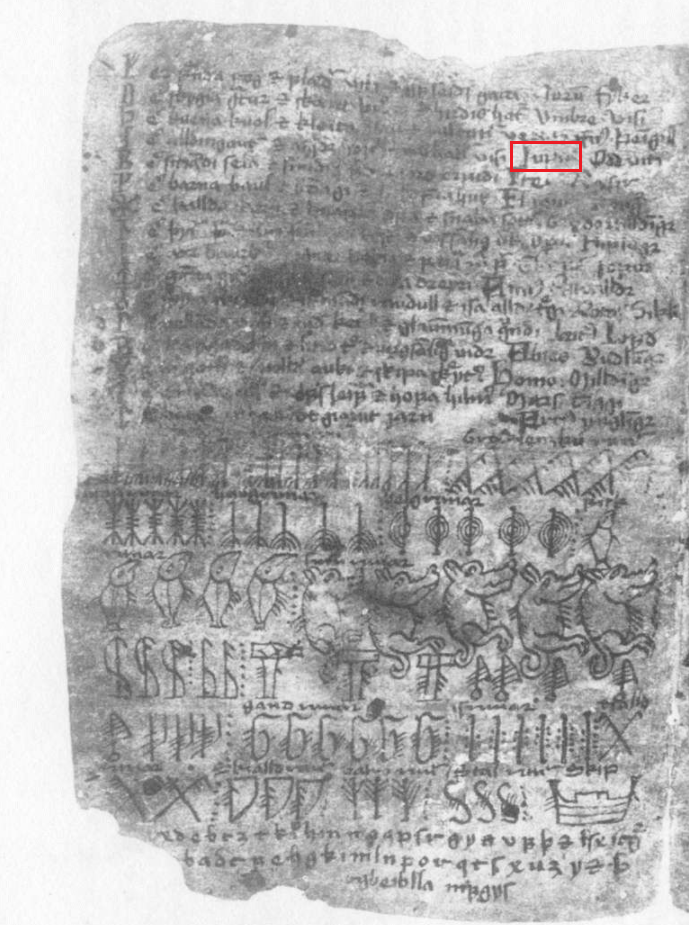
It is always nice to be vindicated. This is a page from a manuscript – AM 687d 4° – which constitutes one of the oldest presentations of the Icelandic Rune Poem. That is to say – the occasionally rather cryptic explication of just what each Rune is to mean.
The relevant word for our interest, I have highlighted in red.
It occurs in the fourth line, detailing what the Icelandics termed ‘Oss’ ( ᚬ ) – and which in the Elder Futhark is Ansuz ( ᚨ ).
That is to say, the ‘Aesir’ Rune, the ‘Spear of the Divine’ (I phrase it thus not only due to the Spear-God Himself and the archaic rune’s shape, but also given its continuance in the Anglo-Saxon sphere as a rather direct ‘Ash’ – the famed spear-wood so prominent even amidst the Greeks).
What is the text of the line ?
Per R.I. Page’s rendering (where, due to the age of the manuscript, some semi-illegible text has had to be ‘enhanced’ – as expressed in the square brackets):
“o er alldingautr ok asg[ar]dz iofjur ok vjalhallar visi Jupi[ter] Oddviti”
Or, in translation (and with my own annotations to draw out particular points of interest):
“Oss is the Aged Gautr” [God]
“and Ruler / Prince of Asgard” [interestingly, the term used – jöfur – is actually from a root which means ‘Boar’; potentially carrying forward an archaic Indo-European tradition around the boar and its position in the fight seen also in the Vedas]
“and Chief of Valhalla” [the term used, ‘Visi’ [and c.f the ‘Visir’ used in the Runologia version of the poem], I would take to be descended from Proto-Germanic *Wisaz – that is to say, ‘Wise’; itself from Proto-Indo-European *Weyd, which means ‘To See’. Between PG *Wisaz and the term used in the manuscript, there may be a PG *Wisona – which means ‘To Point Out’, ‘To Direct’ … and which should therefore posit ‘Visi(r)’ as an effective functional correlate for Latin ‘Dictator’ [from PIE *Deyk – ‘To Point Out’, whence also ‘To Teach’, ‘Vindication’, ‘Vengeance’, ‘Dikaiosune’ [Justice] etc.]. Wisdom and Leadership]
“Emperor Jupiter”
Now, as for why I’ve chosen to render ‘Oddviti’ as ‘Emperor’ – I am, in fact, meaning it in the more archaic Roman sense of the term: ‘Imperator’. ‘War-Leader’.
Oddr refers to a ‘sharp point’, of a weapon – the proverbial ‘Tip of the Spear’ we may say.
Viti, meanwhile, similarly refers to a point of direction – a ‘beacon’ or a signal-fire (a sense continued in the modern Icelandic ‘Viti’ to mean ‘Lighthouse’); and I would tentatively connect it also to Old Norse ‘Vita’ & ‘Vit’ – terms for ‘Knowing’ and ‘Wisdom’ which show up also to convey ‘(Fore)Seeing’ (for example, Lokasenna 29 – wherein it is stated of Frigg: “örlög Frigg, hygg ek, at öll viti” : i.e. She knows / sees Orlog [Cosmic Order] and one’s place in relation to it the best of all) – and which, entirely unsurprisingly, also stem from PIE *Weyd (‘To See’). Perhaps amusingly for our ‘Imperator’ concept – this would render ‘Vidi’ [as in ‘Veni Vidi Vici’] a rather direct cognate.
Whatever the intricacies of the relevant linguistics, the sense being communicated by ‘Oddviti’ is a reasonably clear one: the Leader, directing the force and the thrust of the weapon (or body of men – but, then, I repeat myself), likely from the front – its ‘face’.
In this, it has much in common with that epithet of Lord Agni we find in the Vedas: Anikavat ( अनीकवत् ): similarly utilized to refer to the God as War-Leader, the figure rather literally Leading The Charge, and built from a term (Anika – अनीक) that refers to the leading edge or point of a weapon (and may also refer to an army).
And, of course, the array of ‘Her(ja)’ relevant Odinic theonymy that we are so familiar from elsewhere [i.e. Harja or Harjaz as a warband, and the God spoken of as its Leader – Herföðr, Herjan, and in a sense, HerGautr perhaps as well].
So, all of this brings us to the key question here:
Why is it that this particular formulation of the Icelandic Rune Poem cross-identifies Odin with Jupiter?
Well, the answer is reasonably apparent – by the time the manuscript in question was being written (about five hundred years ago), Iceland had been Christianized for some centuries. Explicating elements of the authentic Old Norse tradition entirely in their own terms would be an exercise in difficulty. Whereas Classical forms and understandings were part of the ‘high cultural’ milieu of most of Northern Europe to varying degrees – and so, even in a Christianized context, speaking of Jove would mean something. It is a referential touchstone (or, if you like, ‘beacon’ – Viti) upon which to hang one’s (wide)hat.
Now at this point, somebody down there in the Cheap Seats is presumably just itching to bring up the longstanding equation of Odin with Mercury via the ‘Interpretatio Romana’ approach. And therefore claiming that, of course, this vitiates any suggestion of Odin as Jupiter – or, more pointedly, that He is Dyaus Pitar (the Sky Father – and we must always remember that, per the Vedas, Dyaus Is Rudra).
Except, as has been discussed quite exhaustively elsewhere, that identification of Odin as Mercury is … not what it seems. It’s a Roman writing about a foreign group and making a semi-educated guess as to where he thinks the lead God of that people might ‘fit in’. Some of his statements (like the worship of Hercules – Whom we may quite reasonably infer to be Thor) make sense. Others … not so much, and must be cast over with a critical eye.
We know from both Vedic and Hellenic evidence that the Sky Father going about in disguise and potentially looking like a vagrant is an ancient and archaic Indo-European perception. For the Hellenics, it occurs when Zeus is testing adherence to ‘Xenia’ [‘Sacred Hospitality’] (interestingly, a duty shared with Hermes and Athena) – for the Vedic Aryans, we find Lord Rudra as AdiVratya [‘First of the Outlaws’, to translate a bit figuratively] doing exactly the same thing. (And, of course, we have Odin in the Grimnismal undertaking similar behavior toward Geirroth)
We could go on at further length demonstrating how seemingly every point raised to attempt to ‘iron-clad’ an ‘Odin is Mercury not Dyaus / Jupiter’ argument can, in fact, either be utilized to show fundamental adherency to the Sky Father typology for Odin (if not, necessarily, the particular form of Sky Father understanding which had become most prominent amidst the Romans two thousand years ago), or at least be interpreted quite differently. But that would be a series of matters for other pieces.
However, what makes some other attempted ‘Interpretatio Romana’ postulations interesting is that they were undertaken not by culturally (and physically) remote Romans – but by Germanic peoples themselves.
This linkage of Odin with Jupiter in the Icelandic Rune Poem is one example – another is Saxo Grammaticus making the quite sensible identification of Odin as Pluto. To quote from the Gesta Danorum:
“Where, then, are the captains of the Goths, and the soldiery of Hiartuar? Let them come, and pay for their might with their life-blood. Who can cast, who whirl the lance, save scions of kings? War springs from the nobly born: famous pedigrees are the makers of war. For the perilous deeds which chiefs attempt are not to be done by the ventures of common men. Renowned nobles are passing away. Lo! Greatest Rolf, thy great ones have fallen, thy holy line is vanishing. No dim and lowly race, no low-born dead, no base souls are Pluto’s prey, but he weaves the dooms of the mighty, and fills Phlegethon with noble shapes.”
Now, as we have earlier and repeatedly demonstrated, the Classical conception of Zeus, Hades, Poseidon – is simply three ‘facings’ of the Sky Father deific. Zeus Triophthalmos. And, of course, there was some awareness of this preserved amidst the Classical milieus – seen not only through the Zeus Three-Eyed just immediately aforementioned but via the linguistics around, for instance, Dis Pater.
It can fairly be argued, I think, that in each case – Saxo Grammaticus, and this Icelandic text – that there was a certain level of ‘outsider’ perspective going on even so. Saxo Grammaticus was a Christian author, and it is entirely plausible that various of the elements he incorporated which seem ‘strange’ in comparison to other Nordic texts or practice were as a partial result of this.
Yet it would be most curious indeed to attempt to assert that a claim of Odin as Lord of the Glorious/Ancestral Dead would somehow be Christian ‘defamation’. Rather than an eminently logical and reasonable ‘Interpretatio Romana’ that does actually state something accurately apt about Odin’s role within the cosmos and the cosmology.
Similarly, I would be at a loss to explain why a linkage of Odin with Jupiter would be made with such ‘defamatory’ intent in mind by the late Icelandic chronicler who compiled the rune poem. It is simply as it appears – a reasonably direct statement of a Classical equivalency as they understood it.
And – most importantly – one which accords STRONGLY with the evidence we have exhaustively compiled from a comparative Indo-European perspective elsewhere.
Never let it be said that occasional insights of brilliant truth cannot somehow come down to us even in later times and texts.
ᚬ Óss er algingautr
ok ásgarðs jöfurr,
ok valhallar vísi.
Jupiter oddviti.


Reblogged this on attis.
LikeLike
This double cross (ᚬ) runic rune sign is of ancient origin.
In Sumerian and then Akkadian writing, this meant: ancient, Old God, and the 1-digit sign.
In the runic writing of the Szekler Hungarians (and also in the writing of their predecessors, the Huns), the meaning of the sign (ᚬ) was 1. And it also meant that God.
And that One is God, One is Spirit.
In the coat of arms of the first kings of the Hungarians, the Turul (Saker falcon), the double cross meant the same thing: One is God.
And this is what it means in the coat of arms of Hungary even today.
LikeLike
Pingback: On Odin As Jupiter In The Icelandic Rune Poem – Glyn Hnutu-healh: History, Alchemy, and Me
Pingback: On Odin As Jupiter In The Icelandic Rune Poem — arya-akasha | Vermont Folk Troth
Thanks for this. I’ve often felt that Wōden is consubstantial with Iove. And I can certainly see what you mean about the Allfather testing hospitalities in the guise of the fool or beggar before rewarding or punishing spirits of generosity accordingly. One of my favourite examples comes from Ovid, being the story of Baucis and Philemon. I have my own retelling if you’re ever tragically bored.
LikeLiked by 1 person
Pingback: Definitive Guide: What is the Significance of Jupiter in Astrology | Certified Astrology - St. Augustine Florida's #1 Certified Astrologer
Pingback: Jupiter draft | Certified Astrology - St. Augustine Florida's #1 Certified Astrologer
I was thinking about very related association of Ymir with Saturn in corresponding stanza of Icelandic poem and here are some sync points:
LikeLike
There are a few things to say there. The first of which being to thank you for taking the time to comment.
Now, here’s the thing. Saturn … doesn’t *quite* ‘match / map’ up with Kronos – but rather, it seems like (to some degree, contingent upon whom you’re listening to) the Romans basically wound up taking a pre-existing deific of theirs and ‘synchronizing’ this with the Hellenic ‘Kronos’ figure.
And basically, we’re not *quite* sure how close (or, for that matter, different) the Saturn in question would have been prior to this with the Hellenic figure in question.
Basically – various parts of the Roman mythos don’t make for ideal ‘yardsticks’ / ‘defaults’ for broader IE comparative theology (on the other hand, some *do* work pretty ok – but I digress).
Now … while I’m aware that there’s … a lot of disregard for the notion of Kronos relative to ‘Chronos’ … the fact of the matter is that this was considered to be a correct and viable ‘underpinning’ to the theonym by a number of commentators both Latin and Greek during antiquity. It may not be *quite* correct in various senses – but I do think that it’s a bit fraught to disregard it out of hand simply because it’s *also* a ‘common (mis?)perception amidst the present day’.
[…]
[I’m going to do my reply in a few parts because i) lengthy, ii) running low on energy and should probably actually eat a meal before getting into substantive matters]
[the next part, which may be in a few hours, we’ll see how the day goes, will basically try and do things head-on with three different IE spheres’ attestations & [comparative] modelling, much of which I’ve (handily) already done]
[-C.A.R.]
LikeLike
Right, back after a brief intermezzo. Now, where were we.
So … the issue here is that I suspect you’ve got (at least) three underlying (P)IE myths, anchored around several figures rather jumbled and blended going on here … which, to be fair, is something one often finds academics (and potentially even Sturluson’s rendition for Norse mythology) doing, so you are not in bad company.
Now, in order to demonstrate the proper alignment of things … we’ll basically be utilizing at least two IE spheres per myth; with preference, for several reasons, given to the Vedic expressions – coz i) oldest (of the spheres we’re going to be using, at any rate), and ii) best & most comprehensively attested (so we .. know what things are and how they fit together therein pretty well – and we don’t have the ‘Sturluson problem’ of ‘editorializing’ intermediaries causing data-loss or ‘corruption’ … or, to be fair to him, frantically trying to *avoid* data-loss and *further* corruption, and occasionally ‘filling in the blanks’ / ‘re-aligning things to make subjective sense to him’, etc.).
So … the myths in question –
Basically, i) the Sky Father deific contra an earlier figure (basically a ‘father’ … and/or a father-in-law)
ii) the Sky Father deific contra a demon(-dragon)
These two myths are rather heavily interrelated in their components of active expression in the two major IE spheres (Vedic & Hellenic) we’re going to use to illustrate them, which would appear to suggest that they were already like that at the PIE level … and I have a theory as to why, hinging around the ‘ritual operationalization’ dynamic via way of potential explication as to *why*. It’ll make more sense when we get to it.
And from there, we’ll look at the Germanic sphere, since that’s your main point of interest (?), with a few elements to be considered (including a lesser-known Anglo-Saxon one).
And iii) you’ve also brought in the Progenitor Twins, via Yama – for that we’ll basically be looking over Vedic & Roman occurrences.
Also, as applies what you’d said with your Reddit post – I think you’re perhaps trying to get a bit ‘over-clever’ with the conceptry about ‘time stars with death of Ymir’. And in a way that … kiiinda doesn’t work too well with the fact that ‘cyclical creation’ is a thing (as attested via the Nordic, viz. that part of the Voluspa wherein everything’s re-setting viz. the “game-tables”, and world rising out of .. you get the idea), and therefore time’s *always* rolling on regardless.
[Also-also .. .while I see what you’re going for viz. the line about Saturn in the Icelandic Rune Poem – to cycle back to what i’d been saying in the first reply .. it must be remembered that these are Icelandic frames of reference upon Roman mythology, as of a thousand years later (well .. a lot longer, really – like, it’s a thousand years post Rome’s Christianization); and so while yup, sure, *in that sense*, it certainly tells us an array of interesting things due to how the Icelandic rubric’s writer(s) chose to ‘encode’ things … one must be cautious about reading it too retroactively as applies the Romans’ own original mythology. Since it’s, if anything, more of the (younger) Norse ‘telling things about themselves’ … but I digress and we should get on with the show !]
[…]
[-C.A.R.]
LikeLike
Right, so – we’re going to start with the ‘easy’ one first … and that’s the Progenitor Twins.
Now, what’s crucial here is that these are the *Sons of the Sky Father* – more directly, often, ‘Sons of the Sun’.
Now, as implied via the name, there’s two … these being the First Man – ref. Vedic Manu (Tacitus’ ‘Mannus’), Roman Romulus … and His Twin – aptly enough, with a name that basically means ‘Image’ (in fact, ‘Image’ is from the same PIE root): Vedic Yama , Roman Remus (in older iteration – *Iemus* with that capital I … well, you see the correlation viz. ‘Yama’).
What happens is you have the First Man (Who’s also basically the first human priest, and tends to set out social order with a structure to follow for the ensuing people) basically coming to rule over a ‘Kingdom’ or ‘City’ of the Living … whilst His Brother *sacrifices Himself*, so as to become the First ‘Mortal’ in that sense, i.e. the first Man to Die – and thereby He ‘goes forth’ to chart the pathway to the Realm of the (Ancestors / Glorious Dead), which is the Kingdom or City which *He* ends up ruling over.
It’s all a direct suite of ‘parallel’ – or mirror ‘images’ if you like. To utilize the Roman exemplar – well, you’ve got it right there.
Rome … and Remuria (‘Lemuria’).
Now, note the key point there – *Self-Sacrifice*.
It’s quite explicit.
And if you’re wondering what i’m on about because “Everybody Knows!” that Romulus killed Remus – well yeah, that’s the thing. The Romans … their mythology twisted and turned in the hands of its bearers; and by the time the major attestations for it come down to us, Rome had already suffered through generations of kinstrife and civil war. It had become, so to speak, their “original sin” – a point Augustine enthusiastically runs about with, so to speak.
Now, one of the oldest versions of the story that we (somewhat) have comes to us from Ennius – and I’ll spare you the … extensive details (I’d written upon all of this some years ago; perhaps I should do so again). But basically it seems to present i) Remus engaging in a ‘Devotio’ style … well, ‘self-sacrifice’ about covers it: pledging one’s self to the Gods of the Underworld; ii) this features *two Suns* in the sky – interestingly, the *white* Sun is the ‘Death’ one that goes into the Underworld. Two Suns for two Sons of the Sun. Subtle, eh? [There’s an array of further direct concordances with the Yama-Manu mythology … but for another time.]
Anyway, where I’m going with this is quite simple.
The Underworld.
No, but seriously (well, eventually yes).
The situation of Yama … does not concord very well with that of Ymir. For a start, there’s an array of etymological propositions for the Ymir name … you can look those up readily enough, I assume.
But yeah uh – the Ymir myth features *none* of the features of the Yama one other than somebody dying. But … the manner of death – being killed by the Sky Father, as compared to *self-sacrifice* is totally different.
The *post-mortem* consequences are also … totally different. Yama reigns in the Realm of the Forefathers – Remus, we may assume, had an archaically greater significance within Roman religion (the ‘Remuria’ observance *was* still a thing, however), but may have been somewhat ‘overshadowed’ by the God (and Goddess) of the Underworld (Yama’s Realm *also* has a God there, and Aditi rules over the Pitrs per a lesser-known SBr occurrence etc. .. again I digress), but effectively *would* still be there.
Ymir ? Nah. Not even ‘in one piece’, so to speak. Let alone looking after any realm. Not like Yama / Remus – taking care of Their (His) ‘Nephews’ when we rather need it the most.
Further – the ‘paternity’ situation just doesn’t work. Insofar as … we uh … well we don’t really have one for Ymir, now, do we.
But we *really* don’t have the Sky Father deific, the Sun (and Water), engaged in it … albeit this gets a bit ‘complex’ as applies the Roman situation. Because they have Mars in the position / role … and I suspect rather strongly that something has ‘shifted’ there – and, again, I’ll spare you the massive digression [suffice to say it involves the de-emphasis of the seeming ‘more archaic’ Roman founding figure, ‘Rhomos’ and a war against the neighbouring Falisci, whose *own* origination myth had them as descended from one Halese, Son of Neptune [and yes, Neptune is a Sky Father deific expression]; oh and some points viz. the ‘Race of Mars’ relative to the ‘Melia’ & ‘Race of Bronze’ phenomenon in Hellenic sphere, plus some comparative theology viz. the Planet Mars in Vedic that … *I digress* ].
If you’re wondering where this all is in Germanic – well, that’s a good question.
Tacitus’ Mannus, Son of Tuisto, has the “Mannus” bit … and we can quite plausibly (imo) get Tuisto to be a ‘Solar’ style theonymic – simple D=>T sound-shift (i.e. running it back from ‘Tuisto’ to ‘D-‘ and probably ‘Dv-‘ or ‘Dy-‘ …) and we’re on our way … to something I should cover at another time. It’s true that there’s no ‘Twin’ attested for Mannus … but I mean … it’s Tacitus relaying information obtained via an unspecified stretch of intermediaries, so it’s not unreasonable to infer that it … just didn’t come up / get conveyed, when the question may simply have been whom the group were *descended from* directly.
Does, of course, raise a question as to … where all of this had eventually ended up at by the time of th Viking Age and its post-facto compilations …
An interesting prospect woudl concern Freyr … I’d previously argued that this *may* etymologically derive from a term [PIE *Per] that would make the meaning ‘First-‘ … we then add *Ingwaz, and presume (not unreasonably) that *Ingwaz from PIE *Nekus [like ‘Necro-‘; ‘Death’ / ‘Mortal’ as meaning – c.f. Tocharian A ‘Oṅk’ & Tocharian B ‘Eṅkwe’, meaning ‘Man’], and therefore meaning ‘Mortal’ [ref. Sanskrit and Old Persian ‘Martya’ – derived from PIE *Mertis , and both meaning ‘Mortal’ as in ‘Man’; and, for that matter, per Pokorny [ *mór-to- ] the similarly plant-originated Mashya & Mashyana first man and woman of the Zoroastrians].
Which would therefore make Ingvi-Freyr the ‘First Man’. Which goes rather handily with the … well, how the euhemerized situation apparent in the Ynglinga Saga etc. has Him. Priestly-conduct, and all.
Anyway, I’d done a much more in-depth thing some years back viz. Yama – you can find relevant parts here
And here
And here
And here
etc.
So … that’s one down.
Oh … and to pre-empt the next thing:
No, Yama / Iemus/Remus self-sacrificing isn’t the same thing as Odin self-sacrificing.
Odin self-sacrificing with the hanging incident actually has *another* correlate in Hindu myth / theology – more upon that in an ensuing reply. Maybe.
[…]
[-C.A.R.]
LikeLike