Some time ago, I had been asked to weigh in upon the claim that there were Runic inscriptions featuring a Nordic cognate for “Aryan”. The following is a somewhat edited (and expanded) iteration of my response.
What’s being referred to is one runic inscription (the Tune stone [N KJ72], mid-1st millennium AD, Østfold fylke, Norway), which while it was interpreted as containing an “Arya” cognate by Wolfgang Krause, a German academic writing in the 1930s (who later wound up a director of the Ahnenerbe’s Runic division) … well, let’s just say that other scholars (and, in fact, the same scholar as well) who weren’t operating under that particular regime both before and since have come to some differing conclusions; several of which we shall take a look at in due course.
As Eythórsson (2012) phrases it, the very specifically “Arya” conception for the term at issue (which we shall be encountering in a moment) appears to have been originally proffered by Krause in a congruence to what Eythórsson delicately labels “[the] “political correctness” in the Third Reich”.
Hence (and as Eythórsson most helpfully chronicles for us) while Krause in his 1934 commentary countenanced the word as “rassischen Beigeschmack haben” (‘having a racial flavour’) – this was stripped out by Krause himself from his subsequent works (published in 1937, 1966, and 1971); with the content of the aforementioned 1966 effort suggesting (to quote Eythórsson’s analysis directly) that “Krause himself seems to have become somewhat doubtful about [even] the existence of the proposed word”, let alone its putative connotation.
The interpretation of the inscription as bearing an “Arya” cognate (and meant in the manner that that word “Arya(n)” often tends to be intended when encountered ‘midst non-Hindusphere Very Online discourse) – is, therefore, beyond even an ‘outlier’ position : Krause’s movement away from such a stance even in his 1937 work (published when the ‘political clime’ aforementioned was at its very height) showing that it was not some sort of post-War (i.e. ‘deNazifying’) counter-tide within the academia that had lead him to undertake such a resiling.
But on to the actual epigraphy.
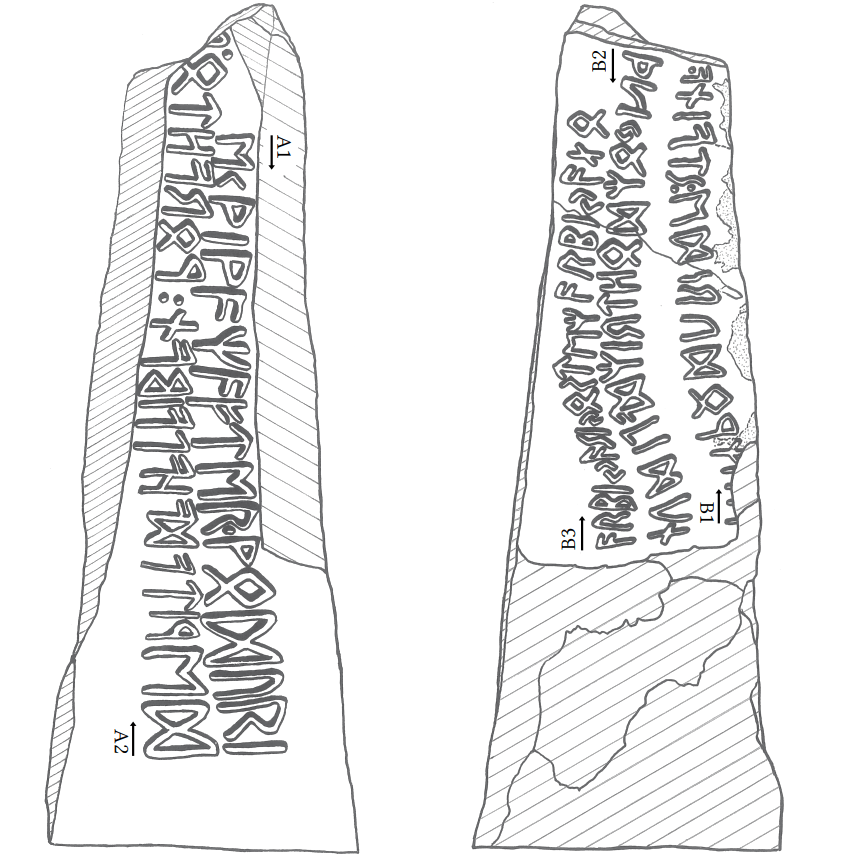
The relevant line to the inscription (as it is more prevalently parsed, at least) reads:
“arbijasijostezarbijano” [see attached image, it’s line B3 therein; image by J. E. Kirk, reproduced by Eythórsson]
There is therefore a bit of a question as to just what words are actually in there based around where one draws the spacings between such.
However, our main point of issue is this – that aforementioned German academic (Krause, who’d reportedly avoided joining the NSDAP proper on account of his poor eyesight, as it happens – one wonders if this trait may have proven a relevant factor for his contributions as to our subject-matter herein) didn’t read the first part as “arbijasijostez”; he instead read it as “arbijarjostez” – and in fact as “Arbija Arjostez”.
What’s the difference?
He’d insisted that what otherwise taken to be an “SI” … was a backwards “R” (despite there being no other such ‘backwards R’ in the inscription – ‘backwards’, here as in the sense of the individual letter ‘facing the opposite way’ to the direction for reading of the line of text they’re in; as Mees (2015) labels it, the inscription is, after all, “executed in a boustrophedon manner”).
You begin to see the problem.
(He’d also needed to infer that the “A” at the end of “Arbija-” was actually a double ‘A’, and splittable … so “A [space] A” … which, to be fair, is not something that could not occur in an inscription of this nature – subject to disagreement by Antonsen (2002), who calls this “totally unparalleled in the older runic inscriptions”; although with Mees (2013) showing otherwise via furnished exemplars for “such graphematic elisions” to be “attested in the early runic corpus” – the footstool found near Wremen which seems to feature just such a ‘double a’ to its ‘ksamella [a]lguskaþi’ being of, itself, likewise mid-5th century provenance).
Meanwhile, more mainstream interpretations tend to render the line as something more akin to “arbija-sijostez-arbijano” or “arbija-(a)sijostez-arbijano”; with questions as to what that middle word might be, being difficult to answer through etymology alone – and therefore requiring some situation for the term(s) within their pertinent context.
This context, for our purposes, being the bequest of a man named Woduridaz as to the inheritance of three daughters (“þrijoz dohtriz”, as we find in B2) amidst whom said inheritance is to be assigned (“da(i)lidun arbija”); although with differing interpretations for the former word as to whether it’s in the sense of being ‘divided between’, or ‘contested amidst’ – and therefore, whether all three, or only the most exemplary of the daughters are intended to actually inherit.
The inheritance (and inheriting) itself is referred to via the ‘Arbija-‘ terms at the beginning and end of that next line (i.e. B3; the last being “arbijano”, “of (the) inheritors”, per Mees (2015)) – with, between these, that all important ‘(a)sijostez’ which should seem to qualify the basis for such apportionment.
As noted, there are … an array of interpretations which have been advanced for this middle term over the decades (which, again, we shall not seek to expansively chart here). But suffice to say, whether it’s “asijostez” or “sijostez” … sans that backward ᚱ, it ain’t going to be the nice convenient “arjostez” that links to “Arya”.
I should, of course, note that it has not only been Krause who has proffered the “arbijarjostez” interpretation. The ‘lettering’, itself, is also maintained by Antonsen (1975), with the outcome summarized, again per Eythórsson, as reading “‘the most legitimate-to-inherit’, a form claimed to be a compound made to *arƀijaⁿ ‘inheritance’ and *arjōstēz, [which] not only retains Krause’s unsubstantiated reading, but would also be unparalleled in Germanic, both in regard to its word formation and its semantics.”
You can find Antonsen persisting with it also in his 2002 ‘Runes and Germanic Linguistics’ (himself citing Krause 1966), where he’s parsed “arbijarjostez arbijano” as “inheritance-foremost of heirs”.
As applies the “arbijasijosteʀ” reading advocated by other scholars, Antonsen seeks to de-legitimate this upon the basis of, and I quote: “Close inspection of the stone itself in April 1979, has convinced me that the seventh rune of this sequence is indeed a reversed r [backwards ᚱ], as read by Krause, not 𐌔ᛁ , as Grønvik maintains. The reading 𐌔ᛁ results from the failure to recognize a natural fault in the stone which seems to separate the zigzag of the [reverse ᚱ] from its staff, but which is considerably deeper than the carved runes. In addition, a reversed r in this word is not surprising, since there are other examples of reversed runes in this text. Indeed, the reading 𐌔ᛁ requires the assumption that the s is not reversed, in contradiction to the other two s-runes in this inscription (B-l staina, B-3 -jostez), both of which are reversed with respect to the direction of writing.”
The latter is, admittedly, perhaps a fair point; although the comment about a “natural fault in the stone which seems to separate the zigzag of the [reversed ᚱ] from its staff” seems rather questionable from my own examination (admittedly of high-resolution photographs, in colour or under magnification, instead of the actual artefact personally), insofar as the actually noticeable or potentially ‘intrusive’ ‘fault’ (which is there) is above the character(s) at issue, and with no reason (again, from my cursory examination) to suggest a break between purportedly connected human scourings as resultant therefrom.
In fact, quite the contrary – the uppermost limb of the ‘𐌔’ seems at pains to avoid an unwarranted conjoining to the top of the ‘ᛁ’ thereupon (and with all of this, as I say, rather downward from the noticeable ‘fault’ above). And, while not a substantive criticism, it did also cross my mind that it sounded slightly curious for Antonsen to have arrived at his position concerning this purported ‘reverse-R’, some four years before he says he engaged in this physical inspection of the inscription-stone in question.
Where did Antonsen intend to maneuver with all of this ? Effectively, to quote his 2002 restatement: “I consider the term arbijarjostez to be a bahuvrihi-compound = arbij-arjōstēz ‘inheritance-foremost’, […]” (i.e. “arbij-” as ‘inheritance’, and “-arjōstēz” as ‘foremost’).
He then goes on to add: “It has been objected that the superlative adjective -arjōstēz is masculine plural in form and therefore cannot refer back to dohtriz ‘daughters’, which is, of course, feminine. These scholars were overly concerned with the Old Norse convention of referring to members of both sexes simultaneously by using the neuter plural and overlooked the fact that it is common practice in Indo-European in general to refer to males and females together by using the masculine plural, which is the case here. The three daughters were interested in establishing the fact that they were the closest of all heirs, both male and female.”
The obvious issue for his reading, there, being the rather pointed fact that there are no male heirs (nor any heirs other than the Three Daughters) at all mentioned within the inscription. Hence, no reason to assert a masculine plural referring to a mixed group of male and female heirs as being used within the text.
So, again, not the most compelling attempted justification to interpreting the thing as ‘Arjostez’, à la some *h₂er- derivatives.
Not for nothing, it would appear, did Eythórsson (2012) characterize Antonsen’s favoured hypothetical as one which “would also be unparalleled in Germanic, both in regard to its word formation and its semantics.” (Eythórsson (2013) winds up at something of a similar ‘reading’, however, to Antonsen for the ultimate purpose of the wording – holding “the phrase sijostez arbijano [to be] an ancient legal term meaning ‘the closest of the family heirs’, comparable to early Latin suus heres ‘his own heir’, i.e. ‘family heir, self-successor”; and with derivation, instead, “from a reflexive stem Proto-Indo-European *s(e)wo- in the archaic meaning ‘own, belonging to the family'”.)
Krause, meanwhile, as Eythórsson (2012) had noted, subsequently went off in an entirely different direction from his earlier self with the “alternative emendation” which he proffered in 1966, of “(a)r⟨bi⟩jostez” – to which he ascribed a meaning of “die zum Erbe Nächstberechtigten” (as quoted by Eythórsson), i.e. ‘next in line to the inheritance’ (and, it would seem, this later take of his upon the term having the ‘inheritance’ – viz. ‘arbija-‘ – as now the sense affixed to the word itself; rather than, as seemingly just about everybody else takes it, our word being an adjective conditioning an ‘inheritance’ style term immediately adjacent).
(And, speaking in terms of these “Inheritance” interpretations – notwithstanding that Antonsen’s effort viz. arbij-arjōstēz as ‘inheritance-foremost’ has our word of interest as ‘foremost’ rather than ‘inheritance’, but with Krause’s seeming effort at turning ‘arjostez’ into ‘arbijostez’ more in mind – it ought be noted that such labelling & concept does not, either, concord to the meaning(s) of ‘Arya’, over there in the Sanskrit. Even were one to instead seek to assert ‘Arya’ in the ‘pop-20th-century-prominent’ sense, one would nevertheless run into the difficulty that whilst ‘inheritance’ as of an estate is a subset of ‘Heritage’ as more general conceptual field … that does not make it suddenly of such a kind as one would find either biologically or culturally ‘inherited’ in such a way as traits from those spheres that are the continually expressed identity-components for a family, a community, a people, both parents and children at once. We would be much further and more lost amidst the ‘Current Yuga’ than I’d thought – if something as manifestly mundanely material as mere property rights were held ‘That Which Makes An Arya’ !)
There are, of course, various other proposals – as Mees (2013) rather amusingly reminds us via referencing what he refers to as “Wilson’s law – i.e. the “first law of runo-dynamics” which […] holds that there will be as many interpretations of any inscription as there are interpreters of it”, this multifariousness is basically as we should expect.
One of the more interesting comes from Marstrander (1930), which I shall quote in Mees’ (2013) explication:
“Marstrander’s reading of asijostez as ā̜sijōstēz ‘closest to the Aesir’ is probably best taken as a(n)sijōstēz ‘godliest, most divine’. It is rather better supported empirically than are Läffer’s and Bjorvand’s suggestions, as not only do the regular Indo-European terms for ‘heavenly, divine’ feature a similar palatal aix (cf. Sanskrit divyá-, Greek δῖος ‘heavenly’ and Latin dīus, dīvus ‘divine’, the later also commonly substantivised as ‘god’), but as Marstrander (1930, 321) points out such a formation might also explain the unexpected inlexional vocalism in Jordanes’ description Anses (non puros homines sed semideos, id est Ansis vocaverunt; Get. xiii 78, ed. Mommsen 1882) as well as the i-umlaut in the Old English gen. pl. cognate ēsa (attested as a form of ‘shot’ in a charm in the Lacnunga). The Indo-European ancestor of Anses is clearly best reconstructed as a u-stem *h₂ensu- as is indicated by the likely Hittite cognate haššu- ‘king’ as well as the surer comparanda Sanskrit ásura- ‘godlike, powerful’ and Avestan ahura- ‘god, lord’ (Kloekhorst 2008, 372–74, pace Bammesberger 1996).
The Tune form asijostez may well have developed from an adjectival construction morphologically comparable to an early Nordic patronymic such as the Istaby stone’s (KJ 98) hᴀeruwulafiz (< *Heruwulijaz), the underlying form *ansijaz (like Latin dīvus ‘god, divine’) presumably taking on a substantive as well as its original adjectival function in early Germanic.
[…]
Instead ansijōstēz seems best translated as a eulogistic superlative, perhaps ‘noblest’ given the semantic extension of both Greek δι̃ος and Latin dīvus to mean ‘noble, excellent’ (e.g. in δῖα γυναικῶν ‘noblest of women’; Hom., Od. iv 305, ed. Stanford 1965) as well as (merely) ‘heavenly, divine’. The references to divine ancestry typical of Old Germanic genealogical tradition were clearly intended to be eulogistic and the comparable uses of descendants of Indo-European *h₂ensu- as ‘king’ and ‘lord’ in Hittite and Indo-Iranian similarly suggest that a meaning ‘noblest’ (perhaps even, with Marstrander, in the sense ‘of noblest lineage’) may have been associated with an early runic ansijōstēz.”
As one might notice, from an entirely different root this effectively winds up somewhere perhaps not entirely far removed to Krause’s earlier “Arjostez” as (‘pop-culturally-meant’) ‘Arya’ correlate – at least, in the sense of ‘Noble’ (as in ‘Nobility’), rather than connoting, so to speak, ‘noble race’ (Although given the prospects of “We’re literally Divine Blooded” as the potential underpinning to said quality of ‘Nobility’ (viz. Marstrander linking ‘(a)sijostez’ here with “lineage […] considered to be áskunnigr or semi-divine”, as Mees (2015) relates), I’m sure Krause’s 1934 German audience wouldn’t have been too disappointed all the same … ).
That we should have set out to demonstrate that there is no ‘Arya’ (linguistic) cognate within this inscription, only to then countenance the prospect for the presence of such a meaning (as derived from another PIE root – viz. ‘Aesir’, then per Kroonen: *h₂ems-u- (alt. recon. *h₂ens- , as seen in Rix), as contrasted with ‘Arya’ hailing from *h₂er- ), should seem a bit ironic. Indeed, from where I am sitting, and for a reason which I am about to explain (following a *quick* detour), it could in effect prove doubly so.
In his 2015 expansion upon that earlier work of his quoted from above, Mees rather delightfully labels the prospect for “(a)sijostez” to work out as a “generic (and alliterating) superlative indicating that the daughters were ‘noblest’ or ‘godliest’ (cf. Homeric δῖα γυναικῶν ‘noblest of women’, literally ‘most divine’) […]” as “Marstrander’s haplographic interpretation” to the term. Yet those pair of parsings – ‘noblest’ & ‘godliest’ – can also lead us in quite different directions than the ‘haplographic’ for our (not-quite-‘Aryan’) “a(n)sijōstēz”.
As applies the former, ‘noblest’, we would pick up from Mees’ (2013) observation concerning “comparable uses of descendants of Indo-European *h₂ensu-” in Indo-Iranic. There, the relevant terms are, of course, Sanskrit ‘Asura’ (note: NOT to be confused with ‘A’Sura’, meaning ‘Anti-Solar/Shining/Divine’, i.e. ‘Demon’), and Avestan ‘Ahura’. These are both well-known as linguistic cognates for that PGer. *Ansuz which presumptively underpins our “a(n)sijōstēz”, and which also develops into Old Norse Áss / Æsir.
The Old Norse, of course, means ‘God’ / ‘Gods’, and the Avestan has likewise ended up almost entirely encountered in application to ostensible divinity. It is therefore not entirely surprising to find the occasional inference for the term, at its antecedant root, to therefore also connote the divine (Matasović having a “PIE *h2ensu- ‘god'”). Yet that would be a misapprehension – as we quite comprehensively can observe from archaic Vedic usage (both as noun and adjective), it more indicates ‘Powerful’ (or ‘Lord(ly)’); hence its affixion to not only Gods, but also humans (RV I 126 2, RV V 27 1; a feature also of Avestan ‘Ahura’, as shown via Kavay Haosravah at Yasht 19 77), and demons (RV V 50 5 & 9, RV X 131 4), indeed groups *slain* by the Gods (as at RV X 157 4, etc.).
While it has come to demarcate ‘Divinity’, in other words – much like Old Norse ‘Regin’ to mean ‘The Gods’, this is the acquiring of such connotation from a term which had earlier been less specifically charged. It is therefore possible that the *Ansuz relative which is presumptively expressed via ‘a(n)sijōstēz’ may likewise be a carrying forward still utilizing this more ‘general’ sense, aligned to RigVedic ‘Asura’ and the older roots of the word than that prominent in later times (indeed, as Ass. Prof. Riccardo Ginevra helpfully affirms – “ON Æsir most likely originally meant ‘lords’.”). This would place it very much alongside Mees’ proffered “descendants of Indo-European *h₂ensu- as ‘king’ and ‘lord’ in Hittite” – and with the sense of ‘nobility’, in the sense of aristocratic lineage particularly, potentially additionally reinforced through Kloekhorst’s supporting of Hittite ‘ḫaššu-‘ as continuation for PIE *h₂ems-, with essence of ‘begetting’ (and, as he references, “a semantic parallel in the Germanic word for ‘king’, *kuninga- that is derived from the PIE root *ǵenh₁- ‘to give birth to’.”); although it should be noted that other opinions would instead place our pertinent PIE root (*h₂ensu-) as simply and more directly ‘lord’ (ref. Ginevra, for instance), and with something of a small chorus of skepticism toward this *h₂ems- / *h₂ens- ‘to beget’ prospect from various quarters (Fournet, for instance; Matasović referring to it as “quite uncertain”; &c.). Perhaps we might even contemplate ‘The (Most) Powerful’ as the intended ambit for ‘a(n)sijōstēz’ here as the eulogized characteristic to these Heirs.
To bring things back toward our main stream – it is also possible that this very same skein of essence to the Proto-Germanic underpinning term, viz. pertaining to Gods, may actually support another prospect as to the intended application for ‘a(n)sijōstēz’. One which, intriguingly enough, would actually correlate quite significantly to the actual meaning for ‘Arya’ in its Hindu context – which is, after all, not an ‘ethnonym’ (i.e. connoting belonging to an ethnos), but rather an ‘ethonym’ (i.e. indicating adherence to an ethos). This being the second layering to that ‘double irony’ to which I had earlier referred.
Returning to Mees, we would ‘pick up and run with’ that most particular word within his restatement – ‘Godliest’. This being a term which, in English, is frequently understood not so much as being ‘like’ a God … but rather, as designating somebody with a different kind of connexion with Divinity – that of being pious, devout. This being functionally what ‘Arya’ in its proper Hindu context entails : ‘participation in the ethos’ in question (which is the essence as to the community or ‘in-group’) through the proper actions of the living faith.
Such an understanding as for ‘(a)sijostez’ (or ‘a(n)sijōstēz’) should certainly appear congruent to the one advanced by Grønvik (2010) – who, agreeing with (as Eythórsson puts it) “Marstrander’s earlier assumption that the form *ā̃sija- is to be related to *ansu- ‘god’,” and therefore surmising for ‘(a)sijostez’ “that it could mean ‘connected/associated to (a ) god; devoted to (a ) god’.”
“Devoted to ( a) God”. Pious. Indeed, The Most Pious, running with Mees’ taking it as “superlative”. Which should certainly – to my mind, at any rate – seem quite an apt quality upon which to assert the inheritance’s apportionment, particularly should it have proven a ‘contested’ one as the result of challenges from other parties (as various scholars have supposed). It should also resonate most strongly in terms of – Fire of Vesta rather foremost in mind – that which is the actual ‘essence as to a people’ … but more upon this, perhaps, some other time.
In any case, as we have seen – the interpretation for our term of interest is quite the multifaceted prospect; with an array of both interpretations and the pertinent contextual underpinnings that have come to inform them.
As applies the notion for an ‘Arya’ cognate lurking for identification, the evidence does not render this a viable position; at least, not linguistically. And, as we have said – in terms of ‘Arya’ finding a functional / figurative correlate herein … it can only be in the sense that Arya is actually meant in Sanskrit, and not the sense that has so often been ascribed to it in a more Euro-American ‘pulp’ fashion.
Frankly, I find that to be a much more intriguing proposition – but, then, I would say that, wouldn’t I. For it is the heritage of religiosity (and the culture which takes that as its foundation) which moves me most deeply and strikes me as the actually most vitally important element to be preserved. After all, it is exactly this which has fallen from continuance in Europe, and lead to these elements being so inscrutable to our interpretation today – even where direct heredity in the genetic sense has been continued.
I make no apology for prioritizing the religious dimension. And for insisting upon accuracy in our analysis for the materials of our heritage that have come forth and been preserved to our time.
I feel that these two qualities – religiosity, and accuracy … as far as ‘apologies’ go – they require none.
And it is to those who likewise prize such a heritage – as with the dictum upon the Runestone, per some interpretations – that the heritage thusly also shall belong.
 arya-akasha