In recent days I have run into a rather recurrent skein of assertions about Odin purportedly being a “Psychopomp”.
Now as for why this has kept coming up – the context has been fairly much what you’d expect.
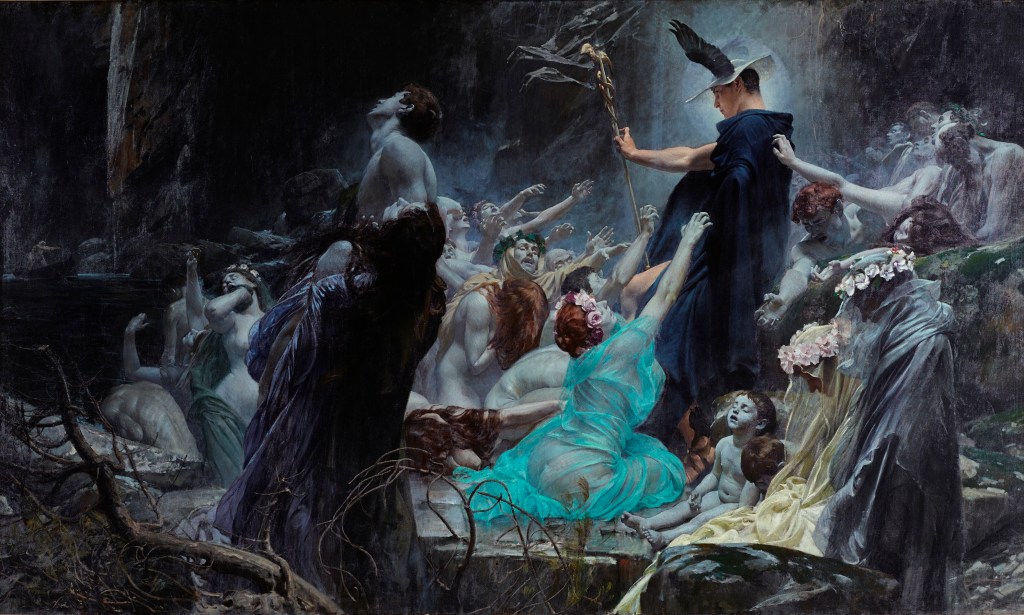
Namely, people looking to affirm an accuracy for that well-known ‘Interpretatio’ from Tacitus, whereby Odin is inferred to correlate to Roman Mercury / Greek Hermes, a prominent psychopomp (the Classical figure pictured here in Adolf Hirémy-Hirschl’s ‘Souls of Acheron’).
Which they’re generally doing in a bid to try and countermand identification for Odin as i) expressive of the Indo-European Sky Father deific within the Nordic sphere, ii) identifiably resonant with an array of Sky Father deific expressions amidst the Hellenic and Roman spheres.
But it is not our intent to re-illuminate – much less re-litigate – various of that herein.
Instead, we shall be taking a look at this ‘Psychopomp’ business.
Namely, what the term means, and its actual application within an (Indo-European) theological context.
Starting, obviously, with where both term and concept may be observed within their original Greek saliency (with some additional points of interest from the broader Classical spectra).
We shall then proceed to the Nordic sphere, and take a look at some of the ‘Psychopomp’ style figures and roles attested therein.
And then address the actual integral question : that being whether Odin ought be affixed with that labelling.
A contemplation which, frankly, seems rather … bemusingly necessary, considering that we have academic journal articles making claims along the lines of, and I quote :
“Odin is […] a psychopomp, for he has his army of fallen warriors – the einherjar” (Moeller, Walter O. “Once More the One-Eyed Man against Rome.” Historia: Zeitschrift Für Alte Geschichte 24, no. 3 (1975): 402–10.) – which … well, you can see just how ‘stretched’, ‘blurred’, if not outright ‘confused’ the application of terminology to Deity has become, even within notionally specialist academic circles, let alone more general commentators out there on The Internet. And that’s before we consider a statement, from the same piece, along the lines of Hercules / Herakles purportedly being a “Psychopomp”.
I – Preliminary Psychagogic Parameters
But lest we get ahead of ourselves … first, what is a Psychopomp?
The literal meaning is rather straightforward.
As Liddell & Scott’s lexicon phrases it – a “conductor or guide of souls”, these being those two parts to the term : ‘ψυχο-‘, akin to ‘psyche’, as in ‘soul’, accompanied (rather directly) viz. ‘πομπός’; that latter term being the “conductor, escort, guide” as Liddell & Scott phrase that word’s meaning elsewhere within their work.
Except there are several bits ‘missing’ from that. As one ought probably anticipate … for it is rare indeed that all the ‘working parameters’ to a concept are to be found entirely housed within only the word or two via which it is oft-abruptly referred.
The Psychopomp does, indeed, guide and escort souls … but from where to where, and amidst what conditioning or context?
In the proper sense, this is the journey which commences at / immediately following death, and leads from that point (both chronologically, and in a sense, locatively) on toward either the Afterworld, or some intermediary point where one (likely upon being Judged) is thence sent further to the appropriate destination; this journey, of course, tending to be a rather ‘final’ one (notwithstanding cyclical ‘reincarnation’ as further movement upon a transmigratory basis on therefrom).
What this means, of course, is that:
a) where the being in question is not ‘there’ and in the relevant sense ‘proximate’ (and assumedly also ‘in motion’) as the soul is journeying (i.e. they’re not ‘conducting’ / ‘guiding’ the soul of the deceased), then they are prima facie not likely to prove a Psychopomp.
b) where the being in question is ‘in motion’, journeying between worlds, but not accompanying a soul – well, there is neither the ‘Psycho-‘ nor the ‘-Pomp’, clearly; even if the journey is being undertaken from this world to an afterworld. This being notwithstanding those occasional circumstances wherein a Psychopomp finds their function being made use of by a hero or other such figure who’s not dead, but has business Down Below – which I would not count as within the definitional ambit proper, but intentionally ‘parallel’ to such; hence Charon conveying Dionysus and His servant in Aristophanes’ ‘Frogs’ … is still a psychopomp, because the service being utilized is otherwise (i.e. in the normal course of its operation) definitionally compliant, even though it is not being utilized, in this specific instance, to ‘conduct’ a soul of the deceased.
c) where the direction of journey is not going to the afterworld (or intermediate place imminently prior thereto, as noted above), but rather in the other direction and to the world of the living, this would not likely accord to the traditional role of the Psychopomp. Hence, Orpheus bringing back Eurydice (or, at least, attempting to), would not count as one. Although I accept that this may be contentious – and would only further annotate that the irregularity of a journey (whether it is an individual, such as Orpheus, undertaking the thing as a ‘one-off’; or whether it is a ‘counter-cyclical’ journey wherein an exception is underway that quite intentionally and acknowledgedly ‘goes against the grain’, as applies the journey itself) can also be the viable point of distinction from the ‘Psychopomp’ and their role proper.
d) where the movement is conducted with the being not acting as an ‘escort’, but instead ‘inducing’ such through, say, spell or incantation … that would again likely not qualify as a ‘Psychopomp’ – although there is a perfectly serviceable Ancient Greek term for this, νεκρομαντεία (‘Nekromanteia’), which again runs into the points of distinction encompassed above around souls being drawn from the afterworld and to somewhere closer to ‘this one’. Hence, Odysseus conjuring forth Shades in Book XI of the Odyssey … isn’t a Psychopomp. (Although there IS a potential overlap for ψυχαγωγός (‘psychagogos’), viz. use in Aeschylus’ Persians (about line 686-7 – “καὶ ψυχαγωγοῖς ὀρθιάζοντες γόοις”) or Euripides’ Alcestis (1128 – “οὐ ψυχαγωγὸν τόνδ᾽ ἐποιήσω ξένον”), wherein this ‘leading of the dead’, utilizes a term elsewhere employed for Hermes and assumedly understood in the Psychopompic sense, to instead refer to the conjuring up of spirits in necromantic fashion)
e) where the movement between worlds for the soul of the deceased is induced by the being killing the deceased (or otherwise bringing about their death) … this, oddly enough, doesn’t vitiate ‘Psychopomp’ status, provided that there’s then some ‘follow-through’ via which the killer undertakes the ‘guide / escort’ function for the soul that they’ve just ‘disembodied’. I mention this as it comes up in relation to Valkyries.
f) simply ruling over, or otherwise having some portfolio linkage with, the souls of the dead, does not render a being a Psychopomp – hence Hades, generally speaking, would not be considered such.
g) having a retinue comprised of post-mortal figures that have been elevated to something beyond human / souls of the deceased – ought likewise not render the being accompanied thus a Psychopomp. Hence, Rudra accompanied by His Wedding Procession (the Bhole Ki Baraat) … isn’t being a Psychopomp.
I could go on, but you start to get the picture as applies definitional carve-outs we could make, &c.
Part II – The Classic Conveyancers
The two immediate exemplars for ‘proper’ Psychopompery which present themselves from the archaic Greek are those of Hermes and Charon (the latter of which being visible faintly toward the left of the painting accompanying this piece).
The former, is emblematically depicted at the outset of Book XXIV of the Odyssey, which takes place swiftly following the slaughter of the would-be Suitors of Penelope by the returning Odysseus.
“Meanwhile Cyllenian Hermes called forth the spirits of the wooers. He held in His hands His wand, a fair wand of gold, wherewith He lulls to sleep the eyes of whom He will, while others again He wakens even out of slumber; with this He roused and led the spirits, and they followed gibbering. And as in the innermost recess of a wondrous cave bats flit about gibbering, when one has fallen from off the rock from the chain in which they cling to one another, so these went with Him gibbering, and Hermes, the Helper, led them down the dank ways. Past the streams of Oceanus they went, past the rock Leucas, past the Gates of the Sun and the Land of Dreams, and quickly came to the Mead of Asphodel, where the spirits dwell, phantoms of men who have done with toils. […]”
[Murray translation]
As we can see – the Psychopomp ‘guides’ the souls, and goes on the journey ‘leading’ such to the Underworld. And whilst not featuring ‘Psychopompos’ directly – there can be no doubting that this is the role observed within the above. The points concerning correlation to some degree with ‘Sleep’ (ref. AV-S XVI 5), and the association for ‘Death’ with ‘Dream’ (AV-S XIX 56, which goes for this as well as Sleep, viz. Yama’s Realm and movement from;), are of a more general interest, but we shall leave those for another time.
We might also make reference for Hermes’ appearance within Sophocles’ Ajax:
“[…] at the same time I call on Hermes Who escorts men below the earth to lull me fast to sleep, without writhing, with one rapid bound, when I have pierced my side with this sword.”
[831-4, Lloyd-Jones translation]
Here, the terminology is slightly different – viz. “πομπαῖον Ἑρμῆν χθόνιον”, the first word being our ‘conductor / guide’, and the last one, the ‘Chthonic’ destination, the ‘Psycho-‘ element being implicit.
Meanwhile, Charon is directly declared a ‘Psychopomp’ within the aforementioned Alcestis of Euripides (line 361) – “οὑπὶ κώπῃ ψυχοπομπὸς ἂν Χάρων”, referring to Charon, as the Kovacs translation phrases it, “the ferryman of souls standing at the oar”. Interestingly, there, encountered cited as a potential barrier to somebody looking to venture into the Underworld himself to bring back to the realm of the living his departed wife. (The same play also features ‘Thanatos’ engaged in a somewhat psychopompic capacity – for instance, at line 47: “κἀπάξομαί γε νερτέραν ὑπὸ χθόνα”)
We also find terminology oriented around The Dead for Charon – elsewhere in the same play (line 252), “νεκύων δὲ πορθμεὺς”; and, beyond it, through Pausanias’ quoting of a fragment from the Minyad (X 28 2) – “ἔνθ᾽ ἤτοι νέα μὲν νεκυάμβατον, ἣν ὁ γεραιός / πορθμεὺς ἦγε Χάρων […]”. The idea here, again, being ‘conveyance’, and in the manner of a ‘ferry’.
In any case, as we can see – the descriptive detailing for the ‘Classic’ Psychopomp entails direct accompaniment for the souls, and conduction in direction of the Afterworld.
Part III – Those Sent By The Golden Hall
Now, to speak as to the Nordic realm … were we to go looking for some Psychopomps, we would be well-served to, as we have with ‘Psychopomp’ itself, consider direct interpretations as to titling.
‘Valkyrie’, as we are no doubt aware, would mean ‘Chooser of the Slain’ – ‘Valr’, ‘The Fallen’, and ‘Kjósa’ for the ‘Choice’; thus it is attested at Gylfaginning XXXVI that exemplars of such “ríða jafnan at kjósa val ok ráða vígum”, that is they “ride ever to take the slain and decide fights”, per Brodeur’s translation. They also “kjósa feigð á menn ok ráða sigri” – which Brodeur’s translation renders as their “determin[ing] men’s feyness and award victory”; although we would instead approach that enigmatic term, ‘feigð’, again via etymology – Kroonen’s Proto-Germanic dictionary of such linking it to PGer. *faigi, as in ‘bound to die’. The effective sense being communicated, in other words, is that the Valkyries don’t just ‘take the slain’, in the sense of a Psychopomp … they also have a rather active hand in who gets slain, to begin with !
A fine suite of illustration for the Valkyries ‘at work’ come to us from the deservedly well-renowned Hákonarmál. There we hear of two such having been sent by Odin (“sendi Gautatýr” – Odin, here, as ‘Gautar-God’) to a certain legendary clash of kings. Wherein, to let Fulk’s translation (10-14) take over:
‘”Gǫndul said that [this], leaned on a spear-shaft:
‘The Gods’ force grows now, since the Gods have invited Hákon home with a great army.’’
‘‘The leader heard what the renowned valkyries said from [on] horseback;
they behaved prudently and remained, helmeted, and held shields in front of them.’’
‘‘Why did you decide the battle thus, Spear-Skǫgul, though we were [I was] worthy of victory from the Gods?’
‘We brought it about that you held the field and your enemies fled.’’
‘‘We two shall ride,’ said the mighty Skǫgul,‘through the green abodes of the Gods, to say to Óðinn that now a supreme ruler will come to look on Him in person.’’
‘‘Hermóðr and Bragi,’ said Hroptatýr [Óðinn],‘Go to meet the monarch, because a king is coming here to the hall who is deemed a champion.’’”
As we can see, the Valkyrie would seem to be informing the human that he is going to be ‘riding’ with Her to the Lord of the Glorious Dead, Who is within the Afterworld-demesne that shall be reached at the terminus of this journey.
And, intriguingly, we appear to find Odin also sending forth both Hermod & Bragi to escort Hakon to His Hall – although with no firm indication as to just how far out these august divinities are intended to ‘meet’ the incoming (post-)mortal king.
I do, however, feel it worth mentioning here, due to the well-known account conveyed through the Gylfaginning (XLIX) wherein Hermódr is sent on to Hel, and indeed upon the ‘Hel-Way’ (‘Helveg’). He does this not in a psychopompic role, of course, but rather in an emissary’s capacity, looking to secure the release of His Brother, Baldr. However, it is worth mentioning here as evidence for at least some degree of association for Hermod with the movement between worlds and specifically to (and from) the worlds of the Dead – thus affording the possibility that Odin, in sending Hermod (and Bragi) out to escort in king Hakon, may indeed have intended there to be a psychopompic resonance to proceedings.
Certainly, it does occur that if one were to go looking for a ‘Hermes’ ‘interpretatio’ equivalent – one could do worse than the figure described not only as going forth upon such a potentially psychopompic endeavour, but via the Gylfaginning as:
“Hann er ágætr at speki ok mest at málsnilld ok orðfimi. Hann kann mest af skáldskap, ok af honum er bragr kallaðr skáldskapr, ok af hans nafni er sá kallaðr bragr karla eða bragr kvinna, er orðsnilld hefir framar en aðrir, kona eða karlmaðr.”
“He is renowned for wisdom, and most of all for fluency of speech and skill with words. He knows most of skaldship, and after Him skaldship is called bragr, and from His name that one is called bragr-man or -woman, who possesses eloquence surpassing others, of women or of men.”
[Gylfaginning, XXVI, Brodeur translation]
Part IV – The Volsung Ferryman
But to return to Odin – we can readily observe a rather key point here. Namely, that instead of going forth to carry out this role of collecting a soul from the world of men and thence escorting such through to an afterworld (even His Own) … Odin sends other figures to do this. They bring souls to Him (where this is, indeed, the intended destination). He, by contrast, is depicted as there awaiting such – an arrangement also to be attested in the Eiríksmál, similarly describing the arrival of a king (in this case, the wonderfully sobriquetted ‘Eiríkr blóðøx’ – Eirik Bloodaxe), and Odin speaking of making preparations within His Hall for such well-anticipated journeyers.
He is not, in other words, Himself, a Psychopomp. Just as Hades, say, would not usually be accounted within the ranks of the Psychopomps – but rather as the ruler of the dominion where these guide the souls of the dead to as destination.
That might seem something of a premature stance to arrive at following a pretty perfunctory delving into the textual canon – yet so far as I can tell, there does not actually appear to be any direct evidence within such of Odin acting as a psychopomp to countermand it.
The closest which I’ve seen is supposition that the ferryman encountered within Volsung Saga 10 which bears away the dead body of Sigmundr’s son Sinfjötli, following the ferryman having asked Sigmundr (the living) if he would take passage across the inlet (“Sá maðr spyrr, ef hann vildi þiggja at honum far yfir fjörðinn”), only for there not to be sufficient room within the boat for both the laid-out corpse and grieving father, and the vessel and its operator to ‘disappear’ from Sigmundr’s view.
To be fair, it is not hard to see how such a mysterious figure has been inferred by many to be Odin – but that is just that. There is no actual identification for the figure as such, nor even an array of the more ‘usual’ ‘tells’ which accompany Odin ‘in disguise’. This despite it being an ideal place, were it Him, to feature something along the lines of a (hooded) cloak of the colour of death (blue-black), in the manner of His introduction at the beginning of the Grimnismal (“í feldi blám”).
After all, it is in exactly such intentionally distinctive panoply that He is presented within the very next section [XI] to the Volsung Saga: “þá kom maðr í bardagann með síðan hött ok heklu blá. Hann hafði eitt auga ok geir í hendi” – as Morris & Magnusson phrase it: “there came a man into the fight clad in a blue cloak, and with a slouched hat on his head, one-eyed he was, and bare a bill [i.e. a bill-hook – a spear] in his hand” (He’s there to sunder the Sword He’d earlier bestowed – following this, Sigmundr appears to have been killed by the human war-host of his opponent). A similar suite of pointedly identifiable descriptors accompanies His appearance at Volsung Saga III, these including : “ok hött síðan á höfði. Hann var hár mjök ok eldiligr ok einsýnn” – “and a slouched hat upon his head: huge he was, and seeming-ancient, and one-eyed”, per our same translators. And even where there is a much pared-back ‘identification’, as at Volsung Saga XIII, wherein we are introduced to an old man with a long beard (“gömlum manni með síðu skeggi”) – not only is the term of reference, “Síðskeggr”, an explicit and well attested Odinic theonym (ref. Grimnismal XLVIII, Gylfaginning XX, Þul Óðins 6), but the text features the receipt of a horse of Sleipnir’s stock, and an express statement that “Óðinn hafði hann hittan”, Odin had he met.
In other words – were the man in the boat intended by the skald to have been Odin … I feel it substantively probable that he’d have been a lot less subtle about it.
Further, as we have observed, a Psychopomp is in the business of ferrying or escorting Souls – whilst the vignette at Volsung Saga X entails the departure of the dead body of Sinfjötli both some time and some distance post-mortem (having been carried to the inlet in question amidst a forest by the grieving Sigmundr. And whilst one could suggest that there is a subtext to be extracted here … the track-record for the saga in this department, as we have seen, tends to de-emphasize the “sub-” and just go almost straight for rendering it “text”, instead.
This is before we get to the observation that the mechanism of conveyance presented – a boat, upon water (rather than on fire) – is not a vector for Valhalla which we find elsewhere occurrent (and, per Eiríksmál V, that is where both Sigmundr & Sinfjötli are supposed to end up). The closest one might come, potentially, would likely be Freyja’s Sessrúmnir interpreted as ‘Ship’ (ref. Nafnaþulur LXXVII) – although that, of course, would be Freyja’s (ref. Gylfaginning XXIV, Skaldskaparmal XXVIII), assumedly would not feature Odin as otherwise nondescript steersman thereupon … and by definition, given the name refers to this vessel being, as Brodeur phrases it, “seat-roomy”, would surely not be presented in the exact opposite terms (viz. “Skipit var svá lítit, at þat bar þá eigi” – “but so little was the boat, that they might not all go in it at once”, again per Morris & Magnusson’s rendering).
Part V – Academic ‘Innovations’
Effectively, what we tend to end up with, where academics are endeavouring to propel the ‘Odin as Psychopomp’ labelling with reference to the actual texts, are detailings like the following from Kopár:
“Besides this shamanistic act of death and rebirth, Odin is also known as psychopompos (i.e. guide of souls to the otherworld) from the Volsunga Saga and Egils Saga Asmundar (Davidson 1964,143). Although it is the valkyries who are generally known to guide the dead warriors to the otherworld, they also do it on his command.”
The Volsung Saga element we have spoken to above; whilst the element from ‘Egils Saga Asmundar’ is evidently a misinterpretation. Davidson (within the prior work Kopár was referencing) has it as Odin “In another late saga, Egils Saga ok Ásmundar, he appears as the Prince of Darkness who conducted a giantess down to the underworld.”
And yet, as one can plainly see from the actual text of the Saga itself (XIII), the figure going to the “undirheima” is not ‘conducted’ thence by Odin – but instead encounters Him therein having already made the trip. To quote in the original language – “Fór ek nú niðr í undirdjúp at sækja skikkjuna. Fann ek þá höfðingja myrkranna. […] Þótti mér sem þat mundi Óðinn vera […]”; which, per Pálsson & Edwards’ translation : ” Next I went to the Underworld to fetch the cloak, and there I met the Chief of Darkness. […] I guessed he must be Odin […]”.
As we can quite clearly see – there is no journeying undertaken ‘guided’ nor ‘escorted’ by Odin (so no “-Pompos”), and with the figure that does the journeying being a ‘Hag’ (“Kerling”), rather than a soul post-mortem, this vitiates both the “Psycho-“, as well.
What remains?
The (correct) claim that “Although it is the valkyries who are generally known to guide the dead warriors to the otherworld, they also do it on his command.”
And the (incorrect) inference that that somehow would render Odin the Psychopomp, rather than the Valkyries actually engaged in the psychopompic conduct in question.
Other scholarly treatments are similarly lacking in appreciation for the distinction.
Vittorio Mattioli, for instance, in a PhD thesis oriented around providing critical commentary for the Grimnismal, has “Mercury was also a psychopomp who carried the dead to Hades, an attribute strongly connected with Óðinn’s choosing the slain.”
Which, as we have sought to illustrate above, seemingly seeks to side-step a lack for Odin actually undertaking the Psychopomp function and conveying souls to an afterworld Himself in the manner of Mercury, in favour of ‘connection’ which can be conscripted almost to the point of ‘conflation’, instead.
And which doesn’t seriously examine when doing so just what Odin “choosing the slain” actually may anticipate within the scope for the whole process. For example, going via Grimnismal XIV (c.f. Gylfaginning XXIV), it should seem to be selection alongside Freyja of a half-share Each from the day’s cohort of incoming great souls. Or, read via Gylfaginning XX, it can be the dynamic inherent to the Einherjar being adopted into His Household as His ‘óskasynir’ – His ‘Chosen Sons’ (in the sense that an ‘adoptive-‘ or ‘foster-son’ is one rendered such via conscious affirmation rather than mere genetic default). Several other prospects also suggest themselves – but neither these nor those two immediately aforementioned vitiate the essential fact that these pertain to Odin receiving of the glorious dead at the afterworld realm, not going out there and actively conveying as guide and escort directly, in order to get them there. Examination for what is meant via “Óðinn’s choosing the slain” affirms the distinguishment from the “attribute” of the “psychopomp who carries the dead” themselves.
Jens Peter Schjødt, meanwhile, goes for a slightly different angle when it comes to his chapter in the academic anthology ‘Myth, Materiality, and Lived Religion In Merovingian and Viking Scandinavia”. Therein we hear of Odin & Mercury that “both were connected to the dead: Mercury as a psychopompos and Óðinn as the lord of the dead in Valhǫll.” A statement which is, clearly, not actually inaccurate within its individual components – but, instead, becomes almost absent-mindedly askew as applies that which has evidently been extrapolated out of them.
As we can quite readily demonstrate, through running the ‘Interpretatio’ equation whether partially or wholly ‘in reverse’. Thus, were we speaking in Greek or Roman terms (i.e. the spheres from whence Hermes & Mercury hail, and through which Odin’s role is, allegedly, to be interpreted in order to attest the ‘Psychopomp’ connexion as the iridescent result), we would arrive at “both were connected to the dead: Hermes or Mercury as a psychopompos and Hades or Dis Pater (etc.) as the lord of the dead in Hades or Dis (etc.).”
And whilst, as we have said, that may very well be true upon the face of it … we would look in frank askance (I hope!) at any analysis which did not countenance the rather prominent distinctions between these, at the very least upon a ‘functional’ level.
Yet for some reason, as soon as the contemplation is, instead of Hermes relative to Hades, Mercury relative to Odin – it all seems to go out the window. And we end up with any array of escalatingly ill-adroit elements becoming co-opted into a bid to compensate for a lack of actual attestation for Odin within this ‘Psychopomp’ role.
Hence we have assertions that Odin having an army of post-mortal warriors constitutes a ‘Psychopomp’ characteristic (I must have missed this as applies Mercury within the Roman mythology …); the inferent logic seeming (at least in some cases) to be that Odin at the head of His Einherjar renders him, as Moeller phrases it, a “Leader of the Dead” … which, rather than being understood as ‘Herjann’ (i.e. ‘warlord’) of a war-host or Jarl accompanied by His hirð of Huskarla, appears instead to be being conflated with that concept which actually is inherent to the Psychopomp – of ‘leading the dead’ in the sense of guiding the souls of the deceased along a defined path to their next world.
To be fair, this is not a ‘new’ difficulty. In 1934, we find Otto Höfler declaring Odin’s position as ‘Totenführer’ (and we should note that in German, ‘Führer’ can readily mean ‘Guide’, as well as possessing its more English-familiar senses as to ‘leadership’, and ‘control’) effectively positing that due to the warlike culture of the ancient Germanics (“der altgermanischen Kriegerkultur”), what he calls the “Seelenführer” (i.e. ‘Soul-Guide’ / ‘Soul-leader’ – ‘Psychagogos’, effectively), therefore relates to His charges more in the manner of a ‘Kriegsherr’ (‘Warlord’) – and thus, what he refers to as the ‘Germanic “Mercurius”‘, “der Totenführer Wodan”, ‘became‘ a ‘Warrior God’ (“Kriegergött”).
He also seems to regard the prominence for female divinity within the (Germanic) context of all of this ‘psychotic’ and ‘Ghost Riders In The Sky’ conceptry, to be a subsequent development and something of an incongruity (in part, he supposes the female saliency to proceedings to have been an entwining of ‘fertility’ aspects – insistently designating Freyja as “die Fruchtbarkeitsgöttin”, ‘the Fertility Goddess’, even as he notes Her having textual attestation to render Her also ‘Totenherrin’ – ‘Totenherrn’, the masculine, being a descriptive titling he utilizes for Odin elsewhere, naturally) – something which we can, of course, show to be fundamentally incorrect via simple recourse to the Anatolian situation(s) of a Sun Goddess of the Underworld, and our familiar figure of Aditi (ref. SBr VIII 4 3 7; AV-S IV 1 2 / AV-P 2 1, etc.), identified also as Vāc or Earth, as ‘Queen of the Ancestral Dead’ (‘Adhipatni’ as the title in the former instance, “pitryā rāṣṭry” / “pitre rāṣṭry” in the latter).
In any case, it seems a most curious thing that we have this continual insistence upon Odin as Psychopomp – and yet one (near) never seems to hear within the same breath Freyja as Psychopomp; even despite the evidence, per Gylfaginning XXIV actually having Freyja in connexion to the Glorious Dead, being situated : “Ok hvar sem hon ríðr til vígs” – that is, this situation of Her and Odin Each receiving half the Slain, is countenanced as occurrent when She rides to the Conflict (‘Víg’) … that is, seemingly in the nature of a Valkyrie, Herself (although I am fond also of the Other potential interpretation – wherein Freyja, riding to war Herself may have a retinue of Einherjar-style post-mortal combatants).
One might also make mention, perhaps, for the circumstance reported at Hárbarðsljóð XXIV (the Odinic half of which being corroborated via Saxo Grammaticus’ Gesta Danorum [II 7 21]), wherein Thor apparently receives a share of the Dead, as well (the Thralls – “en Þórr á þrælakyn.”). It wouldn’t make Him a Psychopomp, of course, but since the apparent ‘standard’ in this regard is being received / claimed by a God post-mortem (“Óðinn á jarla, þá er í val falla”) …
An opposite ‘difficulty’ is to be encountered in Grimm’s Teutonic Mythology – wherein, as we had examined in more detail in a recent writeup, the intrepid investigator makes the peculiar assertion of Souls not simply being ‘collected’ by Hermes (in a role that he otherwise, perhaps somewhat begrudgingly, establishes ‘interpretatio’ equivalency in this department for the Valkyries) … but being, purportedly, outright owned by Him (“to Whom the souls belong”). Something that is, quite simply, not in ready concordance with the Classical (Hellenic / Roman) perspectives, and confuses – again, but from the other direction – the role of the Psychopomp (Who gets said souls to the Afterworld) with that of the true Lord of said Afterworld and the inhabitants thereof. That being Hades, or Dis Pater (etc.), and as we have demonstrated recurrently elsewhere, is a Sky Father deific expression.
You know – like Odin.
Part VI – Malign Conscription Of The Army Of The Dead
To return to our evocation of Höfler – his significant purpose within the course of this piece is (also) for another reason. Namely, the manner in which his work illustrates a rather essential confusion (observable also in the efforts of others) that has also contributed to the misapprehension for Odin as Psychopomp – that being the scenario of the Wild Hunt.
To speak more directly upon this … what we seem to observe is a conflation of several assumedly previously distinct complexes that would have existed within the pre-Christianization Germanic sphere, in a manner which makes it look like something which is associated with Odin, is also of a psychopompic functioning. And in this, it would seem that the fault is not so much that of academics for mashing things together through their lack of discerning caution – but rather, the post-Christianization situation which lumped these thematic elements in together (and all of a negative and adversarial colouration), which is then ‘read’ as ‘proper’ or ‘authentic’ by subsequent commentators attempting to make sense of it all in such incorrectly ‘monolithic’ terms.
Hence, we have i) the particular clade of post-mortal figures, drawn what we might term the ‘Glorious Dead’, and represented via the Einherjar etc. (the Maruts are the typological point of comparison here, for reasons we shall reserve our extolling upon for a future writeup, but which we can say entail a ‘post-mortal’ ‘adoptive son’ dynamic attested in a lesser-known Hindu theological understanding for They); ii) the ‘Ancestral Dead’ that turn up coming from the Afterworld during particular phases of the year, and requiring of propitiation (the Pitrs, of course, being They); iii) the ‘Unquiet Dead’, who are seemingly in evidence due to something which has lead to their not going to the Afterworld, or perhaps coming back therefrom to particular dread disturbance (The ‘Aoroi’ of Ancient Greek reckoning are a good exemplar as to the former; and the Ataphoi, likewise, for different reason); iv) what we might, perhaps, term the ‘Innocent Dead’, that most particularly appear to have been infants or children (effectively that which Grimm refers to via – “Into the same ‘ furious host,’ according to a wide-spread popular belief, were adopted the souls of infants dying unbaptized ; not having been christian’d [sic.], they remained heathen, and fell to heathen gods, to Wuotan or to Hulda.” He also mentions parallel traditions viz. Perchtha, etc. – and we would consider the especial role for a certain Classical Goddess(-complex) in protection for the infant, likewise); and no doubt other sorts of Shades, besides.
There ought be a rather obvious distinction in typology, I think, between what we find described through the Hárbarðsljóð viz. “Óðinn á jarla, þá er í val falla” (“The noble who fall / in the fight hath Othin”, to quote Bellows’ translation) and by Saxo Grammaticus [Gesta Danorum II 7 21], viz. “Non humile obscurumue genus, non funera plebis / Pluto rapit uilesque animas, sed fata potentum / Implicat et claris complet Phlegethonta figuris” (“No dim and lowly race, no low-born dead, no base souls are Pluto’s prey, but he weaves the dooms of the mighty, and fills Phlegethon with noble shapes”, to quote Elton’s translation), upon the one hand … and the situation of claiming the souls of (unbaptized) Children, or the miscellaneously wicked, rather than mighty men of storied deeds and heroic fates – whether or not said ‘claiming’ is being done directly and ‘in person’ or via the deployment of ‘Messengers’ (as Grimm’s writeup seemingly describes such). We would also observe, as Dutton does drawing from Grundy in answer to de Vries – “that the Einherjar would have no need for a psychopomp as they are chosen and ferried to the afterlife by the valkyrjur unlike the lost souls of the Totenheer.”
In essence, whilst it may very well have become the perception on the part of post-Christianization folklore that the phenomenon of the Wild Hunt acted in an adjacent-to-psychopompic manner as applies sweeping up certain ‘lost souls’ (not, one assumes, to convey on to the proper afterworld in the manner of a proper psychopomp), or be comprised of souls which had been condemned to not go to the Christian afterworld … the fact that the beliefs around Odin having a post-mortal retinue of the Glorious Dead proceeding in His accompaniment, had potentially become themselves swept up in all of this as the valuation changed to something ‘Ungodly’ from something Divine (however Terrific) – is just exactly that. A conflation. One which makes about as much sense to take at face value as the component connected thereto seeking to co-identify Odin with the Judeo-Christian Devil, due to the role of the latter in these proceedings.
Conclusions – The Great (Post-)Mortal Mix-Up
As ever, there is more – and more-in-depth – that we could explore with reference to our concept; indeed, entire books quite literally can and have been penned upon the subject(s) at hand. We’ve quoted or otherwise drawn from some of those within the course of the above – and rarely with positive sentiment. But let us close without rancour.
What we appear to have encountered as concerns this notion for Odin as ‘Psychopomp’, is a preening weight of ‘inertia’.
As in, it is presumed that Odin has such a status – seemingly on grounds that previous commentators keep mentioning it.
And so it is inferred to be correct even in the absence of actual confirmations sufficient to hang one’s hat upon.
This therefore warps perspectives and results in it either being ascribed to things that are misapprehensions (as we found viz. the detailing from Egils Saga ok Ásmundar referenced in section V above), significant extrapolations (to be charitable, and concerning Volsung Saga X, as we had discussed in section IV, earlier), or just outright bald assumption (as we had noted, again, at section V, viz. those claims that simply present it as a feature to the purported Mercury / Hermes – Odin ‘interpretatio’, as if this, almost by itself or in some nebulous connexion to “The Dead” should prove sufficient).
In order for this labelling to remain pervasively in-use, therefore, the very term – ‘Psychopomp’ – appears to be blurred, distorted, and robbed of actual, meaningful, detail and distinction; whilst other (theoretically intriguing) potential bearers of the function’s titling are overlooked (most especially, viz. Hermóðr and Bragi, as we had considered briefly within section III); and, of course, the actual (at least, as we’d see it) comparative Indo-European structural-theological underpinnings of salience go un-engaged with.
The Truth, however, is not Dead – nor is it even Departed and beyond us.
It merely awaits (re-)illumination for us, with the trenchant inevitability of Death.
 arya-akasha
Pingback: The Crows of Juno | arya-akasha