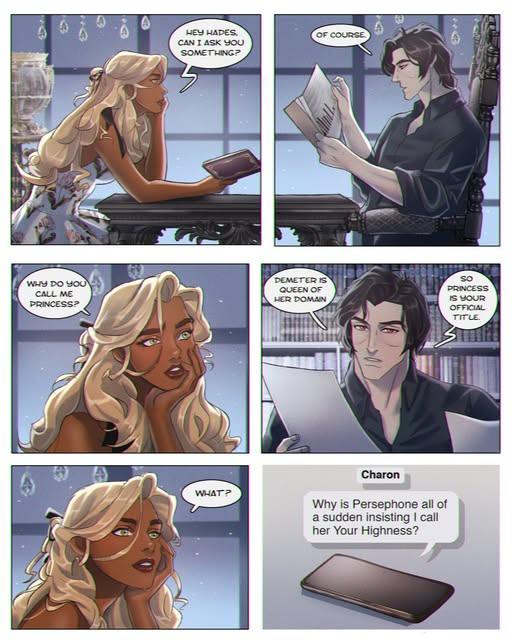
This implies that somewhere out there, there are people who aren’t using royal titles / etiquette when addressing Gods.
Let us remind what ‘Regin’ in Old Norse means.
[Comic panel by an ‘Artcraawl’]
The situation of Persephone viz. Demeter, of course, we would read in light of “Kanyakā”, as at Shiva Purana VII 1 25 38 for Kālī viz. Parvati
i.e. figuratively – ’emanation’
From previous work of mine in this area:
“We would also quote from Bauer, in her “Nominal Apposition in Indo-European: Its Forms and Functions, and its Evolution in Latin-Romance” (she also cites a “Cereres” – i.e. ‘The Cereses”, Ceres in plural, Latin having no ‘dual’ directly) as applies the effective underpinning to this – the why for such a ‘dual case’ occurrence:
“Interestingly in Mycenaean, plural Πότναι (‘Ladies’) is attested, referring to Demeter (La. Ceres) and her daughter Persephone (La. Proserpina; Puhvel 1987: 129). Originally mother and daughter formed one divine entity because Ceres not only was the goddess of earth but also of the interior of the earth. In later times the goddess was split into two deities: Ceres assuming the function of goddess of earth and her daughter Proserpina becoming the goddess of its interior, where she spent part of the year. Consequently Ceres and Proserpina were strongly connected—reflecting two aspects of the original deity—and therefore complementary personalities.”
Now, with this I do not quite agree – as I believe that a ‘split’ of sorts was there right from the beginning. And, instead of it being something occasioned “in later times” – I would submit that the proper understanding is that the nature as to said “split” is what changed in its human relativization. That is to say, the explanatory detailing for it changed – and something rather essential was often lost to the relevant culture’s mythos (at least, pop-culturally) in the process.
I have previously pointed out that we can see this ‘in motion’ (to a limited extent – insofar as it never grew wild and outpaced the truth as to the situation) within the Sanskrit / Hindu reckoning. Therein, one will occasionally find mention for Kālī with relation to Parvati as being a ‘Daughter’ thereof. In some cases, it’s simply the potential meaning as to the word – “Kanyakā”, as at Shiva Purana VII 1 25 38, in an element of narrative occurrence that directly parallels a part (well, several parts, per individual local recensions) of the Demeter-Persephone mythic cycle as we have detailed capaciously elsewhere. What does that mean? “Daughter”, or “Young Girl / Maiden” – that is to say, “Kore” [ Κόρη ], were we to speak it in Ancient Greek. Albeit in that case, it is quite clearly not a ‘daughter’ in the conventional sense of which we are speaking – as it is the Dark (Wrathful, Death-associated) Visage of the Goddess which has been (so to speak) ’emanated’ out from Her via a necessity which should soon arise for just such a ‘Warrior’/’Destroyer’ Form; Kauśikī being the name for the ‘Skin’ / ‘Form’ in question (ref. the “krsnām kośīm”, or ‘dark skin’, described at Skanda Purana III 58 2 per the Yokochi rendition, in terms of its effective underpinning meaning).
And yet, in at least one other case – that being the detailing encountered at Skanda Purana III 67 19-20 – we seem to observe this Goddess[-Form] declaring an intent to see Her ‘Father & Mother’ … Lord Shiva & Uma / Bhavani (and it is perhaps rather further interesting to hear at verses 41-42 & 52-54 that the Earth blooming with flowers in relation to this (re-)encounter is mentioned prominently). This cannot, of course, be taken literally (notwithstanding how well it should otherwise ‘match up’ viz. Zeus & Demeter with relation to Persephone, otherwise – in fact, that is rather the point). After all, there is no such mention for a ‘paternity’ involved at, say, Kaushiki’s emanation earlier in the same text – Skanda Purana III 60 5 simply has the Devi, as Yokochi’s synopsis puts it for the verse : “splitting Herself in two, [sending] one half of Herself – namely Kauśikī – away to annihilate demons.” Skanda Purana III 58 8 also simply features Kaushiki ‘generated’ from the Dark Skin of the Devi (“tasyāṃ kośyāṃ samabhavatkauśikī”), and just a few lines later in any case is declared to be “mūrtisthānaṃ mamā” (III 58 16), translated by Yokochi as “A Locus For My i.e. Parvati’s Embodiment” (in the introduction to the volume), or “Standing for an Embodied Manifestation of Me [Parvati] […]” (in the synopsis for the verse itself); Yokochi pointing out that the text rather directly ‘re-combines’ the Two at a litany of subsequent points wherein the deeds it presents as carried out by the One (or qualities, epithets, adornments, functions, etc.) are listed amidst the hailings also of the Other.”
Jai Mata Di.
[-C.A.R.]
 arya-akasha