
In our house, we prefer to take a ‘live-and-let-live’ approach towards spiders. Most particularly where they turn up in the shower, and there is some concern as to the imminent re-enactment of an arachnine Myth of Sisyphus to shortly prove impending.
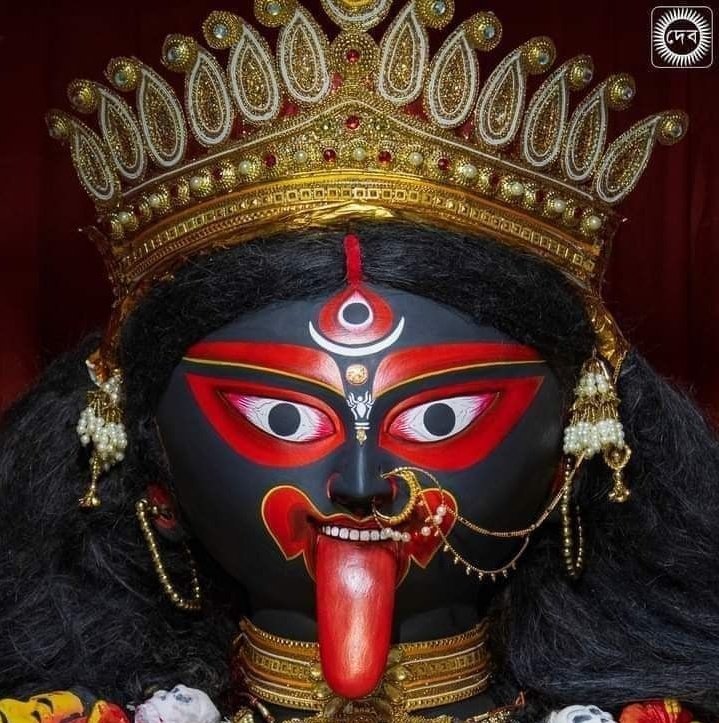
And, because it fairly instantly leaped into my head upon having this photo sent to me by Mum … here’s the Rev. Rolinson (who had assisted the spider in question upon its exit from the shower to the bushes outside) with his temporary hairpiece, along with the somewhat similar iconographic feature one finds in Bengali depictions of the Goddess (look between the Brows).
Now, were you to ask somebody as to the saliency for the Spider within Hindu theology – you would, quite likely, anticipate one of two Upanishadic verses to be referenced. These come to us from Bṛhadāraṇyaka Upanishad II 1 20, and Muṇḍaka Upanishad I 1 7. These effectively speak toward the Universe as being the creation of a being – in the manner of a Spider working upon a web.
A lesser-known verse, however, from the Śvetāśvatara Upanishad, moves somewhat closer to the heart – insofar as, due to the Shaivite context of the Upanishad, it is a rather particular Deific Who has this role of the Spider, we may inferentially suggest. The Being Who carries out the essential work of ’emanating’ and ‘working upon’, ‘structuring’ the Universe according to that most august design ! It is said therein that it is through the power of that Divinity’s ‘Maya’ that They produce such a suite of ‘covering’ all about Them. Along with, implicit to the ensuing verses, the notion that just as the spider does not get caught within their own web … so, too, does the Deity Who has expressed or emanated all this ‘web’ of the cosmos – well, They are not ‘caught’ within Their Web, and all of its travails concerning causality and imperfection and ‘qualities’ and limitations and gunas and the like. To reference the theology more familiar to my handily Spider-adorned paternal forebear – “in this world … but not of this world”, perhaps we might suggest.
The same metaphor is also understandable as the Goddess in such a role, and we shall return to that theme in a moment.
There is also a quote from the late David Lynch which rather nicely encapsulates the whole thing – albeit there, he was ‘bringing it down to our level’, so to speak, to place the human reader within the heart of the metaphor:
“We are like the spider. We weave our life and then move along in it. We are like the dreamer who dreams and then lives in the dream. This is true for the entire universe.”
Of course, for my money (and/or Muni) – we like to go off the beaten path somewhat. And into the ‘practical applications’ … most especially for Warfare !
The concept of “Indra’s Net” or “Indra’s Web” has some prominence, and we shall not delve into its modern regard here. Suffice to say its earliest attestation is at AV-S VIII 8, a hymnal entitled with sufficient laconic flourish via Whitney’s translation as “To conquer enemies”. We have good reason to inferentially connect this to certain dimensions to the Chaitra suite of war-rites which would be proximate to March-April within the Western calendar (and c.f. the Quinquatria oriented for Minerva, and those Germanic / Nordic examples we have sought to discuss from time to time), as we may seek to bring to light in a future work.
Suffice to say, the Atharvanic exemplar aforesaid, situates Indra (and we would be cognizant for the Yajurvedic enthusiasm for Indra as the ‘station’ stepped into via the chief, officiating Priest – as ‘Hero’, we may suggest) with relation to a great, immense ‘web’ or ‘net’, which is to find its syzygy in the rather smaller-scale physical net to be made and wielded via the human ritualists seeking to draw upon the all-encompassing potency of the more metaphysical / cosmological ‘net’ up above (consider the ‘dual situation’ of the Chitra Nakshatra, viz. the Lordship of Tvastr & Indra).
To quote a few verses therefrom via way of illustration:
“5 The atmosphere was the net; the great quarters [were] the net-stakes; therewith encircling [them], the Mighty One (çakrá) scattered away the army of the barbarians (dásyu).
6 Since great [is] the net of the Great Mighty One, the vigorous (vājínīvant)—therewith do Thou crowd (ubj) down upon all [our] foes, that no one soever of them may be released.
7 Great, O Indra, hero (çū́ra), is the net of Thee that art great, that art worth a thousand, that hast hundred-fold heroism; therewith encircling the army of the barbarians, the Mighty One slew a hundred, a thousand, ten thousand, a hundred million.
8 This great world was the net of the Great Mighty One; by that net of Indra do I encircle all yon men with darkness.
9 Debility, formidable ill-success, and mishap that is not to be exorcised away (an-apavācaná), toil, and weariness, and confusion—with these do I encircle all yon men.
10 To death do I deliver those yonder; with fetters of death [are] they bound (sā); the sad messengers that are death’s—them I lead them to meet, having bound (bandh) [them].
11 Lead ye them, O messengers of death; O messengers of Yama, restrain (apa-umbh) [them]; be they slain to more than thousands; let Bhava’s club (? matyà) shatter them.
[…]
14 The forest trees, them of the forest trees, the herbs and the plants, what is biped, what is quadruped I despatch (iṣ), that they may slay yonder army.
[…]
16 Here are spread the fetters of death, which stepping into thou art not released; let this horn (kū́ṭa) slay of yonder army by thousands.
17 The hot drink (gharmá) [is] kindled with fire, this thousand-slaying oblation (hóma); both Bhava and the spotted-armed one—O Çarva, slay Ye (Two) yonder army.
18 Let them go unto death’s burning (?), unto hunger, debility, the deadly weapon, fear; by snare (ákṣu) and net, O Çarva, [do thou] and Indra slay yonder army.”
[Whitney translation – sadly, as noted via the published edition, this was “doubtless only a rough first draft, which he would have revised thoroughly had his life been spared.” The commentary also spells out the setting down of ‘rope’ in the manner of these ‘fetters’ or ‘nets’ whilst key verses are being utilized, as well]
The purpose to this is, as we have noted, for the rather significant destruction of an enemy army – and we would point toward various other occurrences wherein such things seem inferentially to be somewhat-glimpsed , as in the Darraðarljóð (where such a ‘web’ is weaved by Valkyries in advance of the Battle of Clontarf – they ‘Weave Dooms’, we would say … in the old sense to that latter term; c.f., perhaps, the Vedic conceptual linkage for the ‘rope-weaver’ with ‘fate’ or ‘death-time’, viz. “diṣṭā́ya rajjusarjáṃ”, at VS XXX 7), which seems the same phenomenon reported by Porphyry in his Odyssey commentary viz. the ‘Cave of the Nymphs’ where ‘Naiades’ act in emulation for Persephone (or, Roman – Proserpina – and attested as a web-weaver elsewhere, also) … or perhaps that enigmatic suite of lines from Ovid’s Fasti [III 817-820], wherein in amidst those other preparations for warfare we hear of ‘girls’ being instructed in Her Art toward weaving.
A situation which, of course, reminds one fair-instantly also of various other occurrences as to the phenomenon. From the Völsungakviða (otherwise known as ‘Helgakviða Hundingsbana I’ – ‘The First Lay of Helgi Hundingsbane’):
“Sneru þær af afli örlögþáttu, þá er borgir braut í Bráluni;
þær of greiddu gullin símu ok und mánasal miðjan festu.”
Or, translated (by Bellows):
“3. Mightily wove they | the web of fate,
While Bralund’s towns | were trembling all;
And there the golden | threads they wove,
And in the moon’s hall | fast they made them.”
Which, to quote myself upon the subject from a work some almost four years previously :
“Now of interest to us here is not merely that golden threads are being woven, evidently in the Sky [‘Moon’s Hall’] – but that what is being woven is described as ‘Orlog’. Orlog, as long-term readers of ours shall no doubt know, effectively means ‘Supernal Law’ (in fact, that is a rather direct translation), ‘Cosmic Order’, and is cognate as a concept with Vedic Rta, etc. ‘Thattu’, meanwhile, I would suspect to be a formulation of Old Norse þáttr – a remarkable term which at once means a ‘thread’, but also came to mean a ‘story’ (or, rather, a phase of one unless it was a short story – in modern Icelandic, its direct descendant, þáttur, also can mean an ‘act’ of a play, etc.). An excellent expression for what is being measured out here – the course of a man’s life! This notion of an ‘act’ of a ‘play’ is incredibly salient both for the underlying Indo-European deific complex we are dealing with, as well as to Artemis in particular, but we shall come back to that at a later point.
For now, it is enough to note that what is being spun out, via this ‘golden thread’ is intimately connected to Orlog. Why? Because as it happens, the Norns are not the only Nordic figures with an irreducible connexion to both Orlog and golden-thread-spinning.
In the Lokasena, we find these interesting remarks from Freyja –
“Freyja kvað:
“Ærr ertu, Loki, er þú yðra telr
ljóta leiðstafi;
örlög Frigg, hygg ek, at öll viti,
þótt hon sjalfgi segi.”
Or, in translation (again, Bellows):
“Freyja spake:
“Mad art thou, Loki, | that known thou makest
The wrong and shame thou hast wrought;
The fate of all | does Frigg know well,
Though herself she says it not.”
Again, Orlog has been translated – not inaccurately, but most definitely incompletely – as ‘Fate’. And as for why we can tell this has some connexion to a golden thread … well, iconographic depictions of Freyja (the same deific as Frigg, even though here presented as speaking .. well, not so much ‘in the third person’ as about another) frequently feature a spinning-wheel, and we likewise have the otherwise curious attestation for the constellation of Orion (particularly the Belt thereof – that is to say, a ‘thread’) as being Frigg’s Distaff.”
We would ponder, from our 2025 perspective – as has benefitted from several subsequent years’ worth of both research and actual, ‘practical experience’ in certain matters – whether the correlation for ‘Frigg’s Distaff’ (‘Friggerock’; reportedly also identified as Freyja’s Distaff … as we should be unsurprised about, really) with rather specifically the Belt of Orion, might, perhaps, have to do with that fairly ultimate weapon wielded by Rudra, the TriKanda [‘Three-Arrow’], whether against Prajapati or the Triple Forts of the A’Suras. One of these, certainly, correlates to a particular deed which is evidently rather ‘foundational’ within the context of the aforementioned (broader suite of) Quinquatria understandings of Ovid (as we intend to once again re-detail in a futher piece – but suffice to say it pertains to the ‘Capta’ of the relevant Minerva Shrine, inter alia).
In any case, to return to where I had intended to be going with this … the situation of the ‘Web’ – and with the Great God and/or Goddess as the Spider responsible there-for – is ‘operationalized’ whether in grand scale or in smaller, to produce particular effects by the war-priest(s), or group of apparently female operators (as beheld in each of the Nordic and to a certain extent Classical clades of comparanda) who ‘weave a web’, spider-like themselves, with a view toward establishing the ‘fate’ of figures involved in an impending conflict.
It is to this sort of operation which the First Merseburg Charm perhaps refers –
Eiris sazun idisi,
sazun hera duoder.
suma hapt heptidun,
suma heri lezidun,
suma clubodun
umbi cuoniouuidi
insprinc haptbandun,
inuar uigandun! .H .
“Once sat women,
They sat here, then there.
Some fastened bonds,
Some impeded an army,
Some unraveled fetters:
Escape the bonds,
flee the enemy!”
[Translation as given by Giangrosso]
But let us bring this back towards that Atharvanic hymnal of which I have indulged myself in quoting a few (extra) verses than were strictly necessary therefore.
One reason that I had done so was to point out that it is not only Indra Who is called upon, and Who is spoken of as engaged in making utilization for the ‘Net’ at the macroscopic, indeed sheer cosmological scale. We also rather pointedly hear of those famed Roudran expressions – Śarva & Bhava – actively engaged in such proceedings. Goes nicely with that notion for the ‘Web’ as being the product of the Spider , with the Spider having such identification in-line with the Śvetāśvatara Upanishad, no? Also, given the correlation for Minerva / Athena to Rudra (in part, She is also – of course – resonant for the Goddess, as well) , as we have often sought to explore … and, indeed, the situation for ‘Frigg’s Distaff’ with which quite some Weaving might be undertaken, with the immense foe-slaying potency for Rudra’s TriKanda as found at the Belt of Orion – well, you can see how there is quite clearly ‘Something’ of a most archaic and grand significance to be beheld within all of this.
And, since I am upon some form of soap-box upon the subject :
An interesting dimension which is to be observed within the aforementioned Atharvanic hymnal … is that this grand ‘Net’ which is spoken of – it does not simply encompass ‘space’, but also sweeps to take in ‘time’. The notion of a ‘space-time continuum’, so to speak, should almost seem readily presented within this invocation : and deployed toward something as functionally practical as the obliteration of an enemy (human) army. It is an illustration, an evocation ‘in-motion’ – for that which is ’emanated’, which is ‘set out’ via such an ‘Over-Divinity’ in the manner of the ‘web’ from the ‘spider’. Which does not simply congeal a physical space for things to play out within and leave it to its own devices – but, rather, a much more interesting and intricate unfurling also of ‘time’ as both the ‘space’ (temporally speaking) within which things can take place … but also as in the flow of general events, causality, fate that is the more ‘deterministic’ (if you like) ‘scripting’ as to be observed (and experienced) thereto).
Which is what is being ‘tapped into’, upon both axials, via the war-rites which we have alluded to earlier: the physical, not least as it renders the whole thing fairly ‘inescapable’ , the ‘temporal’, effectively, due to the ‘inescapable’ vector advanced likewise (if you get my drift).
And yes, yes I did have most of this basically turn up in my head upon seeing that picture of the Reverend Rolinson with a spider upon his brow. My mind moves within spider-webs of its own of great … tangled-seeming tangentiality, from time to time.
 arya-akasha