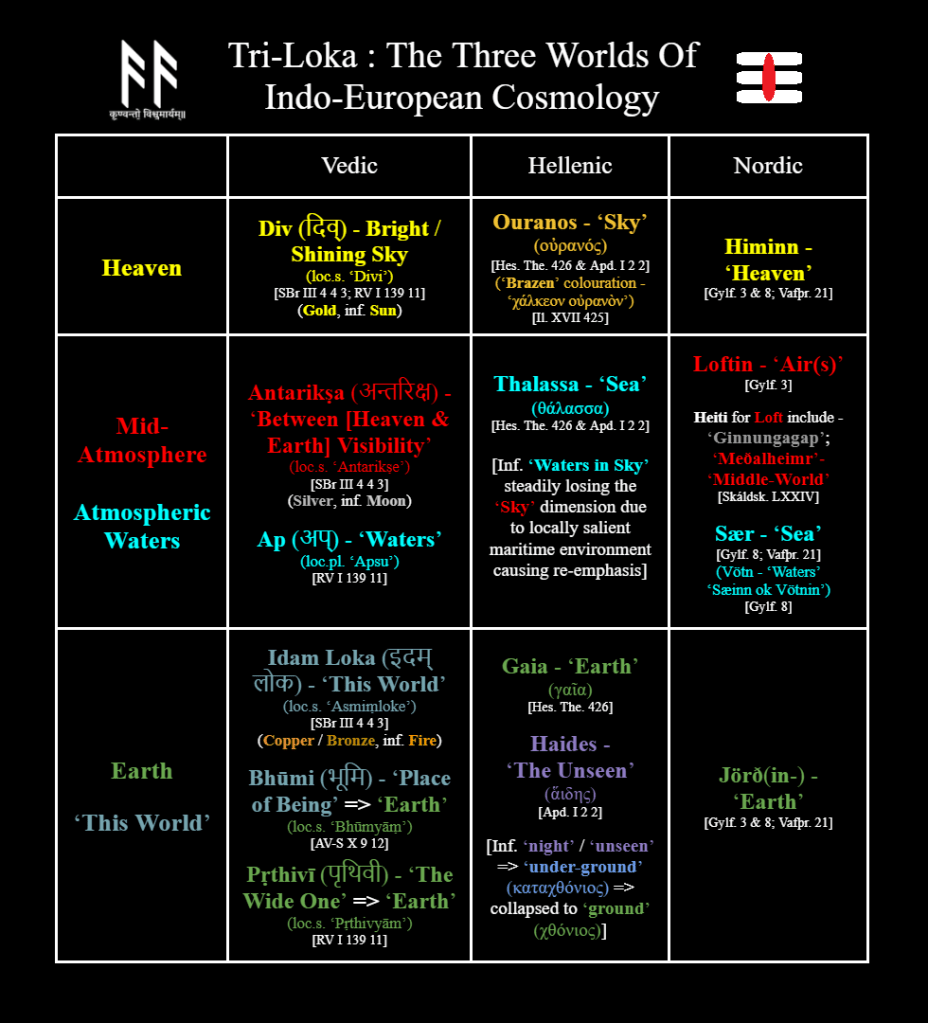
The archaic Worlds-view of the (Proto-)Indo-Europeans featured a functional conceptualization for the Cosmos as broadly divisible into three ‘layers’ or realms.
We can safely infer this due to the shared fundamental TriPlanar structure carried forward by various of the major (post-PIE) Indo-European spheres, attested amidst both their mythic and ritualine perspectives – as we have drawn from in order to make this comparative chart.
It is important to note that this Triple-World schema was not intended (either by myself or by our archaic forebears) to be the cosmological equivalent to a topographical map, wherein one might find the major features to the cosmos all laid out and represented in the manner of a snapshot or ‘God’s Eye View’. (Which could, and did, exist to varying extents – albeit most saliently in literary and ‘descriptive’ rather than pictorial or otherwise physical form, at least as applies what has come down to us from further antiquity)
Instead, the elegant shorthand of the ‘Tri-Loka’ perspective was closer in concept to what we would today term a “topological” map. That is to say – it depicts the spaces in question in an abstract fashion (indeed, the ‘spaces’ are the focus), emphasizing their relative positioning and interrelation with one another (and not, for instance, the arrangement of particular features within them).
Rather like the manner of a modern subway map (which eschews spatial accuracy and detailing in favour of simply showing you ‘where the next stop is’ and what zones you traverse in order to get from ‘there’ to ‘here’). And, as it should happen, for a not entirely dissimilar reason.
Yet whilst the Vedic and Eddic canons have each preserved what would seem to be the Proto-Indo-European trio of (roughly speaking) ‘Heaven’, ‘Mid-Atmosphere’, and ‘Earth’, it would appear the Hellenic (and later-attested Roman) correlate had undergone something of a speciation (albeit somewhat unevenly – as can be seen via the manner in which different source-materials approach the delineations … as we shall expand upon in due course).
We shall seek to discuss both the nature of these developments, and our evidentiary basis for arranging things in the array which we have (most particularly how some of these elements actually do and can be seen to ‘fit together’), in a series of subsidiary sections soon to be on view. It had seemed a more ‘user-friendly’ approach than attempting to throw all six thousand plus words (and counting) of commentary out there in a single go.
In other words – if you’re wondering how on earth (or, rather, above earth) I’ve managed to assert that there’s a ‘Sea’ in the Sky, just what’s gone on as applies that curious development viz. Hades and where its correlates are in the other two IE spheres if not ‘down’, or what’s happened to Tartarus (etc.) … rest assured there’s a suite of analysis for you to look forward to, written up with something approaching my usual brevity.
Finally (for the moment), my thanks once again to the learned Nyāyaratnasiṃha for his patient assistance with several elements to this chart and accompanying written efforts. If there’s anything still somewhat askew in the Sanskritic department, that should very squarely be taken as a reflection upon me rather than him.
 arya-akasha
Pingback: TRI-LOKA : The Three Worlds Of Indo-European Cosmology – Part Two: Sailing The Sea Of Sky | arya-akasha
Pingback: TRI-LOKA : The Three Worlds Of Indo-European Cosmology – Part Three: The Dead Among The Stars | arya-akasha
Pingback: TRI-LOKA: The Three Worlds of Indo-European Cosmology | arya-akasha | Vermont Folk Troth
Pingback: TRI-LOKA : The Three Worlds Of Indo-European Cosmology – Part Four: Amidst The Glorious & Ancestral Dead | arya-akasha
Pingback: Metaphysically Potent Medication, Anglo-Saxon & Atharvanic | arya-akasha