Yet what of Persephone ‘midst the North? Where might *She* be found?
And, for that matter – with the Rivers (of the Underworld), the Water(s) as Pathways toward the Goddess and Cosmic Order within the context as to those Indo-European cultures in or about the Mediterranean … where might the portals of liminal immersion lead us therein?
In this regard, we would speak of Vak Devi Herself – as She, Herself declares it at RV X 125 7, Her Home (Yonir is the actual term used – Griffith renders as ‘Home’, H H Wilson goes for “Birthplace”, Jamison/Brereton for “Womb”, Janasvami for ‘Source’, … however whilst it may prove tempting to go for the most immediate sense to ‘Yoni’ – ‘Home’, and there are certainly other RigVedic occurrences for ‘Yoni’ to mean what appears to be something along these lines … as well as saliencies suggestive of “Spring”, “Fountain”, etc. too within the textual canon) is in the midst of the Waters (apsvantaḥ – the ‘apsu’ denoted earlier [and it might prove intriguing to contemplate in relation to ‘Water-Producer’ a la ‘Cloud’ as has been suggested viz. RV I 139 11, with Vak as Thunder] … with this enhanced via the specific identification immediately following of this with ‘Samudre’ – Samudra … the ‘Ocean’, that is to say the ‘Gathering of the Waters’ – Sam + Udra, and pointedly also the ‘Aerial’ Sea in the Sky, the Waters which bound the Worlds, etc.).
Given that Vak is, of course, Rta (Cosmic Order) in Her In-Universe (‘Active’) Expression – the ‘Home’ of Rta being out there within the Waters fits rather well with the notion of ‘Supernal Law’ (ref. Norse ‘Orlog’ – literally, Outside Law) being likewise thusly situated (although, obviously, not *restricted* only thereto – as the next part to RV X 125 7 proudly declares, it is from this Home or Origination that She thence moves to extend across All Worlds (or ‘encompassing all beings’ in another translative approach to bhuvanānu ) pervading all the way to the Summit of High Heaven. And therefore, of course, just why it is so sacred to Swear Upon The Waters in such a manner. (We might also make mention for the situation at Pausanias VIII 25 7 of the Demeter Lusia [‘The Bather’] murti standing alongside the rather larger Demeter Erinys in the sanctuary at Oncium being apparently ‘confused’ (seemingly with some frequency for it to be worth noting) for Themis … which, despite Pausanias insistence that this is an assertion (or, perhaps, ‘custom’) in vain – we can nevertheless clearly see to possess an essence of truth to it. Certainly, there are prominent associations for Demeter and the Divine Law – as seen elsewhere in Pausanias’ own work (c.f. VIII 15 4, viz. Demeter Thesmia , etc.) inter alia)
This situation viz. the saliency of Rta ‘out there’ in the ‘above & beyond’ to our universe is also expressed via the idea of that most imperious of weapons, the Thunderbolt ( Vajra ) , having *its* (or, perhaps, *Her*, per Sayana’s commentary upon the very next verse) ‘Home’ likewise within the [midst of the] Ocean (Samudra), covered [ abhīvṛtaḥ ] by (the) Water(s), per RV VIII 100 9 : with (rather pertinently for our purposes) the next half to the aforecited line declaring that via the Springs (prasravaṇā) the waters (receive and) bear continuous sacrificial offering before [in either and/or both senses – chronological and/or positional] the Weapon. One would point toward the otherwise somewhat enigmatic attestation encountered at Aeschylus’ Eumenides 826-7 for Athena being the only One of the Gods ( μόνη θεῶν ) to know the keys ( κλῇδας ) to the ‘house’ ( δώματος ) where the aforementioned Thunderbolt ( κεραυνός ) is ‘sealed’ ( ἐσφραγισμένος – consider σφραγίζω etc.). Given the elsewhere-discussed (by me, at any rate) strong correlate saliency for Athena and Vak Devi in various regards (including, perhaps, the likely interpretation for Tritogeneia should the Lake of Tritonis be selected as Her Origin-point, notwithstanding a more overtly ‘Roudran’ interpretation a la ‘Tryambaka’ and the Three Mothers, etc.) … it should seem rather logical to similarly infer that that Thunderbolt of Zeus is likewise of ‘Waters’ / Supra-Universal originations. As it is, after all, the very force of congealed Cosmic Law – and thusly so evidently fatal towards those demonic threats who would seek to otherwise oppose, usurp and denigrate the sacred immanency of the Divine Cosmic Law and Order within this place of ours.
Yet we can go further.
This situation of the Goddess amidst the Waters – we also observe viz. luminaries of the Nordic sphere.
Per the Gylfaginning, we hear:
“Frigg er æðst. Hon á þann bæ, er Fensalir heita, ok er hann allvegligr.
Önnur er Sága. Hon býr á Sökkvabekk, ok er þat mikill staðr.”
Which, per the Brodeur translation:
“Frigg is the foremost [of the Ásynjur – the Goddess(es)]: She has that estate which is called Fensalir, and it is most glorious.
The second is Sága: She dwells at Søkkvabekkr, and that is a great abode.”
Now, to this we shall add in the name of a more complete examination to the typology (without including Gefjun – for another time … ), these elements from the Grimnismal:
“Sökkvabekkr heitir inn fjórði,
en þar svalar knegu unnir yfir glymja;
þar þau Óðinn ok Sága drekka um alla daga
glöð ór gullnum kerum.”
“Þrymheimr heitir inn sétti, er Þjazi bjó,
sá inn ámáttki jötunn;
en nú Skaði byggvir, skír brúðr goða,
fornar tóftir föður.”
“Fólkvangr er inn níundi, en þar Freyja ræðr
sessa kostum í sal;
halfan val hon kýss hverjan dag,
en halfan Óðinn á.”
Which, per the Bellows translation:
“Sökkvabekk is the fourth, | where cool waves flow,
And amid their murmur it stands;
There daily do Othin | and Saga drink
In gladness from cups of gold.”
“The sixth is Thrymheim, | where Thjazi dwelt,
The giant of marvelous might;
Now Skathi abides, | the God’s Fair Bride,
In the home that Her father had.”
“The ninth is Folkvang, | where Freyja decrees
Who shall have seats in the hall;
The half of the dead | each day does she choose,
And half does Othin have.”
Now, where are we going with all of this?
Well, the usual place(s). Underwater and Underworld, of course.
Frigg is, as is well known, Odin’s Wife : albeit where most would probably assert Her to be one Wife amidst several … we would advance a different understanding. Namely, that She represents perhaps the most prominent of an array of Faces or Aspects to the same Goddess … with various of the *other* identities hailed as Wives of Odin within the source-material instead also constituting further ‘Aspects’ or ‘Forms’ or ‘Facings’ and ‘Visages’ as to She. This is much the way in which one would intuitively conceptualize the situation for Kali, Parvati, and Durga, for instance – not different (i.e. differently independent) Goddesses, but instead several Forms for the same Goddess … albeit potentially to be encountered not only ‘sequentially’ (that is – one Form for the Goddess transforming into another in response to changed conditions … like Her becoming angrier, for example … ) but also ‘in parallel’ from time to time as co-occurrent ‘Emanations’ (as we have seen viz. Kaushiki relative to Parvati, &c.) ; and with this theological depth and nuance likely lost following the often downright euhemeric (re-)presentation or re-understanding for the Nordic / Germanic mythos post-Christianization etc. Left only fragmentarily for us to re-congeal and re-piece together via such enigmatic situations as suspiciously similar textual occurrences, seemingly ‘overlapping’ biographical details (or hailings), and the ever-appealing ‘linguistic trace elements’ approach.
Oh, and of course – the comparative Indo-European theology. Which, as applies the ambit (and Ambika) for this (A)Arti-cle, enables us to consider Skaði in clear constellation with both Kali (i.e. a Dark, ‘Shadow’ Form, an Avenging Aspect, for the Wife of the Sky Father; strongly oriented toward the Divine Law’s Sacred Upholding) – and those other emblematic exemplars for our unveiling typology, Demeter / Persephone. After all, Skadi, too, is engaged in the half-and-half (well, Nine-and-Nine) split-division of Her residency between Her Own preferred Demesne (the Mountains – as we also see as the domain for Devi … whether Kaushiki in amidst the Vindhyas, or the storied associations (and straight-out etymology) for Parvati, Girija, ShailaPutri, &c.) and that of a ‘Husband’ (the transmigration therethrough being of decidedly ‘Watery’ association …). [Interestingly, McKinnell observes that in the Nordic sphere, the contrast between Sea and Mountains is one between an “environment (the sea) [which] produces food, while Skaði’s mountain home is essentially barren.” It is not hard to see how this might ‘match up’ with the contrast of both the Underworld and World of Light and Life upon the one hand (the Journey of Persephone) – or that aforementioned Surface World (of Men) within conditions of (barren) Winter and (ripe) Summer (the Transition of Demeter), as well. ]
We might also contemplate Her intriguing hailing as ‘skír brúðr’ (at Grimnismal XI & its quotation by Sturluson at Gylfaginning XXIII) in light of the likely etymology for Ska as, effectively, ‘Shadow’ (ref. the Irish Scáth => Scáthach; McKinnell also adds “Gothic skadus, Old English sceadu, Old Saxon scado, Old High German scato [ – ] ‘shadow’.” (And perhaps we might but briefly muse in relation to Old Icelandic Skiði / Skeiðir – ‘Sheath’, à la Hindu ‘Kauśikī / Kaushiki’, which means just exactly that) Personally, I would not suggest this ‘Darkened’ contemplation need prove mutually exclusive with that *other* suite of potential etymological conceptry viz. ‘Scathing’, ‘Harming’, ‘Injuring’, ‘Death’, &c. – whence the *other* Old Norse ‘skaði’ meaning much exactly that.).
Why so?
Well, as we have seen, the effective ‘contrast’ for the Goddess-Form(s) within our typology is not simply one of ‘Dark’ and ‘Light’ Facings (although it is also that). It can be viewed on multiple levels – another of which is i) the inherent dimension of ’emanation’ for the Dark Form also from the more ‘beneficent’ Aspect (more rarely, the other way around – c.f. Devi Bhagavata Purana at V 23), as we see viz. the Dark Skin of Devi becoming Kaushiki / Kali (as ‘Kanyaka’, indeed, for the Goddess) or Persephone relative to Demeter, potentially, within the bounds of our reconstructive analysis (and hence, perhaps, why at Oncium, Pausanias [VIII 25 4-7] records the Sanctuary there to have *both* an immense, nine-feet tall Murti for Demeter Erinys *and* a six-foot tall Murti for Demeter Lusia (‘The Bather’) … as, assumedly, even where Both are conspicuously & uncontroversially (ish – Pausanias notes an apparent belief in the latter Demeter in fact being Themis … which we would contend is, contra his dismissing of such, in essence not entirely removed from the truth) hailed as Demeter – these may be encountered (and worshipped!) ‘in parallel’ rather than *only* ‘in sequence’ (i.e. One after the Other and following the appropriate (and likely ‘seasonal’) ‘transitions’ between the Two).
I suppose one might suggest that in order to Cast the Shadow – one must have Light. A duality intriguingly reinforced when we observe that the same Proto-Indo-European term (PIE *sk̂āi- or *sk̂ǝi- , *sk̂ī- , per Pokorny) which produces the ‘bright’ Skír(r) in Old Norse … is also responsible for Sanskrit ‘Chaya’ (Who, relative to Saranyu, is *also* a correlate for the Demeter / Demeter Erinys or Melaina mytheme) , Ancient Greek σκῐᾱ́ (Skia – Shadow, or ‘Shade’ (as in, of the Dead; as well as the more mundanely Sunlight-related one) ), and so forth.
Meanwhile, as applies this term, ‘skír brúðr’, itself – we should, no doubt, note that brúðr does not *necessarily* have to literally mean ‘bride’. But, also, can mean ‘woman’ in more general terms – and, given the connotations inherent in what is anticipated viz. a ‘bride’, we would postulate that a *young* and maidenly woman would generally be implied (ref. the Kanya / Kanyaka scenario … and, of course, Kore … ). Skír / Skírr should arguably reinforce this – as whilst it *can* most definitely mean ‘Bright’, ‘Clear’ … it also can mean *Pure* (indeed, it has come to be utilized to label that more Westernly-familiar sort of ‘purificationary bathing’, the Baptism, viz. Skíra / Skírn in Icelandic). As we can see – this seems rather fitting for our overarching typology. Insofar as we encounter within the same (singular) Goddess *both* the ‘Darkness’ *and* the ‘Light’ (potentially following on from ‘Purification’) . And engaged in the *Decidedly* resonant sphere of hunting down (and shooting) a would-be usurper / underminer of the saliency & immanency of Cosmic Order here within these Worlds of ours – sanctioning that criminal with dread punishment both serpentine and underground. I have my own thoughts on the potential ambit for the ‘Bright’ connotation – especially in potential coalition with a somewhat unorthodox interpretation for the ‘goða’ which comes immediately following ‘skír brúðr’ … but we shall save that for another time.
And speaking as to Husbands – it is Odin Who Is the Nordic Sky Father expression. Helpfully, for our purposes, rather directly phrased as “Orci Plutonem” at VIII 5 1 7 of Saxo Grammaticus’ Gesta Danorum (and potentially as Stygius Pluto at VII 11 4, and more simply as Pluto albeit in connexion with the river of Phlegethon at II 7 21 – where this River is understood as the conveyance (or perhaps demesne) for those great and noble souls sought by this aforementioned God).
The ‘Pluto’ dimension we expect for reasons that ought prove rather readily apparent, although it is interesting to observe the ‘Orci’ there – ‘Orcus’, of course, being a perfectly viable designation for the God of the Underworld with reference to either the Dominion (or River, for that matter – and its oily / black substance upon its surface, ref. Pliny Naturalis Historia IV 15 8) thusly named; yet potentially linked more pointedly to the notion of Oaths and their upholding (viz. Ancient Greek Horkos, Zeus Horkios) – which is *exactly* the context within which one hears of this ‘Orci Plutonem’ to be invoked in Saxo Grammaticus, given that the invoker has just offered certain ‘vows’ (‘Vota’) at the funeral (and accompanying pyre) of a king.
Yet let us return to His Wife.
Whilst it is not ‘universally accepted’, we have long advocated for the identification of Freyja *with* Frigg – that is to say, as another (Form for) Odin’s Wife. The detail attested in the afore-quoted passage from the Grimnismal for Freyja ruling in Folkvangr (wherein, per Gylfaginning XXIV, Her Hall is called ‘Sessrúmnir’ – the name also encountered at Nafnaþulur 77 as a *Ship*) and receiving half the Dead of the sort which would be sent to Valhalla (the other half going to Valhalla) certainly sets Her up as being a ‘female counterpart’ to Odin most directly. Certainly, this notion for the Underworld / Afterworld as being under a Goddess – and, most pointedly, that Goddess Who is the Wife of the Sky Father / Lord of said Realm – is a pervasive Indo-European annoting. Aditi, for instance, we hear of at SBr VIII 4 3 7 as being Adhipatni of the Pitrs (and with, as I noted some months previously in an (A)Arti-cle for Kali and Her Army – “Adhipatni, we have to say, is a most *intriguing* terminology to deploy there – as with a *slightly* longer initial ‘A-‘ sound (आधि vs अधि), we would have, instead of ‘High-, Over-‘ Queen … a term referring to Punishment, Pain, and Oaths. A ‘Dread Queen’, we might say (and yes, ‘Dread’ is part of the meaning-field).”). So, as applies Freyja – we would suggest the sobriquet of ‘Juno Inferna’ … not least given that Odin is, per various Nordic / Germanic sourcing-material (a recension of the Icelandic Rune Poem, for instance ( AM 687d 4° ); or the complaint of Archbishop Wulfstan II of York in his ‘De Falsis Diis’ (‘On False Gods’), etc.) quite expressly Jupiter (and this is before we get into the various ‘Jupiter of the Underworld’ style conceptry which we might bring to His Table) (c.f. Pausanias (II 24 4), quoting Homer (Iliad IX 457) – “Ζεύς τε καταχθόνιος καὶ ἐπαινὴ Περσεφόνεια.”).
This situation should seem also to fairly explain that of the Goddess Sága – Who is encountered, as we had noted within the course of our Grímnismál quote above, alongside Odin quite directly (indeed, “daily” – “alla daga”). This, in concert with the also-afore-quoted occurrence for Her immediately following Frigg within the context of the Gylfaginning (35), leads Gurevich to observe that ” it is possible that Sága was identified with Frigg” – a supposition with which we would be obviously inclined to agree. Grimm, by contrast, goes in a rather … different direction by asserting Her to be “daughter of Wuotan ; like Zeus’s daughter the Muse” (Teutonic Mythology I, p. 310, Stallybrass translation) – which is not, as applies the familial relationship he presents, something with any actual evidence to it (it would appear that he considers the analogy to Zeus and the Muse (singular, apparently) to be sufficient).
We would instead suggest that the likely etymology with relation to ‘Saga’ (as in ‘Story’, ‘Telling’ – from PIE *Sekʷ- ; or, per Pokorny, the allegedly substantively identical to those PIE terms for companionship or following, and seeing, *Sekʷ-2) suggests the true nature to Her … that She should be regarded as plausibly coterminous with our (Hindu) Vak Devi. The postulation of Gurevich for Sága to effectively render as “Proclaiming One” has an excellent ring to it – Speech is, indeed, That Which One ‘Proclaims’ With, and our mind *instantly* goes to RV X 125 5, wherein the Goddess Herself declares (in fact, quite directly tells us overtly that She, Herself, *is* Declaring – “vadāmi”; to the general acclaim (“juṣṭaṃ “) of both Gods and Men alike (“devebhir uta mānuṣebhiḥ”) ) that it is She Who makes the male whom She Chooses invested with the Ugra (Furor) Potency of the Rsi (Poetic-‘Seer’), with which he is thence able to extoll the Divine Glories accordingly. Or, as Grimm’s own characterization had had it – “She instructs mankind in that divine art which Wuotan Himself invented” (Stallybrass translation).
Why do we mention Vak? Well, for a number of reasons. As noted above, She has Her Home within the Waters [ref. RV X 125 7]; She is also the Wife of the relevant male deific – and c.f. Brihaspati in relation to Odin , even afore we get into the express co-identifications of Her viz. Aditi (or, for that matter, Prisni (Pṛśni), the Mother of Maruts (ref. Aditi), as ‘Mādhyamikā Vāk’, per Sayana’s commentary upon AV-S IV 27 2) &c.
There is more, *much more*, that we shall yet say in relation to Her – but that can await us in further portions to this series.
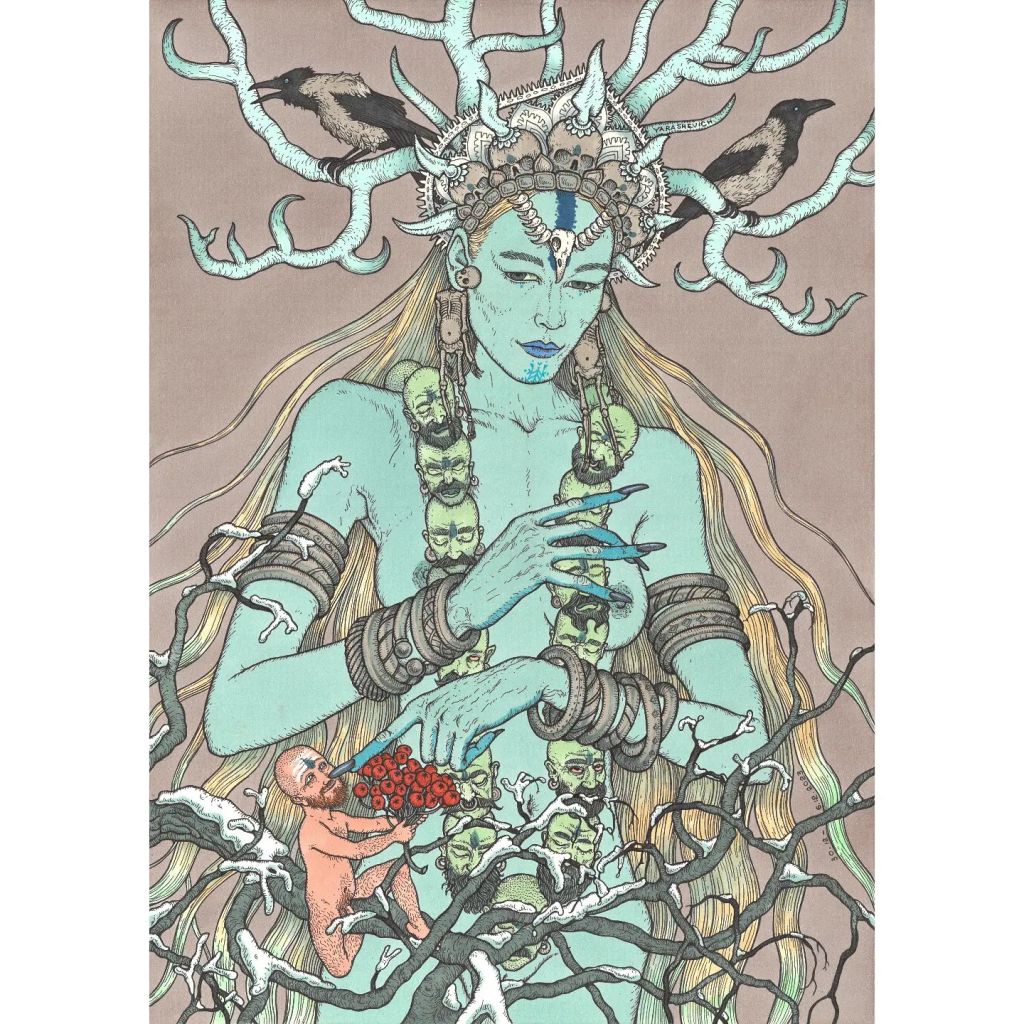
And we also ought make acknowledgement for the art and artist in relation to the illustration I’ve chosen for this piece – the inimitable Andrey Yarashevich, who has produced a very prominently ‘Kali’ style depiction for ‘Winter’. Exactly in line with that which we have been on about at various junctures in this series.
But let us press onwards into the Underworld(s) Proper.
 arya-akasha
Pingback: Grim Waters, Vedic & Eddic – The Death-Visaged Wife Of The Sky Father In Nordic Expression I [The Indo-European Propitiation Of Persephone-Kali – Part Five] – Glyn Hnutu-healh: History, Alchemy, and Me
Pingback: On Algiz, Alcis, Ullr, The Germanic Iteration Of Indo-European Sacred Space, And Its Dread Protector | arya-akasha
Pingback: A Brief (Further) Shiva – Odin Synopsis | arya-akasha
Pingback: Psychopompi Germanica – And Why It’s Not Odin | arya-akasha
Pingback: TRI-LOKA : The Three Worlds Of Indo-European Cosmology – Part Four: Amidst The Glorious & Ancestral Dead | arya-akasha