
We had recently encountered this … bemusing sentiment over on twitter. And therefore, because it may be of a more general interest – shall reproduce our explanation as to why this … isn’t what happened viz. the Durga Suktam and a certain amount as to what’s really going on therein.
BEGINS:
“…I would quite strongly disagree there. Insofar as yes, it is correct that the Durga Suktam is mostly comprised of RV & AV-S verses, largely Agni oriented … but this does not make it “random”, nor does it make it unfounded.
Instead, it is something quite resonant –
As you may be aware, there is a recurrent strand within the Vaidika ritual understandings for the Goddess to be found within the Fire-Altar. I can go off and cite verses if it is of interest or my word is in doubt.
Now, it is true that the preponderance of these is in later texts – whether Brahmanas, or the AV-S [although I think there’s also KYV TS attestation] … however this does not make it some kind of unfounded ‘innovation’.
Instead, we Expect it in the more ritually salient texts … because these are ritual understandings which we are dealing with here. There should not be as much cause for such in the RV because it isn’t such a ‘technical’ samhita [for the most part, anyway]
However, we can be fairly sure that this isn’t either a) a later innovation, and/or b) a specifically Hindu development … because it’s a quite well-attested Indo-European one in easy evincing amidst the Europeans entirely unconnected to later H. evolution.
You may have heard, for example, of Hestia & Vesta – and it is interesting to note that, again, we find concordant ritualistic dimensions to what shows up for the Goddess within the Fire-Hearth in later Vaidika textual presentation, viz. share of offering &c.
We can also be fairly sure that it’s something found within the Indo-Iranic sphere more specifically due to Scythian Tabiti [identified with Hestia by Herodotus, and with a name that quite directly connotes the Blaze], the Queen of the Gods, indeed
and with the Scythians having a notably ‘conservative’ character to their religion [in comparison to, well, that other ‘Iranic’ branch thing which one often hears mention of, the Zoroastrians, at any rate … ]
Meanwhile, if we go back to the point viz. Hestia & Vesta more directly … we observe something interesting.
Namely, that the linguistics underpinning these Theonyms – have these as cognates to our own Vāstu (वास्तु), if memory serves.
Why does that matter?
Well, I assume that you’ve heard of Vāstoṣpati (वास्तोष्पति) … that is to say Rudra (Agni)
So, the Lord/Husband of … well, you get the idea. Just as it is in the later Brahmanas wherein we find such a ‘both’ linkage as a necessary ritualine metaphysics & mythic facing
We would also, of course, observe the saliency for Fire in relation to Durga in the later (i.e. post-Vedic) accounts: the Devi Mahatmyam (II 4 1) has Her arrive via the mechanism of a ‘Mountain of Fire Blazing’ (Parvat & both Tejas & Jvalat, being the terms deployed respectively)
I had then linked to a few previous works illustrating just such a concept in further attestation – viz. , say , the emanation of Katyayani , or the situation of Pratyangira.
Now, as applies this person’s next comment – claiming that, and I quote:
“the worst part is that the word “durga” used here obviously doesn’t refer to the goddess, and it used in a negative way. you can tell the guy who created the “durga suktam” was illiterate in vedic sanskrit.”
Well, my response:
“…but everybody actually using the DurgaSuktam knows very well that ‘Durgani’ refers to the dangers/impediments which the Goddess is implored to assist in our overcoming ?
One might as well seek to claim that everybody hailing the Goddess Durga is somehow ignorant of the theonym having relation also to the demon Durga , whom the Goddess had vanquished
Or, for that matter, that the composer of the famed Thirty-Two Name Hymnal of Durga had no idea what they were doing due to said Hymn hailing the Goddess repeatedly in relation to said ‘Difficulties’ [and their overcoming]
“
Now, what I would append here is that there is a bit of an inconvenience attributable to the … lack of frequency with which we use macrons etc. in English.
Strictly Speaking – Durgā ( दुर्गा ) is the Goddess, and it is Durga ( दुर्ग ) which is the ‘difficulty’ and/or ‘demon’. This makes it a bit easier to see how the theonymic is formed (and the distinction between the terms) – rather than … well, whatever our correspondent was alleging.
Now, there was, of course, a third ‘limb’ to our interaction (as he’d asked a further question about a particular thing) – and without boring with the details, I’ll simply reproduce my replies somewhat lacking in context as they may prove of some utility:
“well, for a start – without going into things that I don’t go into in public … I can tell you that the [traditional] utilization of relevant mantras, with alterations in particulars around Devata oriented toward, is not an unprecedented thing nor is it metaphysically invalid
now it should, of course, be noted that I said traditional utilization … an ordinary person [leaving aside lack of diksha, etc.] just taking a mantra and declaring “oh that means THIS now” and utilizing it in such a way is not the same thing at all.
it should also be noted that … there are several things at play here, as applies the area under discussion. In essence – I don’t (necessarily) disagree that sometimes, people going around and trying to anachronistically ‘read back’ certain deifics etc. are doing exactly that.
And there is a great degree of distinction – to my mind, at any rate – between somebody who is doing the above (often for semi-political, or at least sectarian point-scoring purposes) , and somebody actually engaged in ritualistic operation , doing things properly & traditional
I was going to say something like “ritualistic operation isn’t an argument to be won” or something as a somewhat glib distinguishing factor, but then i noted that that isn’t actually true in all cases either with light to the ‘Priestly Duel’ typologies so prominent in V. operatio
But to return to my replies … it should also be observed that as applies ‘reading back’ elements, the fact that a more recently-prominent deific expression/understanding has clearly descended as a speciation of an earlier-prominent Deity/Aspect/Form …
does not NECESSARILY axiomatically render these … well, 1:1 equivalent, not least in terms of the relevant metaphysics & ritual operation considerations.
An interesting example might be if one were to consider the various ‘Elemental’ Facings to Rudra(-Agni)[SBr list of AshtaMurti provided for partial illustration].
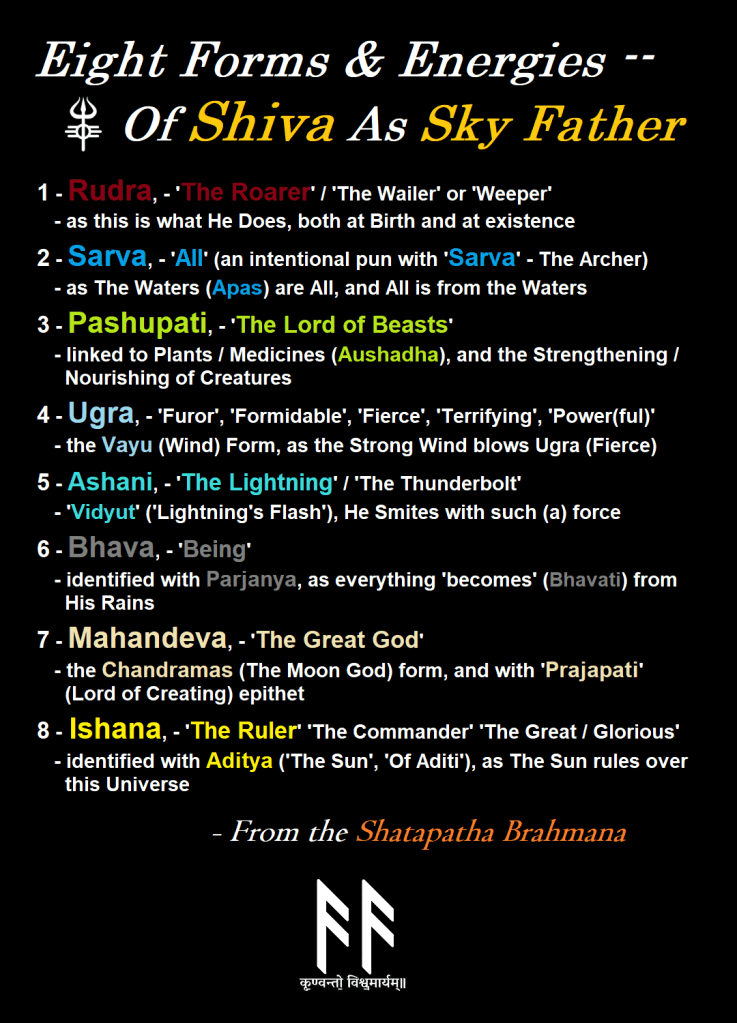
Insofar as Parjanya (for example) … may be a Rudra-relevant expression – however, I suspect that one would probably find a bit of difficulty were one to try and retroactively ‘insert’ Parjanya into the place more usually occupied by Agni in relevant ritualistic operative slot
—
ENDS
 arya-akasha
Unfortunately we seem to live in a time when those with a shallow understanding on any given subject immediately attack and deride others without spending the time to gain a deeper insight into them. Sad.
LikeLike